Itty Bitty Machine Tools: Last weekend I went to Cabin Fever Expo in York, Pa. This is a model engineering show. There were several venders of small machine tools and toling there. Much of what was being exhibited could have been done with these little machines. However if You have the floor space smaller industrial or school shop size machine tools can be had used for about the same money if You shop arround. As Jock mentioned the Bridgport and its copies are popular and will do small work as well as any tiny machine and can do fairly large work as well. Lathes in the 10" to 14" range are capable of small work but large enough for most home shop projects. I would recommend machines of this size to anybody who can fit them in their shop. I think most of the ill will towards Chinese tools is generated by the bottom dollar junk without consideration to the better products they make as well.
|
|
Dave Boyer
- Thursday, 01/25/07 00:48:32 EST
|
Regarding 1/4 inch square hot rolled, I briefly considered using my former rolls to cold roll annealed 1/4 down to 1/8th square for barbeque skewers. I bought a set of skewers years ago at a craft fair and would relay like to make more, but I have no idea where the stock came from. There are more efficient shapes and styles; a diamond cross section is better in keeping the food on the skewer from twisting when turned over, but the design just looks nice. Actually the bifurcated (split into to tow legs) works best, but looks wrong.
The new owner of the rolls is glad I didn’t try to do it. He has granted me visitation privileges, but I think that would be for non ferrous metals only.
|
|
Bob Johnson
- Thursday, 01/25/07 02:35:43 EST
|
Oops, make that bifucated - split into two legs
|
|
Bob Johnson
- Thursday, 01/25/07 02:38:48 EST
|
On 1/4" sqaure hot rolled, at time time folks who forged for the arts & crafts show market (S-hooks, etc.) were fustrated in having problems in drawing out cold rolled to a fine point without splitting. SOF&A looked at making a long pipe forge and rollers to be set up at Quad-States. Hot rolled of sufficient size would be heated in short lengths in the pipe forge and then rolled down to 1/4" x 1/4". Never got past the paper sketching stage.
|
|
Ken Scharabok (Poor Boy)
- Thursday, 01/25/07 04:25:04 EST
|
Ken, were they drawing out cold? I have a whole bunch of 1/4" squre cold rolled and it works just fine for me. I also work at the highest heat possible and 1/2" stock is the highest I go.
BTW how do I get my irons to glow purple like in that youtube? Hehheh.
|
|
Nippulini
- Thursday, 01/25/07 10:00:52 EST
|
Charcoal:
Jock, Andrew,
In my experience, yellow poplar does about as well as oak for making charcoal. In the direct burn by barrel method, split any wood small, about 1" or 1.5" square, by 12" or 18".
|
|
- JohnW
- Thursday, 01/25/07 10:07:14 EST
|
John, Thanks. We used to get some odd wood from the wood lot that I could not identify other than by its bark which looked like poplar but when it burned, if you could call it burning, it left a block of yellow ashes as big as the original wood. Not good stuff. Luckily there was never much of it in the mixed firewood.
|
|
- guru
- Thursday, 01/25/07 10:56:00 EST
|
The CEO here at Entropy Research uses a Hegner scroll saw, a Sherline mill and a Sherline lathe in making her miniature (1/12-scale) furniture and other dollhouse items. Top shelf tools in her opinion. Mine, too, not that that has any bearing on anything.
|
|
Miles Undercut
- Thursday, 01/25/07 10:58:34 EST
|
1/4" Hot Roll: I've often thought about rolling 1/4" stock. 5/16" round is almost identical in cross section as 1/4" square. Just enough larger (23%) that it would be a good tight fit in the rolls and fill them as well as increasing in length.
5/16" round = 0.0767 sqin.
1/4" square = 0.0625 sqin.
The object would be not to just make 1/4" hot roll but to make it with nice crisp (small) chamfers on the corners. This requires two pairs of rolls OR complicated cross head rolls (4 way).
Without some added value the cost would be more than its worth. Doing it for yourself might provide some satisfaction but I doubt that it could be resold.
|
|
- guru
- Thursday, 01/25/07 11:11:12 EST
|
Andrew, are there ant farmers near you? I would think they would like to have their fence rows cut. We use charcoal in the shop and it's easy to make, Cut the wood in chunks about 3", light some kinling, dump the wood in a 55 gal barrel. When it looks like charcoal it probably is. Hose it and dump it out. A 55 gal bbl of wood chunks makes abt 3 5gal buckets full. Forging with charcoal produces sparks so be careful. We have a screen at the top of the stack.
|
|
- Ron Childers
- Thursday, 01/25/07 11:11:22 EST
|
Charcoal:
Yellow ashes? I wonder if that could be a red bud tree? I've heard it does a terrible job burning.
A couple other things to observe in charcoal making (if using direct burn in the barrel method) is (1) you must have a way to stop the fire - a tight lid, water, whatever - or else you will get ashes only, (2) you've got to have a way to sift out the ashes and small particles.
Beyond that I would point out that charcoal is expensive to produce, laborwize, unless you have a lot of grandkids or something. But then maybe other men are crafter than I am.
|
|
- JohnW
- Thursday, 01/25/07 11:11:59 EST
|
Make that "any farmers"
|
|
- Ron Childers
- Thursday, 01/25/07 11:12:49 EST
|
Andrew: There are a fair number of blacksmithing groups in Canada. Click on the down button on NAVAGATE anvilfire in upper right and scroll down to ABANA Chapter link. Then scroll through listings for those in Canada. If a group is within a reasonable distance from you contact them. Ask where they purchase their blacksmithing coal and if there are any members in your area.
If there a business in your area which generates scrap shipping pallets? Wood in them would likely make reasonable charcoal, but you would have to deal with the staples or nails in it.
On charcoal I understand it was, at one time, a fairly stardard barter item for a blacksmithing shop. When settlers/farmers were clearing fields they would make the cuttings into charcoal. Then the blacksmith would probably take so much per bushel off of their account.
|
|
Ken Scharabok (Poor Boy)
- Thursday, 01/25/07 12:37:10 EST
|
Alanthus (sp?) a nasty wood to burn, useless as charcoal and bad to have around the yard too---grows very fast and likes to drop 6" diameter limbs on a whim. Stinks when cut, cannot be used for building or burning---but it does grow in Brooklyn!
Thomas
|
|
Thomas P
- Thursday, 01/25/07 12:44:36 EST
|
Drawing a point.
Harry Jensen, originally from Denmark, was an early student of mine, but he had served one year of his apprenticeship in Denmark. The Nazi troops took over Denmark during WW II, and Harry was taken as a prisoner of war to Germany, where they had him dressing mining tools for the war's duration. When the war ended, he was in the British sector of West Germany, so despite his protests, he was conscripted into the British army. He was discharged a few months later in England. He was at a loss, not speaking the language. As he learned English, little by little, new friends encouraged him to immigrate to the U.S. "You could make a fortune over there." He applied and was refused. He then applied to go to Canada, and was accepted and wound up in Toronto. He got a job at, of all places, a slaughter house. He was forging ornamental work on the side, but was having trouble forge welding.
When he took my class, he corrected my striking methods, and helped us with our striking and signaling.
He said that during his forging time in Denmark, one apprentice was literally kicked in the butt for incorrectly drawing a point on a wrought iron bar. The apprentice was starting behind the end of the bar and working toward the end. He should have started on the end with the MIDDLE of the hammer face on the end of the bar. That helps prevent the splitting at the point.
They were using wrought iron, but this also happens with mild steel, cold or hot finished. The same principle applies. Start at the end and work backwards. This also will control the length of the taper.
Since Harry was pretty handy at the forge, I asked him why he signed up for my class. He said that he was having trouble forge welding. Apparently, he was overheating everything to a too bright sparking heat.
|
|
Frank Turley
- Thursday, 01/25/07 13:04:01 EST
|
Alanthus (sp?), we call "China Tree". Brought to CA by the Chinese during the Gold Rush, any old town in the foothills is surrounded and permeated by China Tree. Useless weed tree, invasive, agressive, suckers and spreads from roots, displaces the locals. The worthless State Park system of CA (sorry Rudy) makes a big deal over them, calls them the "Tree Of Heaven" (horse exhaust) and plants them in their "Gold Rush Units" (State Park idiots, any local fool knows they plant themselves)
|
|
- David Hughes
- Thursday, 01/25/07 13:34:05 EST
|
Frank's right (as usual), work the tip first. For those occassions where working or re-working the tip last or in the middle of a project, I've develped a method of 10-10. Starting with the tip bright red, work it for 10 seconds, then back into the forge for 10 seconds and always strike lightly. You'll find your own timing as each forge is different, but the principle is sound.
|
|
Thumper
- Thursday, 01/25/07 13:44:22 EST
|
Thanks Rich, ptree, Dave, and guru of course. Dave, an air curtain sounds like a good idea, but I don't really have an air supply available, unless you count a box fan and the bellows and forge blower. Just one more JYH-related question, then I'll go back to lurking and searching for parts. I think I've decided to go with the spare tire drive/reduction, but I can't decide whether it should be the kind with the tire above and a little giant-type linkage, or one where the tire is mounted low and drives the far end of a flat leaf spring mounted up above. My impression is that the little giant linkage might have more control, especially for single blows, but is this right? How would the two designs compare in terms of ease of construction and use? I'm aiming for about a 35lb ram here, and I have a 23 x 47 inch baseplate that weighs about 400 lbs to mount everything on. My goal is to use bolts as much as possible rather than welding, because I have more confidence in my ability to bolt things together and have them stay that way than in my welding skills. Being in hurricane country, a secondary goal is to make it so massive that it will stay put even if the garage blows away around it :)
Michael
|
|
mstu
- Thursday, 01/25/07 13:50:23 EST
|
Identification of an anvil that I want to make an offer on. Has a very destinct anchor on the foot, right rear, on the left waist numbers 334 where the name usualy would be at only can make out 3 letters "For" all this from standing at the back. the anvil is supper clean no face dammage or on any part. Looks to be a 300lb.+ from this can you give me any info. Wish there we more to offer. F. Street
|
|
Floyd Street
- Thursday, 01/25/07 14:20:31 EST
|
I am a metal fabricator, designing and building furniture. I want to blacken the metal without painting it. I have discovered a good clear coat product but no stain. Any ideas?
|
|
Tammy Williams
- Thursday, 01/25/07 14:46:35 EST
|
Tammy, in one of the older "FABRICATOR magazines , August 2005, there is an artical called - get the cool look of blackened steel- they recommend using Burchwood Casey's
Tru- Temp system a cold process- Burchwood Laboratories Inc
800-328-6156
|
|
- ptpiddler
- Thursday, 01/25/07 14:59:33 EST
|
Floyd Street: Only anvil make I know to stamp in a small anchor on a foot would be Peter Wright. May have been an inspector stamp or perhaps indicate one for export. Is it 334 or 3 3 4 or possibly 3 . 3 . 4? If so, weight would be more like 424 pounds. Are there small flat areas on top of the front and back feet? FOR might be part of FORGE (e.g., MOUSEHOLE FORGE) or perhaps part of PATENT.
|
|
Ken Scharabok (Poor Boy)
- Thursday, 01/25/07 15:19:47 EST
|
Mstu- the pivoting leaf spring design does not have the "throw" of the hammer like the dupont linkage on the tire hammer design- rsilver just posted 3 pictures of the very first tire hammer built on Forgemagic- I don't think you would have any trouble bolting most of the hammer together or having someone weld up the main frame for you-
where are you located? The best idea would be to sign up for one of Clay Spencers' tire hammer workshop then you would have a well built hammer and you would have help building it and it would not be considered homemade and would have good value if you wanted to sell it as Clays'
hammers are in demand
|
|
- ptpiddler
- Thursday, 01/25/07 15:49:04 EST
|
LG, "DuPont Patent" Linkage:
This linkage in one form or the other is THE most efficient form of power hammer linkage available. Almost every successful mechanical hammer used this geometry.
It does not matter if you use leaf or coil springs in this kind of linkage (or rubber as Bradley used). The key is the horizontal toggle arms that compress the spring. When horizontal (in a straight line) they provide infinite leverage against the spring. This means the ram has very little preventing it from moving.
On the UP stroke the ram flies past the horizontal point compressing the spring. As the toggle angle becomes more acute the leverage against the spring lessens until the spring force equals the upward inertial force of the ram and gracefully stops its movement.
On the DOWN stroke the spring and toggles helps push the ram faster than it would drop via gravity OR the operating speed of the hammer. This great increase in velocity combined with the stored (not lost) energy in the spring is what makes a mechanical hammer hit so hard and require less HP than other designs.
People have called the "snap" or "thow" as PtPiddler just did (he's the inventor of the NC_JYH "tire" hammer), without understanding the dynamics. Once you understand the dynamics clearly it makes a big difference.
Two critical things:
ONE the spring must be heavy enough to stop the upward movement without the linkage bottoming out.
TWO the die height must be high enough that the toggle angle is not much below level (about 20 degrees) so that the spring is not softening the blows. This is a mistake that many JYH builders make. Their dies are too low and the spring is reducing the force of the blows. This also means that you cannot run the hammer slow. It has to run fast enough to overcome the spring which then makes the hammer hard to control. Many builders (including some selling kits) do not understand this very important aspect of the Dupont linkage.
If you REALLY want to see and understand the LG linkage order a copy of the Dave Manzer LG tune up DVD we sell. It is an inexpensive education and the best work ever done on the Dupont linkage.
|
|
- guru
- Thursday, 01/25/07 16:19:22 EST
|
Small Anchor Marks: The U.S. Navy used to mark many of its machines and tools with a small anchor (1/2 to 3/4") and a number. We have an OLD Southbend toolroom lathe that has the little anchor stamp and US clearly marked on the ways just as square and pretty as the manufacturer might have marked it.
It is a possibility.
|
|
- guru
- Thursday, 01/25/07 16:24:05 EST
|
mstu,
I built a leaf pivoting spring type hammer. I would say the pros are;
1. easy to build and to scrounge the parts for.
2. I get a definete, "snap" if you will, from the spring, as it takes an "S" shape when running, storing energy in the spring and delivering it just as the dies close.
3. I set mine to run slower than a LG, and I feel it is more controllable. I can go from light to hard blows without adjustment, and can get nice single, but only medium blows.
4. the machine is shorter in height than a spare tire dupont style.
I think an effective spring and moving parts guard is easy to fab for this style.
Cons;
1. The machine is longer than a dupont style.
2. The blows are slower than a dupont, at least on mine.
3. I have been told that the dupont is more efficient.
Having only very limited experience on several different dupont style hammers of differnt weights, and much experience on my machine, and limited experience on a much lighter pivoting spring type I would offer the following.
Building the ram and tup should be about equal for both. The frame for both will be about an equal task. Both can use a spare tire and car spindle for the clutch, again equal. Your space requirements may make a difference. Both designs need to be tuned. The dupont as the GURU notes to utilize the stored energy, and on the pivoting spring also to use the stored energy.
On the pivoting spring, the stored energy comes from the spring deflecting into a "S" shape on the upstroke just near the change over to down, and the spring trying to return to straight adding to the downward energy. The tuning as best I can describe it is to find the right daylight on the dies at rest, to let the machine and dies get just ahead of the spring on the down stroke. I think the adjustment on the pivot spring types is quite easy, as I have a turn buckle in the pitman arm.
I have not run a dupont style spare tire hammer, and they do indeed intrigue, In fact if I had some extra spare time, and the head room in my shop to accomadate one, I would love to have one of each.
But most important, plan for any hammer you build to need maintenance. This is tuff service, and stuff wears out fast. If in hobby to lite service, you may go a couple of years or more till major work, but it will need work. I ould only bolt together a frame ETC, if I used pinned nuts. Otherwise it WILL shake stuff loose. In this service if a 1/2" looks good try to use an 1". But build and enjoy, and when you learn stuff, just change it. I am and probably will continue to change and tweak as long as I have the thing.
|
|
ptree
- Thursday, 01/25/07 19:29:21 EST
|
Every single reference book I own demonstrates drawing a point from the end, I've never heard of any other way. One way I've incorporated into my work is chamfering a bevel on the tip of the rod before forging. I figure if that process helps with upsets it should work for drawing. In fact, I only get splits with working at too low heat or by not chamfering.
|
|
Nippulini
- Thursday, 01/25/07 19:59:18 EST
|
There are actually 2 styles of tire hammers being built
The hammer in a tube style is taller as the Dupont linkage is above the tube that the hammer slides in- so the top of the tire is approx 7 feet high
The earlier hammers had the slide BEHIND the hammer - so the Dupont linkage is in FRONT of the slide and the top of the tire can be approx 6 feet high- The pictures that Rsilver posted on Forgemagic show the earlier style with the slide behind the linkage- The hammer shown costs less than $50 to build and is powered by a well pump motor- probably 1/2 HP- also note the drive roller- a 3/4 drive
socket- about 2" in dia- these early hammers were truly
made from materials from the scrap pile
|
|
- ptpiddler
- Thursday, 01/25/07 20:18:43 EST
|
The unwanted tree must be the ailanthus. At first I was thinking of a corruption of "acanthus," but that would have been entirely too ironic.
|
|
Mike B
- Thursday, 01/25/07 21:44:31 EST
|
Tammy-- watch out for Birchwood-Casey's Presto Black. It has to be rinsed immediately and even then it will leave a tough residue of ugly yellow crud in recesses that is all but impossible to remove. Used right, on simple flat surfaces, it gives a gorgeous rich black finish. I have not used it outdoors, but a friend has, on gates, says it works great. Expensive. Choice Steel in Albuquerque sells patinating chemicals they get from somebody in Arizona, and their pewter gives a nice dark finish,
|
|
Miles Undercut
- Friday, 01/26/07 00:31:31 EST
|
Forging from Behind the Point:
This is a method taught to conserve heat. You leave a significant lump at the tip after initial forging and then draw it out last. The conservation of the heat lets you draw a longer point. When you forge the lump you work from the tip back.
Uri Hofi and others have been teaching this method for years. However, you need to be sure that tip is still hot when you forge it.
Splitting: I have had different batches of steel behave quite differently in this matter. I've had cold drawn mild steel that I could forge to a point cold and similar steel that would split when worked hot. I think a lot has to do with chemistry and steel quality.
There is also the question of small bursts or tears inside the steel that when rolled out become quite small and barely effect the steel except when you forge it. Any kind of cold shut or inclusion in the billet could cause a similar problem. I suspect that much of the steel that splits unexpectedly has this type of flaw.
|
|
- guru
- Friday, 01/26/07 02:03:41 EST
|
Steel Blackener: I have a bottle of "Tool-Black" sold by Precision Brand, Dowers Grove, Il. 60515 (312)969-7200 I havn't used any of it yet, so I can't really say how it works, but it may be worthwhile to check out.
|
|
Dave Boyer
- Friday, 01/26/07 02:37:16 EST
|
after a few years of searching I've finally found it... a free anvil! It's a decent size (pretty near the limit of what two guys can lift) & in great condition - mostly. The edges are great, but the steel plate has broken off around the hardy. So there is still a heel on the anvil, but the steel plate has broken offs from the hardy to the back of the heel. Now I only handed over a (particularly nice) bottle of scotch for said anvil (it was the least I could do) so I'm happy, but I was wondering if there is anything I can do about this. As it is, I couldn't use the hardy - since one side is 1/2" lower than the other.
It's funny that I'd just given up on buying an anvil & then one appears....
|
|
andrew
- Friday, 01/26/07 07:42:09 EST
|
Broken heel: Andrew, This is a common break and serious repair. A lot depends on the type of anvil you have. There are two possibilities. The two anvils are:
1) An old wrought iron steel faced anvil (most likely an English anvil like a Mousehole Forge).
2) A cast iron steel faced anvil like a Fisher Norris.
The first anvil is repairable, the second one not, or not recommended lest you loosen the rest of plate and ruin the anvil.
This is a serious weld up repair tha can be done two ways. 100% weld build up (good practice id you are not a pro) and welding in a fitted piece. Both repairs have their pros and cons and are probably a toss up as to quality and durability. The fitted piece is probably the easiest but needs some explanation.
In either case you will be welding to medium to high carbon plate AND wrought iron. The first needs care welding and the second does not like to be arc welded. The weld zone at the steel plate should be preheated to about 300°F (~150°C) before welding. The wrought will just be a pain as the slag melts out and leaves holes that will have to be cleaned and filled.
Step one of fitting a plate is finding a piece about the right thickness and cutting it to shape. The original plates were forge welded on, re-forged to shape with the body then hand ground on a huge wheel. The result is the plate thicknesses vary greatly on each anvil and the break surface will be uneven as well as worn. I would use a piece of structural grade mild steel but SAE 4140 be very good as well. The most critical part of the fit-up will be having the piece mate well to the surface so there are no or few gaps. The better the fit, the better the job.
The edges of the break and the plate should both be V'ed out to 45°. On the sides I would V out the plate for about 3/4 of its thickness and about the same on the anvil heal. You may want to V out the steel plate more than the wrought to preserve material that is going to be difficult to weld. I would not try to weld inside the hardy hole so that should be an area that is well fitted and let go at that.
I would start by clamping the plate tightly (maybe a bolt through the hardy hole) and running a single root pass around the edges. Then preheat that top plate (the residual heat from the side welds will help). Then weld the top cleaning and peening between passes. While it is cooling weld the sides and heel.
Then there will be lots of grinding and touch up welding. I would drill the pritchel hole from the bottm slightly undersized. Do not skimp on radiusing the hardy hole.
When done you might want to grind a flat on the base of the anvil and stamp "R mm-dd-yyyy" and your initials. The "R" is for repaired. This is the honest thing to do.
|
|
- guru
- Friday, 01/26/07 10:23:07 EST
|
I am looking for someone to make a set of 8 English Longswords for dancing. See www.CDSS.org They recomend a guy in England - the swords do not have an edge. Our current ones are aluminum and were made by someone in Baltimore (they belong to a team member who is leaving). The wooden ones are available from CDSS to give a sense of size. Our team in is Gaithersburg, MD.
|
|
Laura
- Friday, 01/26/07 12:56:00 EST
|
I'm not up to Laura's request, but for anyone who wants to address it, would suggest a spring type steel - mild steel will take a set from the actions of the long dance fairly quickly. Also, there is no edge for these "swords" the ones I've seen over the years either have mill edge or a slightly rounded edge to make grasping them bare-handed safer. The actions of long sword dances do not require that the swords go though the violent gyrations typical of rapper sword dances, which require a ball bearing swivel handle on one end, a thin thickness - from memory 1/16" or less, and a true spring temper. Some of the rapper moves have the swords gyrating overhead moving on each other, basically imitating an egg beater.
Long sword dances typically end with the dancers forming a multipoint "star" with the interlaced long swords, called a "nut" by the dancers. Rapper sword dancing also typically end with a nut as well. Most of the long sword dances I'm familiar with were for teams of 6 or 8 dancers. Rapper typpically had 5 with extras thrown in for excitement - Tommys (typically someone dressed in fancy/dress clothes) and Bettys (typically a man dressed as a woman) were the most common.
Good luck to anyone who wants to try - should be fairly simple - I just don't have the set-up to quench and temper a fairly long piece of steel currently.
|
|
- Gavainh
- Friday, 01/26/07 13:28:06 EST
|
Andrew: If you have someone built up with weld try to find a piece of aluminum slightly larger than your hardy hole. Forge down to a slight taper and then tap into hardy hole. Weld material will not stick to aluminum. You can do the same with the pritchel or use a length of mild steel. You can drill out the plug afterwards from the bottom. If the round plug extends below the anvil it can serve as a grounding point.
|
|
Ken Scharabok (Poor Boy)
- Friday, 01/26/07 13:49:32 EST
|
Hello,
My name is Tony and I have a kerosene fired portable forge. The refractory needs repairing in the fire box. There seemed to be a coating over the refractory and it is peeling off. It is approx. 1/8" thick. Can anyone tell me what material I should use to coat the refractory with. Thank you for your help. I live in Tennessee and have metal working experience.
|
|
Tony
- Friday, 01/26/07 16:40:12 EST
|
Tony, The coating is probably a previous repair. We sell ITC products for refractory repair and coating. ITC-200 is used to repair broken brick and worn areas. It is applied over and thinned with ITC-100. The ITC-100 is used in many forges and furnaces to seal the refractory and to improve efficiency.
You will want to scrape off the loose top coating. If it is firmly attached then leave it. Vacuum the loose particles and then dampen with a spray bottle of water. Apply the thinned (per instructions) ITC-100 with a brush and let dry until it is no longer smearable. Then trowel on ITC-200 to smooth out and fill holes. If large pieces of brick are missing I would use some broken up refractory brick to fill the bulk. Let the whole dry for a few days then apply a top coat of ITC-100 over the entire refractory interior. Let dry.
Post repair and construction drying of refractories is tedious. Most of us cannot wait. If you can wait a week in hot dry weather and two in cold damp weather it is best. Then fire for a few minutes and then shut down to cool and let cool while moisture escapes. Do this several times getting it hotter each time. Then when you cannot stand it any longer fire away. .
|
|
- guru
- Friday, 01/26/07 17:34:38 EST
|
I'm one of those strange machinists who like to build scaled down steam equiptment. I am interested in building a working Nazel power hammer only in a small scale, so I thought this would be the right place to start looking for info. If anyone could help out I need to get a detailed set of blueprints and maybe some pictures of some working machines. any help would be appreciated, thanks Johnny Nailz
|
|
Johnny Nail
- Friday, 01/26/07 17:28:16 EST
|
NAZEL PLANS: Johnny, The Nazel is one of the most complicated of the self contained air hammers made. These are not a steam hammer but a direct coupled compressor and ram system. The valving is quite complicated and the casting hides all the air passages. You start with a low speed electric motor, couple that to the compressor via a small composite pinion running on a large dameter flywheel. This shaft has a crank that powers the compressor piston via a long connecting rod. Air from the compressor passes through a pair of rotary valves fitted into the casting. Air goes from the valves into and out of the cylinder. There is also a check valve and some other devices. The control valves are rotary and connected together by links.
The ram piston on the Nazel has a snubber feature that others do not. There is a bronze bushing in the piston and a large diameter piece that is part of or bolted to the cylinder cap. When the piston rises it engages the snubber which compresses air in the piston thus creating an air spring that slow the piston and helps start it back down.
In all it is a surprisingly complex machine. There are no complete drawings of the machine extant that I know of. Bruce Wallace (Nazel.com) might have a set but he is not letting them go.
Standard steam hammers as invented by James Nasmyth and made by Erie, Champersburg and others are much simpler machines. At one time there used to be kits for making them. These have a steam throttle, reversing valve and feed back lever. The original design raised the ram and then dropped it, the exhust being pushed out by the weight of the ram alone. Almost immediately the design was changed to admit steam into the top increasing the downward speed of the ram.
Over nearly two hundred years the only significat improvement to the Nasmyth design was the Chambersburg safety cap. This replaces the cylinder cap and has a short rod attached to a piston in the pressurized cap. If the ram over travels and hits the rod it must overcome the pressure in the cap which slows it down. This is to prevent the piston from going through the cap which was not an uncommon occurence.
|
|
- guru
- Friday, 01/26/07 18:16:11 EST
|
Does anyone know a good place to buy a used buzz box? This would be a low use, probably only need about 100 amps, or there abouts, just for something like 7018s. Mainly what I've found has been new, which I would prefer to buy a used one.
|
|
- Boogerman
- Friday, 01/26/07 20:40:47 EST
|
Looking at the Pawloski design for a ram guide linkage on forgematic.com (http://www.forgemagic.com/bsgview.php?photo=179&cat=M&by=), what sort of spring would work? It looks too small to be an automotive suspension. Wouldnt the support rod take an awful lot of stress? The engineering on that looks very difficult to keep the spring from breaking off the bottom of its support rod and turning projectile.
|
|
JLW
- Friday, 01/26/07 20:55:11 EST
|
cheers, I'm interested in making a treadle hammer. but I want one that is capable of giving steel a right good thumping. whats the best possible design for a really heavyweight treadlehammer thanks j
|
|
- jeff
- Friday, 01/26/07 20:56:01 EST
|
thanks for the very detailed repair description. I'm certainly not a professional metal smith but I can make things stick together reasonably neatly. Lots of grinding will be a good distraction from writing my PhD thesis....
I'm not certain where it was made. I am in Australia, so english would have to be a first guess - though it does come from an area settled by Germans. It's a standard London pattern design though. It seems to have a large X stamped on the side with "Queen Dudley" underneath and NO 58 written vertically upwards on the right of the X (posibly NOS8). It's all stamped, so I'm assuming it's not cast? There are 3 porters holes - below the horn, the heel & another on the bottom. Now I'm no monarchist, but I've never heard of a Queen Dudley, so I'm a little skeptical on that one....
After I've welded on said plate, do I need to heat treat it? Do I need to use hard-facing rod? Also, if I do weld around the hardy, will this take the abuse from hardy tools?
|
|
andrew
- Friday, 01/26/07 21:25:09 EST
|
DE-CARB vs ATMOSPHERE
My old Carpeter Technology Tool Steel Handbook claims that to reduce (not prevent) de-carburizing the steel that a slightly OXIDIZING atmosphere should be used as the scale helps to protect the steel from de-carurizing. Go figure.
|
|
- grant
- Friday, 01/26/07 21:33:01 EST
|
Andrew, Thats "Queens Cross" (as in road crossing), Dudley England, The image is the road crossing. Some have described it as looking like two hot dogs. The maker was Joseph Wilkinson, it is a late 19th Century English wrought anvil. Richard Postman says the big market was in Australia.
On your anvil heel repair I would not try to heat treat it. Just use it.
|
|
- guru
- Friday, 01/26/07 21:41:19 EST
|
I'm looking to set up my forge in my garage. I was considering lining the garage with concrete board but I'm not sure how far up the wall to go with the board and if I should line the whole garage or just the area around the anvil/forge.
|
|
mconrad
- Friday, 01/26/07 22:37:34 EST
|
JLW, With odd ball untested designs you had better ask the designer. Yes, the statement that he didn't like the Dupont linkage and then providing something possibly just as bad as an alternative is questionable. This is an old idea that people have come up with over and over and there are many reasons it does not work.
Look at the DuPont linkage on a Fairbanks hammer. They used much shorter toggle links that were securely attached, not the long flailing things like Little Giant used. Part of the reason Little Giant did what they did was to get around DuPont's patent, which they did by really screwing up the design. They couldn't use pins through the arms (like they did after DuPpont's patent ran out) so they hooked T shaped toggles into a rough cast pocket in the ram. . .
There have been dozens of mechanical arrangements for mechanical hammers and only a couple worked well enough to be commercially successful. There are many hammers that were built then just disappeared from the market AND existence. If they had worked they would still be with us in one form or another.
With the EC-JYH we proved that you could put a shock absorber in a power hammer linkage and it worked. But it was very inefficient and had a strange dynamic. Yes it worked but there are better ways to build a hammer.
The DuPont linkage can also be built with a bow spring like the Champion hammers (See the SA-JYH). In this arrangement the spring is also the upper arms. There are less parts and you get the same geometric effect. There is also a way to do it with stationary arms and rubber bands. This is similar to how the Bradley strap hammers worked. In this case the resilient member is also the lower arms. . . In each case you have the weight suspended between horizontal supports that change angle and thus leverage. They provide little resistance at the right time and greater resistance at the right time.
As to the problem of flying parts you should see what a power hammer does to a piece of steel set at an angle to the die surface. It is going to fly OR you are going to be hurt OR both. The machine mechanism can have guards put around it, the working area cannot.
|
|
- guru
- Friday, 01/26/07 22:54:34 EST
|
Garage lining,
Citing legal and insurance issues, Building codes should dictate.
But that aside, Importantly be sure all the crevices cracks etc. within the hot work area are sealed up, You dont want any hot bits flying off into a crevice to smoulder on unnoticed.
|
|
- Mike
- Friday, 01/26/07 23:01:42 EST
|
umm im new to the whole blacksmithing thing im 16 but i relly came here to know what metal to use into makeing a strong sword i use them to train.etc with so im wondering if any of you whould know any good metal sorry if this post botheres you
|
|
volcan
- Friday, 01/26/07 23:13:58 EST
|
Does the No 58 indicate weight? Is there some other weight markers I should be looking for? Not that it really matters since it won't change anything.
|
|
andrew
- Friday, 01/26/07 23:14:53 EST
|
Fireproofing: Mconrad, It depends on what you are going to be doing, how old the building, how clean/dirty. . .
Generally the sparks and light scale that would fly far enough to be a problem cannot set fresh lumber on fire. However, dirt, debris, stowed junk. . . Just about everything else is more of a fire hazard.
On the other hand I have an old 1806 Grist mill that you could set the wood on fire with the slightest spark. NO grinders or welders in the mill!
Many a blacksmith shop has been in a dirty old wood building often with wood floors. The most protection the floors saw was a layer of tin or some sand. HOWEVER, this was mostly before the era of the angle grinder, cutting torch and arc welder. All three throw sparks 10 feet or more (including straight UP) that are possible fire starters. Forging is actually much tamer unless you like to over-rev with welding overheated stock. . .
I would worry about the welding and grinding areas the most. Protecting the forge area walls up the first 4 feet will do a lot of good but grinding sparks will fly all the way to the roof. If you have a forge with a sheet metal stack then you should have protection behind and above it. There are specifics in fire codes.
The thing about fire safety is it is more common sense than anything. You can have a completely fire-proof structure then bring in 30 gallons of oil for heat treating and flash it with something too big. . . Or have a shelf loaded with paint and solvents along with the necessary rags to go with them. . .
I would finish ALL the surfaces in a small wood frame building with concrete board or sheet rock if I could afford it. You get a lot of fire resistance AND you can paint it white for better visibility. If there is paper backed (even when foil covered) fiber glass insulation then it should ALL be covered.
|
|
- guru
- Friday, 01/26/07 23:17:28 EST
|
Boogerman: Ebay and Craigs list are good places to start, along with fleamarkets & auctions. I would stay away from the 110volt units, as I never heard of anybody that had much sucess with one. The 180 to 225 amp "Farm Welders" and Lincoln toombstones work pretty well and usually sell pretty cheap.
|
|
Dave Boyer
- Friday, 01/26/07 23:22:44 EST
|
Is there any mathematical model for the movement in the EC-JYH linkage? I wonder if any description of the tuning was included in the original patents?
|
|
andrew
- Friday, 01/26/07 23:24:11 EST
|
58: Andrew, I think this is a miss read marking. English anvils were marked in hundred weights. There is no number larger than 27 in the pounds place and no number larger than 3 in the 1/4's place. Normally the numbers are marked horizontally like so.
# . #. ##
See our FAQ's page, Shop Mathematics, Hundred Weight Calculator.
|
|
- guru
- Friday, 01/26/07 23:24:17 EST
|
may i ask what metal should i use for a sword mainly a 2 handed firm grip and has to be relly sharp thank you for your time
|
|
volcan
- Friday, 01/26/07 23:37:12 EST
|
Math and Patents: First, The fellow that took the time to understand the LG linkage the best mathematically, Dave Manzer, passed away last year without passing on the work. I asked him about a couple times and I think he felt that it was too hard to explain and that as an amateur mathematician he had no business trying to explain it to others.
Using vector vector mechanics you can calculate the conditions at specific points than graph them. However when you add the inertial dynamics it gets to be very interesting to keep up with. A good custom computer program would do the job well and then you could trial and error all kinds of design variations. I could probably write it in couple months if I had nothing else to do.
Patents are a public document that is designed to protect the invention without giving away any unnecessary details. Mathematics is almost only needed for proof of concept and design but NOT for a patent. Patent drawings are often distorted and out of scale so that nothing not needed for that legal protection is given away. You can have a patent and still have trade secrets that make the patent worth having. . . No, there is no math.
The Dupont linkage would be a good project for an engineering student.
|
|
- guru
- Friday, 01/26/07 23:38:51 EST
|
Swords: Volcan, Swords are made from steel. The type of sword and its purpose determine the type of steel. Practice, play, theatrical, "live steel" and movie prop swords are all relatively soft steel with dull edges. They range from common 304 Stainless steel to SAE 4140 hardened and then tempered soft. This makes the toughest possible blade that will not break and dings less than a soft steel sword. Stainless is often used for theatrical swords and wall hangers because it does not rust, therefore there is much less maintenance.
Very hard, very sharp swords are made for cutting demonstrations and that is about it. These are made of tool steel, hand made "Damascus" steel or hand made "Wootz". All require a great deal of skill to work and to finish.
You have a long path ahead of you. Here is the begining:
Sword making Resources.
|
|
- guru
- Friday, 01/26/07 23:50:03 EST
|
well i guse ill look on anothere website bye
|
|
volcan
- Friday, 01/26/07 23:51:02 EST
|
He couldn't wait for half an hour to get an answer he could have easily found if he had spent that time poking around here. . .
|
|
- guru
- Saturday, 01/27/07 00:36:23 EST
|
Volcan- With such an attitude I predict a very brief career in bladesmithing (or any other endeavor). 8-0
Oh well, it take all types, and sooner or later most ofthem drop in here.
|
|
Bruce Blackistone (Atli)
- Saturday, 01/27/07 00:42:43 EST
|
Andrew: Do you have access to bathroom scales? In recent years their weighing capability has been expanded to allow for an increasingly heavier population. If you max out them, check around for any place which has a commercial, weight bar/platform scale.
What size is the hardy hole compared to the size shank you will be using? Say it is 1 1/4" and your shanks are 1". You might make a sleeve then to go into the hardy hole, supported underneath were the plate is missing.
If you weld back by build-up, I have had very good success in just using 7018 welding rod, hard peening down each bead immediately after it is laid. This seems to somewhat work harden the mild steel rod. I tried to e-mail you my procedures but your e-mail addy rejected.
|
|
Ken Scharabok (Poor Boy)
- Saturday, 01/27/07 00:50:51 EST
|
Does anyone have a link to a table which simply gives arc welding electrodes by number and then whether they are AC or DC rods? Looking for something I can print out and put in my rod drawer.
|
|
Ken Scharabok (Poor Boy)
- Saturday, 01/27/07 02:24:08 EST
|
sorry about that - I typed it in wrong. The one is this message should work better. thanks
|
|
- andrew
- Saturday, 01/27/07 03:03:10 EST
|
uiyu
|
|
- yit
- Saturday, 01/27/07 03:12:30 EST
|
Andrew: That one doesn't work at all.
|
|
Ken Scharabok (Poor Boy)
- Saturday, 01/27/07 07:17:05 EST
|
this is a question for Ken. Your forges, can they get wet. i just had a big windy rain down here and my shop fell. it got little bit wet the insulation is damp.
thanks y'all
Andrew B.
|
|
- andrew B.
- Saturday, 01/27/07 09:33:15 EST
|
Andrew, Water is not good for the kaowool. If it stays in place just let it dry out before firing. If it is just damp it will self dry, but if it is soaked then give it time before firing.
|
|
- guru
- Saturday, 01/27/07 10:19:59 EST
|
This may sound stupid, but why?
|
|
- Nippulini
- Saturday, 01/27/07 10:42:37 EST
|
Nippulini,
No refractory likes going from wet to hot. The water becomes steam and if trapped, it blows out chunks. Some refractories also have chemical changes from wet to dry that make them fail if fired wet.
|
|
ptree
- Saturday, 01/27/07 11:02:27 EST
|
A little example from the past on the power of water turning to steam.
We had a valve fail, in a closed position. The lawsuit followed lead to some testing in my lab. We set up a similar situation, and it was very instructional. The valve in question had been condensate (water) filled, as had a short lenght of pipe to another valve. The valves were both closed, and a radiant heat source had been located next to the pipe. Poor design! In my lab we set up the same conditions, with a pressure gauge, and a vent valve for safety. I had a 10,000 psi gauge, remote to and protected from the test. A few hundred degrees F and bingo, The pressure rise was so quick that the gauge failed before I could open the vent! In the actual case the pipe threads failed, as the pipe was Schedule XXH, threaded into the valve. Also bad design, as it should have been welded.
The power of water in phase change is awesome. In any change, from any phase to any phase. The first steam engines used steam introduced into the cylinder and then condensed by a water spray to cause a vaccumn! with a big cylinder made tremendous power. Not efficient by still powerful.
|
|
ptree
- Saturday, 01/27/07 11:10:33 EST
|
Ken-- Miller will send you-- absolutely free-- several heavy cardboard slide-charts that give the amp ranges for every rod known to man. Also they have similar slide charts for MIG, TIG. For a quickie, go to http://www.bae.ncsu.edu/courses/bae201/welding/electrodeamps.html Harris will send similar charts for oxy-acetylene welding and cutting pressures, tips. Smith has hilarious safety posters showing vartious disasters that can ensue when safety rules are ignored..Free.
|
|
Miles Undercut
- Saturday, 01/27/07 11:11:55 EST
|
When I've coated my gas forge with ITC-100, I've used a 60W or 100W bulb inside to dry it out. Still takes overnight (at least), but seems a lot faster than just air drying.
|
|
Mike B
- Saturday, 01/27/07 12:08:35 EST
|
Andrew B: Assuming you didn't coat the inside with ITC then, as noted above, just let it dry out on its own. A 100 watt bulb inside the chamber certainly wouldn't hurt.
When you do fire it off again run it on as low of temperature as possible for a bit.
|
|
Ken Scharabok (Poor Boy)
- Saturday, 01/27/07 15:29:01 EST
|
hi ,I think you may have missed this question earlier, but I'm looking into building a treadle hammer. Does anyone here know what the best possible instructions are for a really heavyweight treadle (if there is such a thing) I'm not in a position to buy a powerhammer yet or hire a striker for that matter. But I want to get into forging much heavier stock...say 2inch ms or more. So far all the instructions i've found are for sale only , which is fine but the adds just dont seem to tell you exactly what your going to get. If you could give me some imput on this it would be much appreciated thanks jeff
|
|
jeff
- Saturday, 01/27/07 20:00:18 EST
|
Jeff- you need to build a "tire hammer", you will work yourself to death trying to forge with a treadle hammer- for the same amount of time and money you put in the treadle hammer, you could build a tire hammer- 50# hitting at the rate of over 200 times a minute- try doing that with your foot- look at anvil fire-user built hammers for the concept or sign up for one of Clay Spencers tire hammer building workshops-clayms@brmemc.net
|
|
- ptpiddler
- Saturday, 01/27/07 20:32:05 EST
|
I've seen a few hammer designs using shock absorbers. What's the thinking behind that decision? I understand springs - it's a handy place to keep energy so you can get it back later. Energy is a handy thing for a hammer & not to be wasted. However shocks are a dampener. A handy place to put energy if you never want to see it again (besides heating the room), but it certainly won't be available to the ram.
Obviously they work because quite a few people have built them, but I don't understand the thinking. Can anybody explain it to a simpleton such as me?
|
|
andrew
- Saturday, 01/27/07 20:47:33 EST
|
Ken for welding rod info try this
http://www.lincolnelectric.com/knowledge/articles/content/awsclassification.asp
|
|
Mark P
- Saturday, 01/27/07 22:12:18 EST
|
Shock Absorber JYH: It was an old idea and I think I was the first to actually build it. It was a simple easy thing to do. If it had worked a little better it would be a great idea. Some things you have to try. The problem with the shock is that the faster it cycles the less the ram moves. AND all modern shocks are pressurized. . . something I was not expecting.
If there was a good in-line mechanism for hammers it would be a nifty item.
|
|
- guru
- Saturday, 01/27/07 22:25:59 EST
|
Currently, I am using a brake drum forge outside, that I built. I am interested in building an indoor coal forge. Can you suggest a place that I can find some plans?
|
|
Michael McShane
- Saturday, 01/27/07 22:33:38 EST
|
Heavy Weight Treadle: The problem is simple biology. YOU cannot personally produce but so much energy. All the energy in a treadle hammer eventually comes from you. A force multiplier increases force by reducing stroke. It does not multiply energy. Raising your leg and half your body then transferring all your weight to that side and then back repeatedly is no easier than using a sledge hammer.
Treadles with about a 100 pound ram have been found to be about the best. However, they will not help draw out 2" bar any more effectively than using a sledge hammer and rigging tongs on a pivot to hold the work on an anvil.
|
|
- guru
- Saturday, 01/27/07 22:33:44 EST
|
What steel is a saw mill blade made of? I looked on JunkYard steels and didnt see it. I have a good source of them to make knife blades from.
|
|
JLW
- Saturday, 01/27/07 22:42:12 EST
|
i figured that would be the case. thanks for clearing that up for me. jeff
|
|
jeff
- Saturday, 01/27/07 23:22:27 EST
|
Coal forge plans: Michael, A simple word description (specification).
A table made of 1/4" or 3/8" plate set at a convenient height (about 28") about 2 x 3 feet OR 3 x 3 with an edge about 2" to 3" tall, a firepot set into a hole to fit centered from the sides and the same distance from one end.
The size of the forge has a lot to do with coal reserve as well as room for stock. See our FAQ on coal fire management.
Legs made of 1-1/2" pipe or 2" angle. The firepot, blower and valve can be purchased from any one of our major advertisers. It is best to mount the blower behind the forge rather than under it as it will get very hot under the forge.
The legs may need diagonals. I like to build a shelf about 8" off the floor using bar gratting. You have to be careful what you store there. Its a good place for firebricks, cut steel, tongs. . .
Some smiths like to add a pull out or hinged stock rack to help support long stock. These are made from 1/2" round bar.
A side draft hood made per the drawings shown on our planfile page.
This is what USED to be called a "portable" forge but today is a permanent shop forge. You can make your own fire pot but they need to be heavy. AND if you fail in the design/execution the forge may not work very well.
The above and a glance at any similar or factory forge and the description above should be enough for anyone.
|
|
- guru
- Saturday, 01/27/07 23:29:42 EST
|
JLW: If it is a circular saw with inserted teeth it is probably some sort of medium carbon OR LOWER. Best advice I can give is to cut out a chunk and try heat treat methods and see if You can get the results You are looking for. This advice is what You need to do to ANY unknown steel.
|
|
Dave Boyer
- Saturday, 01/27/07 23:29:54 EST
|
Michael: For a really easy side draft hood get an old rusty 30 or 40# propane tank and cut both ends out so You have a 12"diameter cilinder. Cut an opening about 10"wide by 10" high for the smoke to enter. Stand it up next to the firepot and put 12" stove pipe on top.
|
|
Dave Boyer
- Saturday, 01/27/07 23:35:28 EST
|
Hello. I have a question. How are railroad spikes made? are they drop forged? Are they made in one machine or are there dies for a press or power hammer to make them? I ask because, as funny as it sounds, I wouuld like to find one of the machines or whatever that makes them, and make them out of different steels. Thanks alot!
Sam
|
|
Sam Salvati
- Sunday, 01/28/07 00:10:08 EST
|
Michael: May I interject my own opinion here. The Guru's advice about firepots is very true. They must be relatively heavy if you expect them to last. If you have the choice between building one out of 3/4 inch or 1 inch plate, and buying a cast iron one, buy the cast iron one (providing you can afford it). Allow me to elaborate:
I built mine out of 1 inch plate that came from the shanks of a scrapped out field ripper. In retrospect the fourty dollars for the two shanks wasn't a bad deal (something like 200 pounds or so). Plus the ten dollars for a box of heavy electrodes. Plus two 7 inch grinder disks, and two 4.5 inch grinder disks. Plus an undetermined amount of oxy/acetylene and electricity to the welder. Plus about three or four hours shop time. Plus the time required to cut the bottom back off and weld back on from the inside because the original design was too deep (if four inches is good, six inches is not always better!)...for a grand total of somewhere around 70 dollars (if shop time is worth $15 dollars an hour then it would be somewhere around $110-$130 dollars.)
The cast firepots that distributors sell are a thought out design. After all I spent on mine, I came pretty close to the price of a new swap meet priced fire pot, and mine doesn't work as well as a cast one (i believe) because the inside corners are too anglular and not really at all smooth . It does work, just not as efficiently as I'd like sometimes. And remember this is just my personal advice.
-Aaron @ the SCF
|
|
sandycreekforge
- Sunday, 01/28/07 00:20:29 EST
|
Water pump holding tanks in the 10 to 30 gal. size make good side draft and stacks too. I use a bi-metal blade in my saws-all and cut just inside of the welds at the ends. Most of the time there is double thickness but the ring usually slides out if I keep out of the weld. Well drilling company here has oold ones when I need them.
|
|
Jerry
- Sunday, 01/28/07 00:26:33 EST
|
Railway spikes,
I expect they are made like regular nails, But to a larger scale.
The material is a bar or most likely a coil of 5/8" square stock thats fed through a machine, That heats then forges its head, feeds out to the overall length then pinched off to create the chisel type point.
|
|
- Mike
- Sunday, 01/28/07 01:20:10 EST
|
Sam: The machinery that Mike is describing is HUGE, way beyond something You want in a home shop. You could tool up a powerfull and fast hydraulic press to make them on a small scale, but unless You have a pretty well equipped shop even that would be a major undertaking. I think hand forging them would get old really fast.
|
|
Dave Boyer
- Sunday, 01/28/07 03:26:11 EST
|
Railroad spikes: My understanding is that they are made from bars lang enough to make two, each end is upset to form both heads, then it's cut in half to form the pointy ends of both.
|
|
AwP
- Sunday, 01/28/07 03:38:11 EST
|
In the past I have seen double-headed RR spikes as AwP describes. For whatever reason they weren't cut in half to form two spikes.
Thank you to those who sent me a link to arc welding rod currents. Been a while since I took a welding class. I thought they were pretty well AC or DC. Was surprised to see most can be run on either, depending on performance desired.
First welding class I took instructor used 6010, then 7018. Said if you can learn to weld with 6010 you can weld with anything else. Might be, but I also saw fustrated students who likely gave up on arc welding because of the 6010.
I do most of my welding with 312-16 as it is most either tack or very short welds. However, my sources of cheap 312 rod have dried up. I suspect I will hoard what I have left and switch to 6011 for most work and 7018 for long and strong welds.
|
|
Ken Scharabok (Poor Boy)
- Sunday, 01/28/07 04:36:48 EST
|
Take a look at eBay listing #250077830941. What a collection of tongs. However, likely the smiths there only used a dozen or so on a regular basis.
|
|
Ken Scharabok (Poor Boy)
- Sunday, 01/28/07 04:45:20 EST
|
Ken, could you send the anvil repair info to emily.zpam@gmail.com. I'll sift through the spam to find it. I'm not sure why my normal address isn't working on this forum... cheers
|
|
andrew
- Sunday, 01/28/07 04:57:30 EST
|
andrew: Information sent. Put it in text this time rather than as an attachment.
Keep in mind opinions vary greatly on anvil repair. However, I have rebuilt about 15 anvils using my techniques and reports from some owners are they are holding up very well.
You have an advantage in the area of the missing plate is not in one widely used by other than possibly a farrier.
|
|
Ken Scharabok (Poor Boy)
- Sunday, 01/28/07 10:08:53 EST
|
Railroad spikes are from what I have seen, upset forged. From the sizing, I would suspect that a nice 1" Atlas or National upsetter would do a nice job, especially in small lots. I would do singles rather than the double ended. the point could then be forged in a relatively small press.
The 1" upsetter is what is know in the upsetter trade as a "forklift machine" I.E. move the 30 to 40,000# machine in, set it on the floor, hook up the electricity and air, and coolant, and bingo, right to work. That is of course assuming you have the dies and tool holders. I suspect that the tooling to make spike heads would be cheap as these things go, say about $10,000 for the grip slide tooling and another $10,00 to $30,000 for the tool slide dies. If tool holder is needed add perhaps $40,000. You could then run about 2000 spikes a shift or more, assuming you have the means to heat them that fast. Probably need an induction heater system for that.
That said, if I was needing small lots of special material spikes say to make knives from, I would consider a pnuematic upsetter of the homemade type. I suspect that even if the dies had to be made out, a jackhammer system, with compressor and all would be possible for under $5000, and if needing onlt the shank and head to make "RR spike" items from, in most cases the point is not needed anyway.
|
|
ptree
- Sunday, 01/28/07 11:45:55 EST
|
As an aside, McMaster-Carr sells new RR spikes at a quite reasonable cost. Shipping will be significant though due to weight. Used spikes are often available on eBay, with unused ones there on occasion.
|
|
Ken Scharabok (Poor Boy)
- Sunday, 01/28/07 12:13:09 EST
|
Rail Road Spikes: I have been in the Richmond. VA Tredagar spike mill (when it was still operating) and here is what I saw.
A very large OLD rusty machine of maybe 10 to 20 tons (weight). It was in a dark building but from what I could see it was probably some kind of big mechanical upsetter that was automated (mechanically). There were rotary feed rolls and the point was simply pinched in the middle of a double headed pre-spike. As mentioned, it was probably just an oversized wire nail making machine.
To feed the mill there was a 20 foot tunnel furnace that was fired with natural gas. It was between 16' and 18" square.
In the same shop there was a rolling mill where they rolled old RR components (I saw axels) into the 5/8" square that the spikes wer made from.
On the same site there was an old A-frame steam hammer of a couple ton ram weight laying on its side in the brush. I did not see the plant in operation and at the time I had little interest in the details of the operation.
But the machinery was fed 20' lengths of hot bar, headed it, pointed it and spit them out into a large size steel tote all in one continuous operation.
|
|
- guru
- Sunday, 01/28/07 12:18:54 EST
|
Spike machine,
I can see the double head a better way that the bar heading could happen together reducing the need for such serious clamping over the spikes being headed singly.
Nails, much smaller need so little heading force by comparison they are headed then sheared off the parent stock one each. One can see just behind the nailhead serrations from the clamp that holds the wire during the heading. The points are put on by a pinching operation that leaves tiny two triangular bits as scrap.
|
|
- Mike
- Sunday, 01/28/07 14:08:29 EST
|
Spike machine,
I can see the double head a better way that the bar heading could happen together reducing the need for such serious clamping over the spikes being headed singly.
Nails, much smaller need so little heading force by comparison they are headed then sheared off the parent stock one each. One can see just behind the nailhead serrations from the clamp that holds the wire during the heading. The points are put on by a pinching operation that leaves tiny two triangular bits as scrap.
|
|
- Mike
- Sunday, 01/28/07 14:08:32 EST
|
Many upsetters are automated these days if there is much size in the production runs. At the axle shop we had several automatic upsetters that would use "Auto tongs" to move the billet down the grip slide to progress the axles thru the 4 to 5 dies it took to make the axle flange. Once running, they had an axle in each die position on every hit. Took much bigger drive motor as there was much less recovery time on the flywheel. Also used "C' type slot coil induction heaters to provide the thru-put. The material handling equipment cost as least as much as did the upsetter. The upsetters will all be massive, and OLD. They have not made any new upsetters since about 1970 I was told, and most are 1950 and before. They are so massive in the frame that they seldom break a frame, and everything else is makable. There are NO foundreys that can pour a large upsetter frame in the US today. A 9" upsetter has a two piece frame and the halves will run about 150,000# each after machineing. The newest upsetter in that shop was about 1958 I think, and the newest in the three shops they owned was that one. It had of course been rebuilt about every 10 years or so.
As to holding the bar against the heading force, in an upsetter, that is what the grip slide is for, as well as the backstop that sets the amount of stock in the machine to upset. Our 10" upsetter was used to make a 22" by about 3" thick flange on a approx. 5.5" bar in 5 hits. It you can do this a puny 5/8" square is not much challange:)
|
|
ptree
- Sunday, 01/28/07 14:24:59 EST
|
In a continuous upsetting process like this how would they keep the die heads cool? Cooled water jackets?
|
|
Ken Scharabok (Poor Boy)
- Sunday, 01/28/07 15:18:48 EST
|
Aren't 6010 and 6011 pipeline rods, designed to weld through just about anything-- rust, paint, poor fit-up-- avoiding or minimizing those nasty inclusions by floating the crud to the surface? They are much easier to start and run, than the 70-series rods but will never give as pretty a bead.
|
|
Miles Undercut
- Sunday, 01/28/07 15:32:36 EST
|
I said it was HUGE machinery. The dies and grippers weighed more than any one piece in your shop. In this case contuinuous was the length of a bar in 4 hour shifts. While there is a lot of heat transfer for a given time, the times are VERY short. Heads formed in tenths of a second. I think a lot of these machines had circulating water cooling but in many cases it was just a spray. . . the water and steam went where it may. This was also OLD equipment. Probably just post US Civil War.
|
|
- guru
- Sunday, 01/28/07 15:33:30 EST
|
I am learning saw pounding. I need to dress a roundface doghead hammer. Any advice on hammer face dressing ? Thanks
|
|
- jack
- Sunday, 01/28/07 15:58:39 EST
|
Ken,
In our shop continous meant something a bit different than what the GURU is thinking. We had only to load 10,000# bundles or stock in about 20' lenghts. The bands were cut, and then the system did the rest. First a bar unscrambler lifted one bar at a time onto the shear. The shear cut the billets(1.25 to 2.62" dia) to lenght,( that is why some of the bars were more than 20'lenght was to allow a crop end and then multiples of desired lenght) Then the billets went to the induction heater. From there to the upsetter for forgeing, then to the cooldown conveyor, and then into a tote. From the time the bands were cut till the forgeings came out of the tote no hands touched them. Consider that there are only really about two companies in this country that make these axles, They have to be FAST.
In this service die heating is a REAL problem. That is where the die lube I often speak of was developed from. These dies work, when everything is right at about 600F. If the cooling sprays are not right, they are washed out in minutes! The die lube that I speak about is diluted to perhaps 5%, and that 95% water is the cooling medium. It mostly flashes to steam, removing huge amounts of heat. Even so, at 600F, a 2250F steel would weld to it at these tonnages. The die lube is designed to allow the steel to flow with almost no friction, prevent welding and galling, and to prevent frictional heating. In the automatics, there is a 6 second window to squirt die lube/coolant and get the heat out and let the lube dry completly. And it works. The dies used in this service are mostly a prehardened proprietary die steel that is essentially 4140! We turned the dies in normal CNC lathes, and then went right into service on the short runs, and H-13 for the long run stuff.
If you have not tried this lube, against the graphite based lubes you can not imagine the difference. Just as the GURU cautions against reinventing paint, I caution against reinventing die lube.
|
|
ptree
- Sunday, 01/28/07 16:02:00 EST
|
When speaking of huge machines, such as upsetters, one must be aware of the costs of operation that are very different from a small shop.
An upsetter, or a upright forging press such a National Maxi-press, use lots of air for the clutch and brake. i would guess that a 9" upsetter uses about 25 hp of compressor to operate. The clutch piston is after all about 6' diameter, and the brake pistin is 20" or so.
These machines also use oil in a total loss system to lube the bearings. The lube oil for the crank, slides and cam bearings is ISO-460 gear oil. This is so thick that it is easier to shovel at 30F than to pump. I put in a heated tank, and a heat traced manifold to cover a city block plant to keep these machine running relaiabley in the winter. 9 upsetters used something like 1700 gallons a week. All that gooey gear oil ended up in the pit under the machine.We had rope scroungers to pull it back up, and then we had to dispose of 2000 gallons of water and scale contaminated oil a week. I found a recycler to clean it up and return it. A HUGE savings.
Imagine doing a rebearing job, when it takes a 10ton crane to pull the bearing caps. The mains on the crank were 36" dia, x 24" wide bronzes, custom poured for that machine. The cranks were custom, open die forged heat treated 4140. Break a crank on a 9" upsetter and you can be back in production for about $110,000, about 2 weeks later, IF you have a spare crank on hand.
|
|
ptree
- Sunday, 01/28/07 16:12:02 EST
|
Hammer Face Dressing: Jack, It is an art. It is best done on a belt sander. The next option is an angle grinder but you can mess up badly with one of these. NEVER use a bench grinder unless you have a huge one where the wheels are three or four times heavier than the hammer.
The best way to learn is to look CAREFULLY at a good hammer for the given purpose. Almost all hammers have a crown to the face but some are arced in one direction rather than crowned. The crown should be enough that you are unlikely to accidentally mark the work with and edge. The edges should then be radiused smoothly blending into the crown.
When starting from scratch on a face with sharp edges I use an angle grinder and I work in facets keeping the lines straight and the widths similar. Start with chamfers then split the chamfers. Round gently then go to the belt sander to blend the facets into smooth curves.
When dressing a hammer with a previous dress I start and finish with a belt grinder or possibly a file and sand paper.
All this requires a good eye for shape and a deft touch with the grinder. You can easily wreck a hammer with a heavy coarse grindder and have to shorten it 1/8" to recover. Knowing what shape you want is the hard part.
|
|
- guru
- Sunday, 01/28/07 17:05:03 EST
|
Ptree: I love those descriptions of Big Machines and their operations!
|
|
- John Odom
- Sunday, 01/28/07 18:16:56 EST
|
John Odom
Like many memories you tend to wash out those bad memories, like working 3 weeks of 20 hour days in the cold or hot to get those big un's back up when they break. I do love those big old things too. I think I like the big hammers better than the upsetters. Upsetters are harder to fix! The big hammers mostly just needed big machine tools to make new parts. Not like an upsetter that needs a crank forged, and when machined, that forging weighs in at about 100,000#.
bearings for the back shaft are roller bearings custom made and take 6 months to a year. If you have two crashs in a short time you end up in deep do-do!
Seriously, any forging equipment tends to the high to very high maintenance side of the game. The main machine is dependent on all the support stuff like billet conveyors and the induction heaters and all their support stuff. All working in a hot, gritty beyond belief environement. And if you are running large induction heaters, you tend to have issues with stray currents welding the balls to the races in bearings on the stuff that is close. I was the maintenance manager just long enough in the axle shop to really get an appreciation for what the maintenance guys are up against. I prefer plant engineering or even safety/enviro to maintenance manager. I really enjoy R&D best of all, but that's a hard gig to find.
|
|
ptree
- Sunday, 01/28/07 20:43:07 EST
|
WOW, thanks guys, and LOVE the story Mr ptree! That is amazing!!!!!!!
|
|
Sam Salvati
- Sunday, 01/28/07 21:33:40 EST
|
I dress my hammers very crefully with an angle grinder, then finish off with a high grit belt sander with the plattern removed so it gets nice and slack. The slack takes care of the crown nicely. My polished hammer faces forge almost mirror finish cold.
|
|
- Nippulini
- Sunday, 01/28/07 21:51:25 EST
|
Sam, Billy Merrit (sp?) from Indiana has made a pattern welded RR spike. I've always assumed he forged it to shape.
Wouldn't be that hard to make a header and then ise a top tool to finish it to shape.
Thomas
|
|
ThomasP
- Monday, 01/29/07 00:59:01 EST
|
6011 vs 6013 arc welding rod? In reviewing the links sent to me on the current options for various rods I noted 6013. Appears much like 6011, but with less splatter. For those who use both on a regular basis do you have a preference?
In playing with 6011 I noted the flux deposit is very difficult to completely remove. Same problem with 6013?
|
|
Ken Scharabok (Poor Boy)
- Monday, 01/29/07 04:59:31 EST
|
Ken, These are the two primary rods I use in an AC buzz box.
E6013 is a general purpose rod often suggested for sheet metal work. It flows well and has a classic arc welding flux slag that makes a medium thickness smooth hard shell that pops off cleanly from good welds. In fact it will peal and pop off on its own in many cases. On bad welds it is a lot of work to clean off and trying to weld over slag filled pits just produces bigger pits. It makes very smooth welds with practice.
E6011 is a noisy agressive rod that puts down a rough bead with a thin slag covering in most cases. It will burn through rust, paint and scale and stick things together better than most other rods. It takes much more practice to make a clean smooth weld but your welds are more likely to be tight if your welding prep is shoddy. It is the junk yard warriors rod. I personally have a harder time starting and keeping an arc going with this rod than E6013.
For those of you that have a hard time starting an arc there is a brand of rod (Lincoln I think) that makes rods with an easy start tip. They look a little like a box match with a little light colored tip dipped onto them. They are a LOT easier to start the first time. However, if you need to restrike the arc after a short tack or short bead then they are not a lot of help.
As in many things, in welding cleanliness is next to godliness. If you take a minute to slde that angle grinder over the edge of that dirty old rusty plate or I-beam before you try to weld it you will get a smoother cleaner weld than if you leave rust and dirt. Leave the rest rusty as it helps keep sputter balls from sticking.
|
|
- guru
- Monday, 01/29/07 06:29:58 EST
|
On the road today. Will be back in this afternoon. . .
|
|
- guru
- Monday, 01/29/07 06:30:50 EST
|
Guru & Ken, thanks for the anvil repair info. I think I'll leave it for the minute and just use the anvil. The hardy is 1 1/4" so I will put in a sleeve with a section of plate to provide uniform support over the area that is broken off. That way I can start using hardy tools but don't have to commit to serious anvil repair just yet.
Regarding the repair, for future reference - the iron under the missing plate is vary non-uniform in height. Am I better off trying to build up the low spots or grind down the high spots to make a flat surface prior to welding on a new section of top plate?
I have now used the anvil a couple of times. After 2 years using the head off a truck or a section of rail-road track, I can now fully appreciate why both of these are crap options compared to a real anvil!
|
|
andrew
- Monday, 01/29/07 06:38:46 EST
|
I'm sure many of us have seen this one, I'm adding it to the forum for the recent discussions involving railroad spikes.
http://www.appaltree.net/aba/images/projects/KootenayRailroadSpikeContes.jpg
|
|
- Nippulini
- Monday, 01/29/07 12:57:32 EST
|
Does anyone know anything about Iroquios Ironworkers? Looking at their press/ironworker combo and any info on this company would be appreciated.
jamie
|
|
jamie
- Monday, 01/29/07 14:53:41 EST
|
A few more ?'s about ironworkers. What does a stroke control do for ya? How bout a roundover punch? I've never used a press for any forging. Is 40 ton enough push (what kind of operations could it handle) thanks again
|
|
jamie
- Monday, 01/29/07 14:58:40 EST
|
ptree - you forgot the biggest pressure of having a large press down, the customer / production manager / employees on piece rates / etc etc breathing down your neck for the duration of the rebuild ! -
I remember "fondly" rebuilding a cluch on a 2500t maxipress, going a bit behind schedule and nearly stoping production at one of Nissans engine plants, a few sleepless nights !
I was reading some technical papers about press / upsetter main frame design & the elastic circuit. The frames are only stressed to 2.5 ton sq inch of section at the weakest point on the circuit under max load - probably why they last so long.
|
|
- John N
- Monday, 01/29/07 15:33:04 EST
|
Needed to go into town so I stopped by auto parts store with welding supplies. Bought a package of 6013. Impressed. Welds much like the 312-16 I have been using.
|
|
Ken Scharabok (Poor Boy)
- Monday, 01/29/07 18:06:22 EST
|
I am interested in learning how to make a cast and melt copper to make decorative items for my muzzle loader. Can you tell me where to start. I used to melt lead and make my own bullets, but I need to know how to safely melt and poor copper. Thankyou
|
|
john
- Monday, 01/29/07 18:45:10 EST
|
Iroquois is a new company- the ironworkers look ok- not especially refined, as compared to the industry leaders, but it should work fine as an ironworker.
The press idea is hard to decipher from their website- I cant tell if it has an independant cylinder for the press, or it is somehow using the main cylinder to push down press tooling, like the Scotchman ironworkers do.
Although it seems tempting to buy an all in one, I am not sure it would be that great.
A real ironworker doesnt need stroke control, because the stroke is always the same- it shears, or punches, and then returns. But I assume you would want more control over it when using it as a press.
the "roundover punch" is not a standard industry term- I am guessing its what they call a rounded press brake die for the press section.
If it was me, I would do what I did- buy an ironworker, and build a press. A real press can be built to be more flexible in terms of sizes it will work, whether you build an H frame or a C frame. A real press can have a 2 speed pump, which an ironworker doesnt need.
I am a fan of GEKA, Mubea, Peddinghaus, Piranha and Scotchman Ironworkers, in that order.
40 tons is ample for most forging. Although my friend Bernie Hosey has managed to break his 150 ton press by overloading it squashing 8" pipe, but he is special case- sorta in the "madman" category- the majority of smiths I know who use presses to forge with would be happy with 40 tons.
|
|
- ries
- Monday, 01/29/07 18:52:35 EST
|
John N,
I did not mention the customers, and management breathing down my neck, but it always happened:( We did not have piece work in the last shop, so the guys wern't as hostile:) The big Nationals do indeed have huge frame sections, but I have seen several that were cracked/broken. We had an Ajax that had a scab plate on the side that was 6" plate about 4' x 8'. Lots of weld too! We bought the remains of two 9" Nationals, and but the good halve together, welded up and line bored to make one good machine from two broken machines.
The toggle linkage on the upsetters saves them most of the time, but you get a dead cold machine, with a cold billet and the wrong toggle springs and!!! A cold billet that breaks the machine open can still break a crank, and sometimes it breaks the toolslide pockets as well.
We had a frame, out back in the weeds, off a 9" that had more welded up cracks than I could count and it was cracked again!
I still like steam hammers and boilers more! Primitive but more fun.
|
|
ptree
- Monday, 01/29/07 20:26:40 EST
|
ries (and all)
thanks for the response. a little about me and my needs. i am a one man shop with a little help here and there. so the machines i am looking at are on the lower (price) end of the spectrum. the unit will not be used constantly, so the pricier machines seem like overkill. I know, ya get what you pay for but sometimes its hard to pay double.
i have a line on a lightly used iroquis with a bunch of tooling for a decent price or an edwards 55 ton with a coper/notcher, which I really want, and tooling for about a grand less. cant really go much higher with my single phase service.
in any case, it will be a decent investment as there are so few of the lower end machines on the market in my area(pacific nw). seems like a lot of those edwards units being sold.
if anybody has any feeling about these units or ironworkers in general this is a big buy for me so I appreciate the input.
|
|
jamie
- Monday, 01/29/07 20:26:42 EST
|
is there anyone here, who could point me in the direction of a college with a machinist major? i'm loknig at a tool/die maker degree. thanks
Andrew B.
|
|
- ANdrew B.
- Monday, 01/29/07 22:52:48 EST
|
I know what you mean about used machines of any kind in the pacific nw.
But I am extremely skeptical of edwards ironworkers. They are pretty mickey mouse, if you ask me.
Iroquois I just dont know about- have never seen one. And they have almost no national presence- no ads, no dealers, no hits on google- kinda suspicious.
I have found that the cost of shipping from other states is often worth it, since the prices elsewhere are so much lower. I have a freight broker in Medford Oregon I call up, and he gets an independent trucker to pick it up, and its not really that expensive.
There is a very nice Mubea on ebay right now, at 4 grand, but its in jersey, probably cost another 500 to 800 to get it trucked out here.
I would be looking at www.machinetools.com and www.locatoronline.com
also check out www.macpubl.com - this is the west coast used machinery magazine, machinery journal.
old george washington machinery, over in Quincy, in eastern Wa, has several hulking old mechanicals you should be able to get pretty cheap- heavy, but bulletproof old buffalo's and a peddinghaus.
He also has something he calls a "gebr vitte" but the model number says Mubea to me. All of the machines he has he is asking 3 grand or less for.
Mechanical ironworkers are going to be cheaper than hydraulic- they are not as nice for precision punch placement, but they are a lot faster for production work. Bigger machines are almost always a better deal, dollar for dollar. Everybody wants the little guys.
I would not go below 35 tons- the punch capability just gets too small.
I know my ironworker still brings a smile to my face every time I use it. One of my favorite tools.
|
|
- ries
- Monday, 01/29/07 22:53:53 EST
|
sorry- thats www.macpub.com , no "L".
|
|
- ries
- Monday, 01/29/07 22:54:53 EST
|
Jamie: I have a Metal Pro 4000. This is a Mickey M. machine compaired to Rise's favorites. But at $1300 with the shear, brake, notcher and a bunch of round and rectangular punch & die sets and in OK shape it was a pretty good deal. Downside is that it is slow and the inside the frame location of the punch & notcher limits capacity. I didn;t have much floor space left anyway, so the small footprint fit My requirement. I dont use it full time, I am a 1 person "hobby" type shop that does payed work from time to time. At the plant there was a Peddinghaus 44 T mechanical. That was an awesome machine, I would do immoral things to get one. It had a 3 punch slide on it so You could have 3 sizes mounted ready to go and lock 2 up out of the way and put a transfer block in to activate the one You needed. The punch could be lowered to locate it with a cam on a handle and the ram would free travel down to the punch, push it through and then retract it. This machine had the capacity of any 50 ton machine, I think the 44 was metric tons [2200#] But as the Guru says about power hammers, ANY is better than NONE
|
|
Dave Boyer
- Monday, 01/29/07 23:43:04 EST
|
Andrew B.: The usual way to become a tool & die maker is to serve an apprenticeship in a toolroom. I did it from 1977 to 1981. You need to find a company that offers apprenticeship, take the job and they will send You to night school or set You up with a corospondence course. Many states regulate the apprenticeship process. Check with Your state labor relations board. If You get into an approved apprenticeship it is more likely that a different employer will accept Your papers as meaning something. This is a trade well worth learning even if You don't do it for Your whole life. If You go the college rout You will probably have to major in Machine Tool Technology. That would be OK, but You won't be a tool and die maker when You are done. The 'Book Learning" part of the apprenticeship coveres blueprint reading, mechanical drawing, shop math, machining operations, basic heat treating & simplified metalurgy, jig & fixture design, stamping dies, and injection molds and die casting dies. At work in the toolroom You learn how to operate the machinery, and build/repair what ever sort of tooling they build or use at that plant. After completion of the apprenticeship it is wise to work at several other toolrooms and get more and different experience. This may piss off the place You served the apprenticeship, but it is better for You and better for industry in general. You should make it a point to figure out who the smart guys at each shop are and keep an eye on what they are doing and how they do it. Every shop will have people of varying ability, the sharp ones are the ones to learn from.
|
|
Dave Boyer
- Tuesday, 01/30/07 00:03:56 EST
|
Andrew B: For further information about career opportunities in tool and die making contact the National Tooling and Machining Association, 9300 Livingston Road, Fort Washington, MD 20744. (800) 248-6862. www.ntma.org. Likely they can tell you about tool and die making training programs in your area and perhaps even refer you to member manufacturers with an apprenticeship program.
|
|
Ken Scharabok (Poor Boy)
- Tuesday, 01/30/07 07:53:19 EST
|
Casting Copper Alloys: John, Casting brass is relatively easy, copper is tricky because it absorbs so much oxygen.
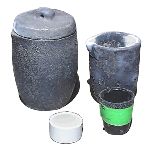 First you need a good crucible. You cannot get away with homemade for high temperature melting. Graphite are common, silicon carbide are the best and clay are the cheapest. The small white crucible to the left is a common jeweler's melting bowl and will do well for many small projects. First you need a good crucible. You cannot get away with homemade for high temperature melting. Graphite are common, silicon carbide are the best and clay are the cheapest. The small white crucible to the left is a common jeweler's melting bowl and will do well for many small projects.
IForge #137 Lost Wax casting demo
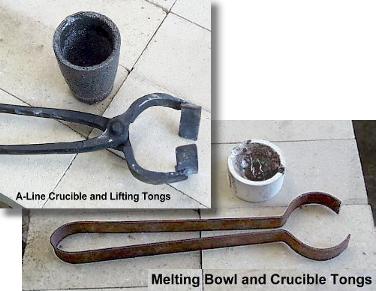 You will need tongs and or pouring shanks to fit the crucibles. This is NOT a one size fits all job. All your crucible handling tools MUST fit well and usually are matched sets. You will need tongs and or pouring shanks to fit the crucibles. This is NOT a one size fits all job. All your crucible handling tools MUST fit well and usually are matched sets.
A full set of protective gear is a must.
This varies depending on the amount of metal but at a minimum is safety glasses, leather apron and gloves. Foundry spats are essential if you work at bench level. These keep hot metal from running into your shoes where it STAYS until you get the shoes off. A full face shield is better than safety glasses and protects your pretty face and beard.
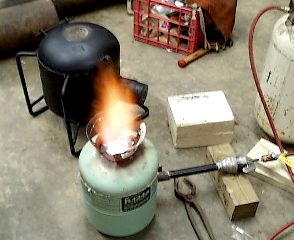
AND you will also need to have a way to melt the metal. This can be done in a coke, charcoal or gas furnace. You can also use an oxyacetylene torch to melt small quantities of brass in a jewelers melting bowl. The melting furnace above is typical however it was based on hard refractory designs even though it was made using Kaowool. A much better design is to have the top 3/4 lift off or tip up so that you can lift a small crucible with pouring tongs rather than using lifting tongs and then transferring to a pouring shank or tongs.
The following are our other iForge demos.
iForge demo Molds I
iForge demo Molds I
We have book reviews on the foundry books by Chastain and I highly recommend the books by C.W. Ammen.
|
|
- guru
- Tuesday, 01/30/07 11:35:43 EST
|
Machinist Major & Tool & Die Design: Andrew B., This is one of those unusual areas where everyone probably got there a different way.
First there is a WIDE range of skills in this industry. There are "machine operators" who take part in and out of machines and pull the lever. This have been largely replaced by cheaper robots. Then there are first class machinists who can operate almost any type of machine. Job shop machinists have to be skilled, talented and accurate. They often get only ONE chance to make a part right and screw ups and the slow are often out looking for another job. THEN there are true tool and die makers. This is elite who have usually done all the rest and excel in accuracy and detail. In the old days every surface of a die for making anything no matter how sophisticate the shape was machined and hand sculpted by a tool and die maker. Today machines do much of the work but many industries still have die makers that can adjust, repair and do the fine finish work that a machine cannot often do.
To become a "machinist" in most parts of the U.S. only requires a 2 year or associate degree from a community college or trade school. My ex-wife too one of these courses, left teaching and is making twice as much money as she did with 25 years of teaching experience. She managed this in one year because she could by-pass a lot of the general classes due to her college degree and teaching experience (she could teach the math classes that were requirements).
Once employed, the company you work for will probably have an "apprentice" program. This is basically a system to track your experience and give you promotion steps. It has nothing to do with nothing outside that business EXCEPT that you can show your next employer your experiance level.
Today a lot of Tool & Die work that was once done by hand is now done with CAD-CAM machines and rapid prototypers making EDM dies. A lot of this is high tech and changing day by day. It helps to be experienced in CAD, particularly AutoCAD but you also need to be adept at learning other software programs.
To get an education in the higher end of a lot of this you may be looking at a mechanical engineering degree, not a machinist's certificate. There are engineering schools all over the country. Pick one.
If there is a specific specialty of industry you want to be employed at ASK them what their requirements are. Today you probably need a LOT more math and competency in using it for any job in this area. Many industries also have the local schools doing job training for them. In my wife's case the local nuclear fuel plant hires largely from the local community college and the college in turn provides what they want. . .
Hope this helps.
|
|
- guru
- Tuesday, 01/30/07 12:53:15 EST
|
Apprentice and Journeyman: What Dave Boyer said is true and forgotten by a lot of people. A Journeyman "journeys". They travel from job to job to learn as much as possible from as many other people and shops. That is what the word means. At some point a journeyman becomes a master by experience or shear will. Even though the process is no longer what it was at one time the educational aspects are still the same.
ALSO, there is a tendency for people to not get pay increases within a given organization. To get more pay you usually have to change jobs, go to a bigger market. . .
|
|
- guru
- Tuesday, 01/30/07 13:00:18 EST
|
I am interested in finding someone who can make a custom log brand hammer. My husband and sons are log home builders and would like to use one to brand their homes. Do you know someone who can build such a brand? Thank you.
Marilee
|
|
Marilee
- Tuesday, 01/30/07 15:52:32 EST
|
Marilee: It would help to know how complicated and what size your brand would be.
|
|
Ken Scharabok (Poor Boy)
- Tuesday, 01/30/07 17:26:15 EST
|
For the last 3 years I've been smithing on a Champion-school-bus brake-drum forge hybrid I cobbled together. I just found an old retangular cast iron forge w/ clinker breaker in great shape and I want to use it because of it's greater surface area. The thing is flat across to the outer lip. I burn coke exclusively and was concerned about there being no fire pot to build a bed of fire in. I'm thinking about cutting the bottom out of a cast iron pan, attaching it over the clinker breaker and pouring fireplace cement around it to build the recess. Is all this necessary to do, or am I just over thinking the problem?
|
|
Thumper
- Tuesday, 01/30/07 22:08:25 EST
|
Poor Boy: I want it to say: Fleming & Sons. How big or small would you suggest? Would a 4" wide x 2" tall be okay? It does not have to be complicated. Thank you for your help.
|
|
Marilee
- Tuesday, 01/30/07 22:31:35 EST
|
Marilee; I know close to 100 people who could do that job depending on the complexity of the branding iron; however most would not take the job without being able to meet in person to make *sure* that what you want is what you conveyed to them.
Could you post what continent you are on?
Thomas
|
|
Thomas P
- Tuesday, 01/30/07 22:32:42 EST
|
I am a 15 year old blacksmith and have been at it for four years. I have a well equiped shop on my parent's farm. I have decided to try and make a medieval style helmet. I have forged a armorers hammer and plan on making a T-anvil
(such as the ones show in "Eric Thing Armorer Part I: The Tools") I was wondering if anyone knew if 2" square steel would be thick enough for a small anvil like these. Any helpful information would be appreciated.
p.s. I really appreciate having anvilfire as a resource and use it often.
|
|
Daniel Gillund
- Tuesday, 01/30/07 22:39:06 EST
|
Andrew B: The NTMA mentioned by Ken has groups all over the country. Most of the shops that offer a bonafide apprenticeship are members. The organization is involved in setting up the night school cirruculum. This is an excellent suggestion.
|
|
Dave Boyer
- Tuesday, 01/30/07 22:56:49 EST
|
Andrew B: There is another aspect that seperastes a [good] tool and die maker from a toolroom machinist: This is the ability to take a complex job from a pile of blueprints through to a finished and working tool. This requires good orginization and communication skills, and verry good mechanical abilities. If You are born with most of the right stuff You can learn the rest. An understanding of the engineering involved with the end product is mandatory, but an engineering degree is not. A shop that builds large and complicated tools often hands the job over to thh tool& die maker who is responsible for making working drawings for the machinists and tool makers who will be doing some of the work. Some shops have group lead men, a more fomal delegation of responsibility. This is a trade that is at times rewarding and at times frustrating, but definatly worth learning.
|
|
Dave Boyer
- Tuesday, 01/30/07 23:12:31 EST
|
Daniel:
I have two T-stakes, one made from 3" square bar, and one from 2" bar. I do the great majority of my helmet-forming work on the 3" version; I can hit it as hard as I want. That's awfully thick bar, though, and you may have difficulty obtaining it and welding it.
My 2" stake has a 1" square hole on one end, so I can use it as a horizontal holder for small stakes. I use it for this purpose almost exclusively. If you don't mind a T-stake that yields a little when you hit it hard, you can do pretty good work on a 2" T-stake. Also, the smaller cross-section means you can get into smaller spaces.
If you have easy access to 2" bar, and can get it welded, it will probably serve, especially if you do your heavy forming hot. It must be anchored solidly! Mine is sunk in a square hole that goes all the way through a laminated block of 2x10s. I strongly recommend using one end of it to hold small stakes; if you get seriously into plate-metal forming, you will find yourself making a pile of stakes to do special jobs. The other end can be rounded off to do rough forming on.
One thing I found out quickly -- I also needed a vertical stake holder to compliment the horizontal one. The vertical one is just a single piece of 2" square bar, sunk in the wood block as the horizontal one is, with a 1" square socket welded on the upper end. The same stakes can be used in both holders, allowing much easier working of all surfaces of a helmet.
Eric T.
|
|
- Eric T
- Tuesday, 01/30/07 23:34:49 EST
|
i have a chance to buy a 1947 50# little giant power hammer that runs good and seems to be in good condition for around $3000. Is this a good deal. Several of my smithy friens say jump on it......thanks,
|
|
waller
- Tuesday, 01/30/07 23:47:28 EST
|
I have a chance to buy a 50# little giant power hammer for about $3000. It works well and doesnt seem tohave any cracks. Some of my smithy friens say jump on it....?
|
|
- waller
- Tuesday, 01/30/07 23:52:11 EST
|
Waller, LG's sell for less than a thousand US to as much as $4500 in perfect condition ready to run. They would be MUCH more expensive new if they were still built.
Running and running good are two different things in the LG world. Just because it goes up and down and hits does not mean it is running good. Guides can be worn out and sloppy, dies worn out, sow block (the part that holds the dies) cracked or damaged, bearings bad. You would not believe HOW bad an LG can be worn and still run.
Lift the ram with a pry bar, try to wiggle it back and forth. Push up on the crank wheel while the ram is lifted off the crank. Look at how it is oiled. An LG that has been used any should be covered in grease and oil.
Even though they ARE valuable machines LOOK at it closely. Study the parts for cracks and repairs. It may only be a $2000 machine. . . It may be worth more than the asking price.
|
|
- guru
- Wednesday, 01/31/07 00:42:27 EST
|
Custom log Brand Hammer: Note to ALL. I do not think Marilee is taking about a brand but rather a marking hammer. It is a long handled spike hammer with the company's logo in raised lettering like a touch mark or letter stamp and used to identify logs. It is a job for a letter stamp manufacturer.
|
|
- guru
- Wednesday, 01/31/07 00:47:14 EST
|
waller-- I have a 50-pound Mayer Bros., the hammer they made after they lost control of the Little Giant their daddy invented, in the late 1920s. It works fine-- when it has not succeeded in breaking a toggle, which it does every now and then. Richard Kern, who did a book on restoring these hammers, said you always have to remember you are dealing with a machine that is forever trying to destroy itself. They need a lot of tuning to be really effective. Why not get one of your smith pals to go check it out for you? Another couple thou and a compressor plus freight will get you a brand new air hammer.
|
|
Miles Undercut
- Wednesday, 01/31/07 01:13:37 EST
|
Log branding,
I seen these hammers made up with many characters on the edge of a ring/disk or a simple "X" configuration of just 4-8 characters. The handle coming down the center.
One simply turned to the correct character then strikes the end grain of the log to emboss whatever desired.
|
|
- Sven
- Wednesday, 01/31/07 03:07:35 EST
|
Logging brand/name hammers: I have been told they were used by loggers who primarily rafted logs down a river. Loggers would mix the logs together for rafts and the stamp then helped determine which log belonged to who when they arrived at the mill.
About the same process as branding cattle for mixed cattle drives.
Marilee might consider some type of nice metal label to be affixed at some location.
|
|
Ken Scharabok (Poor Boy)
- Wednesday, 01/31/07 03:34:37 EST
|
Eric: Thank you for the help, but it seem the more I know, the more question I have. I can get 2" at the local steel supplier, so I plan to make a stake out of that and special order 3" later (if I find I want to continue with this). A few more questions: how long should the two pieces to make the T be? Would the depressions on a swage block (centaur forge; Kankakee style) work for doing the dishing as you desribed it? Will a 3.5" ball hitch ground a little flatter work for a mushroom stake? And finally, is there any way to make square holes without hours of filing? Thanks agian,
P.S. Eric: I feel you articles make a great contribution to anvilfire and found them helpful.
|
|
Daniel Gillund
- Wednesday, 01/31/07 07:57:53 EST
|
Square Holes: Daniel, See our iForge article #167 on Stakes and bosters, making square holes.. Note that the weld build up method is probably not strong enough for this tool. If you look at Eric's stakes the ends have been thinned by sawing about half off under the stake hole. This makes the job a little easier.
You can also PUNCH a square hole which is the blacksmith way and the way every forged anvil was done until farily recent times. You will need help (a striker).
|
|
- guru
- Wednesday, 01/31/07 09:01:24 EST
|
Trailer ball stakes are used quite a lot by smiths. However they are rather limited as they are quite small. For some other small tools see our iForge demo #47 swage tools by James Joyce.
For a little over a year I collected various sheet metal tools for armour work including steel balls. I took advantage of the fact that I travel a lot to blacksmithing events but that should not be a detriment to a young fellow willing to camp out and travel cheap. There are events all over the country (world) and this happens to be a year when to semi annual events are held. The Southwestern Blacksmiths Association is having their regional meet and the Canadians are have CanIron. There are many others.
During that year I found a range of steel balls and ball stakes running from 8" diameter down to less than 2". These included large and small ball mill balls. A scrap forging that was supposed to be a joint in heavy articulated earth mover. Two inexpensive cast mushroom stakes and a stake holder. As you can see, the original uses were as varied as the sources.
During that year I also collected ball peen hammers as my set had been raided. I now have a graduated set from about 2 ounces to 5 pounds. While not ideal for armour work they are handy. Probably the most important tool I purchased during that year was a used Beverly shear.
|
|
- guru
- Wednesday, 01/31/07 09:18:52 EST
|
Daniel Gillund: You can also make a square hole by simply arc welding. Say you have a plate 1" x 4" you want to put a 1" hardy hole in. Cut off plate and then weld in two pieces of 1" x 1" x 1 1/2", leaving a 1" square hole in the middle of the plate. When clamping for welding use a slug of 1" x 1" x 1" with one layer of business card on each side where the hardy hole will go. The business cards then provide a slight oversized slop factor.
|
|
Ken Scharabok (Poor Boy)
- Wednesday, 01/31/07 09:24:01 EST
|
Swage Blocks and dishing: These CAN be used for armour work but most are too small and the depressions too deep. Modern blocks are also often poorly cast and rough. You must be prepared to spend a lot of time grinding on them to make them useful. AND there are a couple that the side impressions are useless due to the parting line going down the middle instead of at the corner. By the time you have ground or machined these to a useful shape you could have made your own.
The impression depth for a spherical shape should be no more than 1/4 the diameter of the sphere and 1/5 is recommended.
For a great deal of armour work a wood block (stump or laminated block) goes a LONG way. The depressions can vary and you can use both ends. Remember to keep them shallow.
Depending on where you live large sections of tree trunk can be had for the hauling after they are cut up due to being felled by a storm. If you catch the highway department in the act and ask politely (you have to act quickly) they may even cut a few pieces to length for you. These are very handy in the blacksmith shop as well as armoury.
See our NEWS covergage of the 2003 and 2004 WV Armour-In.
For a gallery of various iron swage blocks see Swage Blocks . com
|
|
- guru
- Wednesday, 01/31/07 09:37:37 EST
|
Stake Proportions and DIY stakes: The proportions of these vary greatly but the normal extension is about 12 to 14" (305 - 355mm) on either side . Do not overlook the possibility of making these from round stock which is often more available as used shafting. Flattening the top where it needs it can be done with a grinder and the round surface helps to make the weld prep for the T joint.
T-stakes (bickerns) and T-anvils (bigornia in Spanish)used to be more common the T-anvil was favored by the Spanish. These were made in weights of 100 pounds or more having a horn and heel as large as most anvils. The stake shank gave the center a great deal of mass in line with heavy blows.
If I was going to buy new material to make these I would get enough to make two and sell the second. Your one time cutting fees and the warehouse and cost at a weldors is not going to be double (more like 1.4).
Eric Thing's Stake and Swage Bench: This is an excellent design for making these tools more useful. I had designed a similar bench for myself for supporting swage blocks. Laminating pieces of small wood makes it convenient to come by and to make the shape you want. It also makes it easy to make square holes and pass through holes. If you stick to construction grade lumber the 1.5" thickness will be uniform for 2x4's through 2x12's and the pine plenty heavy enough in such a large solid section.
|
|
- guru
- Wednesday, 01/31/07 10:22:09 EST
|
Logging Brand Hammer
Ken, Sven and guru: Yes, the brand I am talking about is a hammer with a brand of raised letters that once you hit it, it leaves your name, mark or brand on the log. I live in Wisconsin, USA. Can someone give me direction on a blacksmith, etc., who could build this. Any more info would be greatly appreciated.
|
|
Marilee
- Wednesday, 01/31/07 11:08:07 EST
|
Marilee-- Doesn't Bailey's, the logging supplies outfit, make these up? Or couldn't they direct you to a source?
|
|
Miles Undercut
- Wednesday, 01/31/07 11:37:38 EST
|
On T-stakes I don't see the need to make them out of one solid piece. Make the top out of a hardenable material and then weld on the stake portion of mild steel. With good welds and dressing it should be very difficult to tell it wasn't originally one solid piece. Equivalent of the old composite bodied anvils. Only use high cost material where it is needed.
|
|
Ken Scharabok (Poor Boy)
- Wednesday, 01/31/07 11:40:52 EST
|
Marilee: Contact Bob Bergman in Blanchardville. While he might not be interested in the job I am sure he can refer you to someone. As implied by Miles, they might have it made elsewhere and just pass on the cost with mark up to you.
Problem I see is the size of your design. Letters would be very small. Once stamped on I doubt they would be noticeable long. Most of the log stamping hammers I have seen on eBay have been no more than two letters which stamped quite deep.
I have a DUNN & MURCOTT (over BROOKLYN, NY) anvil. Their stamp was about the size you envision. However, letters are so small that, once stamped, they are difficult to read unless you known what you are looking for beforehand.
|
|
Ken Scharabok (Poor Boy)
- Wednesday, 01/31/07 11:48:11 EST
|
Perhaps a chunk of forklift tine would be a scroungable piece of heavy usually hardenable tough stock for the top piece of the t stake---taking the "welding to high carbon steel" precautions of course.
Thomas
|
|
Thomas P
- Wednesday, 01/31/07 12:15:56 EST
|
Ken, log stamps are usually pretty large. 1 x 2" is not uncommon. Lumber inspectors also use a similar tool.
Marilee, This is one of those things that while a blacksmith with sufficient skills COULD make it, this is actually a job for a specialist, a marking stamp company. They use machine tools not normally found in the blacksmith shop to cut the letters.
Companies that make stamps: (not the one I was looking for)
http://www.youngbrosstampworks.com/
www.wagnerengraving.com/steelstamps/
www.pannier.com/products/
Search for "log hammer or log stamps"
|
|
- guru
- Wednesday, 01/31/07 12:31:10 EST
|
Would the heated hammer leave a nice charred mark? Or would you fill the depressions with tar or any other black fill? I've made a few branding irons for food and leather work, and to be honest it's not that hard to do.
|
|
- Nippulini
- Wednesday, 01/31/07 13:33:07 EST
|
Nip, These are used COLD on the end grain of various woods including hardwood. Its like your touchmark on a hammer and you give it one clean wack. They are not a branding iron.
|
|
- guru
- Wednesday, 01/31/07 14:14:19 EST
|
Where can I find a on-line list of steel beams, plates, pipe that are readily available?
|
|
- John Van Herk
- Wednesday, 01/31/07 14:44:15 EST
|
Stock Lists: John, You need to go to your local steel service center for availability.
What you are looking for is only found in several separate databases. The AISC database which is published by the AISC as "Steel Construction Manual". This includes all common inch designation steel beams, channels and angles.
For pipe and tube there are different databases. Pipe, is different than tube dimensionally and in available alloys. Pipe is sized by weird internal nominals based on external threads with varying wall thicknesses that do not effect the OD. Tubing is sized by OD and ID or occasionally OD and wall thickness.
If you want to know what is available you have to go to a specific warehouse as catalogs all list the complete line of sections, not specifically what is available.
If you want something CLOSE to a complete database then download my Mass2. It is a DOS program but I have no problem running it on Win98 through XP. However, every windirt OS has different installation routines. Your best bet is to unzip the program in a folder called Mass2 then create a shortcut using the Mass2 icon provided. This is an incomplete BETA copy of a product no longer in development. However, most of it works. If you like it send me $50.
Mass2inst.ZIP
This includes the entire AISC 1983 database (with permission). It was the outgoing version at the time. I have also listed all US standard pipe. Note that just because there was a standard size designation does not mean it is made.
|
|
- guru
- Wednesday, 01/31/07 15:34:11 EST
|
Guys, I asked a question that musta got overlooked yesterday. I'm changing forges to a rectangular one with a flat cast iron table with an outer lip. No fire pot, just a double thickness of iron around the clinker breaker (second layer beneath the table). I burn coke exclusively and think I shold have a depression to contain the coals. I intend to take the bottom off a cast iron pan, bolt it to the table and ramp up to the lip of it with fireplace cement. Is that necessary, or will the flat surface suffice?
|
|
Thumper
- Wednesday, 01/31/07 16:23:15 EST
|
Flat doesn't work well with coke. Rather than modifying a good forge I might keep looking. . . Generally coke firepots are 5/8" (min) to 3/4" cast iron. What they used to do in this type forge is build up the floor around the grate with clay. This made a "duck's nest" to help control the fire.
|
|
- guru
- Wednesday, 01/31/07 16:35:02 EST
|
Guru, we're dealing with a "beer budget", here and I picked this forge up along with two blowers and some huge tongs for a song and I've needed a bigger work table for some time. The only modification I'll be making is 2 small holes to bracket down the cast iron pan and the mud. I was going to buy and insert a fire pot from Centur Forge, but that would double my investment so I came up with my "Rube Goldberg" solution instead. You didn't say you disliked my idea, so I'm gonna take that as a go ahead, thanks for the input.
|
|
Thumper
- Wednesday, 01/31/07 17:17:08 EST
|
Hey,
i have a 20 inch or so, circular rivet forge, with a pan with 3 inch turned up edges, that has the grate above the pan, its screwed on but is about a quarter inch above the pan, my shop is also outdoors, so, ive been told not to clay it, but to sand it,so that the sand can be dumped out each night and the forge will not rust up, this is too much work ,and i dont like workign with sand, it adds to the clinker and is too much of a hassle, heres my question,
is there anything that is a concrete sheet, or composite sheet, thats about a quarter or half an inch that can be semi easily cut to shape, then set into the forge, and taken out when im done forging? or, even a sheet of steel that can be replaced when i burn it out or whatever, in my mind i have a kind of composite sheet thats a bit spoungy, about an 2 inches thick at the edges, witht he grate hole cut in it, and the grate hole edges at an angle, to get the "fire pot" type shape,
guru, you have seen my forge, is there anything like that that i can buy, or do?
thanks,
|
|
Cameron
- Wednesday, 01/31/07 20:44:38 EST
|
also, in adition to my other question, would i be able to like, line my forge with a plastic bag , then, shape say fireplace cement,or something to the shape i want, and then once it is dry pull it out, remove the bag, and set it back into the forge, then always remove it after use, and re instal it before use?
|
|
Cameron
- Wednesday, 01/31/07 20:46:39 EST
|
I have purchased 2" square stock (to make the T-anvil), and have begun working on it using my JET bandsaw and my father's 7" Dewalt grinder. I have made 45 degree cuts on the front, and made similar cuts that go back 5 1/2" on the top. (the top bar is 24" long) I enclosed pictures and am wondering if I should go back futher than 5.5" on the top and how rounded to make it. I decided to wait with the square hole because I plan to buy a JET mill/drill as soon as I can afford one. I included a picture of my large ball as well as a mushroom stake I had made from an old cultivator axle and a hardy tool I had made from a regular ball hitch. I appreciate all the help.
P.S. I am not going to make two stakes since I will be making it entirely by myself and also because there isn't anyone around here who would want to buy the other (if I made it).
|
|
Daniel
- Wednesday, 01/31/07 21:39:58 EST
|
Sorry, I couldn't figure out how to put pictures on here. If anyone could tell me how I would be very thankful.
|
|
Daniel
- Wednesday, 01/31/07 21:42:00 EST
|
Cameron & possibly Thumper: You might be able to do what You want by casting wirh refactory cement.
|
|
Dave Boyer
- Wednesday, 01/31/07 23:24:33 EST
|
Claying of Cementing: I vastly prefer NOT to do either as they add weight to the forge to the point of not being portable any long and it also can trap moisture between the refractory and the forge. If you are going to build a masonry forge then do so but not in a cast iron forge.
When I build brick floored gas forges I use bar grating to support the bricks. When fired up water POURS from the bricks for the first hour or so then steam follows. The bar grating provides lots of ventilation for the steam and circulating air to cool the supports. Tin box and cast iron box (the old commercial) gas forges have the same problem and rust out from the inside NOT the outside. You would not believe the damage until you rebuild a few. Refractory is porous and absorbs moisture from the air. On heating it is pushed away from the heat out into the shell. When a forge is run hard every day the rust is not too bad. But when it is only run an hour or two at a time the moisture is repeatedly trapped between the refractory and the steel. Rust ensues. For this reason most gas forges are a bad design and why I build mine differently.
Coal forges are worse. You have the moisture problem in the refractory PLUS the corrosive sulfurous compounds from the coal which leach out and EAT steel.
Metal forges are best kept indoors and dry. It stored outdoors they should be very clean. I've replaced the bottom in enough forges that I know the truth of this.
If you want to build a heavy refractory forge do it with fire bricks and steel supports that are easy to access for cleaning and painting. Bricks are a standard size ands shape and can be replaced as needed or removed and replaced.
Refractory cement is cheaper than bricks but because it is not fired at high temperatures as are bricks it is not as strong OR durable. You pay less, you get less.
Think about it.
Photos: No we do not have a way for the public to post photos or links here. On a free to the public forum that does not require registration that is dangerous and you end up with banners and links to who knows what. . . Our future forum will have that capability but to prevent shenanigans we will have to have a registration system with proof of ID.
Forging your own curved stake surfaces is the way to go. Silversmiths that usually do not have steel forging capacity end up buying dozens of various shaped stakes and some have collections of hundreds. . . often looking for the perfect shape. As a smith you can make your own.
|
|
- guru
- Thursday, 02/01/07 00:30:25 EST
|
|
|
[
CSI - anvilfire MEMBERS Group |
Getting Started in Blacksmithing ]
|