Wrought Iron RR Rail: Only the very earliest rails such as some experimental ones in the East were wrought. By the time the railroads were pushing west bulk medium carbon steel was the rule. I have a piece of wrought rail that was probably part of a city trolley or horse drawn system for a brief time.
What you often see in old RR-rail that looks like "grain" is where the surface of the rail extrudes or smears and creates cold shuts. In some places after the inside edge of the rail became slumped and cold worked they reversed the rail so that the other side could wear. This was especially true on sidings where the loads were heavy but the traffic slow.
|
|
- guru
- Friday, 03/23/07 09:10:20 EST
|
Gentlemen :
I live in the town of Star, NC and in our town we are working on a memorial project for our town's logging tramway that existed in 1896-1902. We have rescued a portion of the 75 foot smokestack from the 40 horse boiler that was at the mill from the woods. It is in fairly decent shape however there are some problems. When the smokestack finally fell down, the iron fire coal catch was bent badly. It is made of used wagon tire irons and was circular before it fell, now it is extremely oval in shape. I am interested in trying to make it round again, however the iron is rusty and I am afraid it will snap if I try to bend it. Are there any suggestions as to how to accomplish this without snapping the rings?
Thanks -- John Maynard - Star, NC
|
|
John Maynard
- Friday, 03/23/07 10:30:20 EST
|
John, First I am sure you know there is a difference between restoration and preservation. You most often preserve things as-found and prevent further damage.
Something made during that era MAY be wrought iron or it may be steel. See our FAQ about "wrought iron" for identification.
If it is wrought and severely corroded then there is a good chance it will break. Old wrought is similar to wood in structure and corrosion expands and removes the slag inclusions leaving a very weak iron structure. There is no repairing it to being ductile again. If it is wrought in good shape it can be bent cold OR at a very high heat (yellow) but should not be bent at low heats. The heat will change the rust to a different form of iron oxide and the piece will not look the same afterwards (at least not for 20 years or more).
If it is old mild steel it should still be ductile and will bend back into shape.
There is rust and then there is RUST. Generally if 80% of the steel is there it can be straightened without a problem.
There are a lot of blacksmiths in NC and I am sure you can find one that will help identify the metal.
|
|
- guru
- Friday, 03/23/07 10:48:45 EST
|
Plow repair---I have also heard it referred to as "pointing" a plow. "Practical Blacksmithing" by Richardson, written in the late 1880's early 1890's should cover it with a pretty "common terminology" as it is a collection of articles sent in to a blacksmithing journal of that time.
Ken Paul Ailing was the smith at "Ohio Village" the Ohio Historical Society's 1860's village in Columbus, OH and unless he's moved recently should still be in the area. Soon after the village laid off *all* their trained craftspeople Pauls was badly burned in a house fire; he's had a hard row to hoe!
Thomas
|
|
Thomas P
- Friday, 03/23/07 10:58:59 EST
|
Sources for good coal ?
Where does everyone get their coal ?
I live in Central N.C.
Kayne and son are 5 hours from me, plus I want to buy at least a ton.
Any ideas.
Thanks,
Phil
|
|
Phil Lewis
- Friday, 03/23/07 12:48:44 EST
|
What are the best welding rods to use on cast iron railings? and have you got any tips? Ac or Dc?
|
|
Mark J
- Friday, 03/23/07 13:38:56 EST
|
Phil: go to the navigate tool, (upper right this page)go to "coal scuttle"
|
|
ML
- Friday, 03/23/07 13:42:11 EST
|
Mark J: Google hobart welding, they have charts on line to select rods & shows whether ac/dc & voltage range for diameter. Or wait for a reply from the guru or one of his helpers. They will have a better answer for you.
|
|
ML
- Friday, 03/23/07 13:45:15 EST
|
Ml,
Kayne is the only place listed in NC and they are five hours away (one way).
I was hoping there was a source closer and Kayne lists a price by the fifty pound bag,don't know if they sell bulk.
Phil
|
|
Phil Lewis
- Friday, 03/23/07 14:11:29 EST
|
Mark, Cast is difficult to weld. Using arc you want a NiRod (ask your welding supplier). Using gas (yes it works) you use cast iron. Most of the time brazing is the best repair that does the least damage to cast iron. When you arc weld a complicated cast iron shape if there is an enclosed space (circle, square. . ) and you are welding the perrifery thre is a good chance that the other side will break from the thermal stresses.
|
|
- guru
- Friday, 03/23/07 14:13:40 EST
|
Phil, They sell in bulk but delivery charges are high. It makes it worth the trip. Besides, they have a ton of other things you just HAVE to HAVE. . . ;)
|
|
- guru
- Friday, 03/23/07 14:15:12 EST
|
Wrought Iron Rail (maybe): If I was to get a picture could you identify it? I know it is much lighter than modern rail but it is much heavier than mine rail so I don’t hold a lot of hope for a wrought iron gold mine. Too heavy to be of much use anyway right?
I was also curious what all of you thought of the Mythbusters hammer shattering tests. Is it like getting cut in half by a broken cable, everybody knows some body who knew a guy... Even the smith they talked to ‘knew a guy who...’ I saw lots of problems when they did it the first time but the revisit seemed really through. How about it guys, chipping sure but how many of you have shattered a hammer? Pictures?
Ken Nelson
|
|
Ken Nelson
- Friday, 03/23/07 15:41:17 EST
|
I am currently building a landscape rake to be pulled behind a tractor via the 3 point hitch. I have looked at some from northern tool and they specify that theirs have 1" x 5/16" "spring" steel tines. My question is,
In your opinion will A-36 suffice? My concern would be bending. My intent is to use it for raking up rocks 1/2" to 3" in diameter for a ten acre property. Mostly where we drive. Cost of steel is not such a concern but the ability to temper several 2 1/2' pieces. Thank you
|
|
ML
- Friday, 03/23/07 15:41:47 EST
|
Guru and Thomas,
A little late here, but thanks for the feedback on the hardfacing cast iron question. It was just a thought, and you guys have persuaded me that it wasn't a very good one. But that's why I asked. :)
|
|
Matt
- Friday, 03/23/07 15:44:24 EST
|
ML
I owned one of those landscape rakes by Northern tool. There is too much 'tine' and not enough 'space' between the tines. The tines need to be more like 1/2" wide at the same spacing. I think they use 1" so they can bolt the tines to the frame and so they can use cheaper steel. I took off every other tine when I used mine.
I know this was not your question, but I didn't want you to copy a bad design.
Mike
|
|
Mike Berube
- Friday, 03/23/07 17:09:08 EST
|
Mike Berube:
Thanks for the input. I was thinking I would experiment with different widths to find what works. I already have a box blade I don't need another one ;)
|
|
ML
- Friday, 03/23/07 17:20:40 EST
|
Ken Nelson, Mythbusters are a bunch of guys who "think" that they are experts. First, the anvil they use is a Northern Tool ASO, so their anvil test was bad. Second, they tried to make the hammers brittle by heating them, then putting in oil, which caught fire, they put the fire out VERY slowly, so the only acheived annealing. When they tested the annealed hammers, the steel handles bent (big surprise). I've felt like e-mailing them and telling them what they did wrong.
I chipped a hammer while forging with anger (yes I turned to the dark side). Shrapnel from the toe of the hammer face shot backwards into my hand. Vise grips and cursing aside, I got the chunk of metal out.
Never use a hammer while angry.
|
|
- Nippulini
- Friday, 03/23/07 18:08:26 EST
|
I have not seen a hammer shatter. I have chipped many. And when playing with some simple 1050 press forged hammer head rejects, I cracked one in a large number of places when I water quenched. I suspect that hammer would shatter if a real blow on a hard anvil were to occur.
I have also seen a number of broken dies that did shatter, when a cold billet snuck through.
|
|
ptree
- Friday, 03/23/07 18:22:36 EST
|
Has anyone heard of a "Hoover', anvil. I know long ago Ralph Hoover (a farriers tool maker), designed one, but it was called a "G.E." and was supposed to be of superior quality. I'm getting some pic's sent on one for sale that's 100#, but don't want to label it an ASO out of hand, so any input would be appreciated.
|
|
Thumper
- Friday, 03/23/07 19:21:35 EST
|
Got the pics on the anvil. It says HOOVER in caps, below there's a letter "S', inside a diamond shape, and below that is written "S-5", all lettering is raised. Thanks
|
|
Thumper
- Friday, 03/23/07 19:26:29 EST
|
Thumper: There is just a passing mention of Hoover in Anvils in America: "The following names might be found on farrier's cast anvils: Hoover, Thomas, Valley and Enders. I have either seen them in person, seen advertisements for them or viewed a photo of these anvils."
You might call Richard Postman at 269-471-5426 and ask if he would like photographs.
|
|
Ken Scharabok (Poor Boy)
- Friday, 03/23/07 19:50:09 EST
|
Thanks Ken.
|
|
Thumper
- Friday, 03/23/07 19:58:01 EST
|
Ken N. I have personally seen hardened AND TEMPERED tool steel turned to rubble in a press mishap. I have seen tool steel crack from quenching alone. I don't want to be there if somebody puts enough force on a fully hardened but untempered chunk of steel to make it shatter. The Mythbusters flawed test was discused before, but there are a few points I will mention for Your benifit. 1) The steel needs to be CAPABLE of being fully hardened. 2) As Nip pointed out the quench must be suitable to harden the material. 3) You have to hit it with something hard while it sits ON something hard to get the greatest shock.
|
|
- Dave Boyer
- Friday, 03/23/07 21:26:52 EST
|
Mythbusters: They are as bad as Junk Yard Wars. Lots of fun, but not reality and often not factual. I had thought it would be great fun to challenge a Junk Yard Wars team with a bunch of blacksmiths. However, when you realize the whole thing is scripted including who wins and who loses as well as what is planted in the yard. . . then all the fun goes out of it.
I have not seen the Mythbusters broken hammer show other than the clip of the hammers shattering. . . We all know that was phony. REALLY, you can do the same with two overripe bananas frozen in liquid Nitrogen. That is not phony AND it is impressive to see what happens to matter frozen that cold.
It is entertainment using faux science and bad logic. A couple overage kids blowing things up in the backyard. The problem is that some of the "factual" shows like the History channel are getting as bad in their quest for entertainment.
There are some REALLY great experiments and demonstrations in chemistry and physics that can be just as entertaining as the faux science. Where is Mr. Wizard when you need him?
Famous line from "Dinosaurs" refering to the Mr. Wizard show, "Whoops, we need another Timmy!"
|
|
- guru
- Friday, 03/23/07 22:52:12 EST
|
Shattered hammers.
The catch word is "shattered". Who has never seen a hammer with spalled face edges? Spalling is what normally happens. Entire, hand-forged hammer heads are not quenched in one 'swell foop'. The main reason is that the thinner wall either side of the eye will lose heat in the quenchant faster than the peen or head. When quenched in its entirety, the difference in heat abstraction may cause a crack on the eye wall.
Note. Quenching a tool in used, dirty motor oil will cause a slower quench than if clean oil is used.
I heat, quench, and temper the head and peen separately, leaving the eye area normalized or annealed.
Getting to Boyer's point # 1, re "fully hardened."
When dealing with high carbon steel, a common hammer head steel, there is something called the case/core effect (having nothing to do with case hardening). My readings tell me that if a 5/8" W1 square bar is hardened by heating and quenching, that the material will harden all the way through. However, if the piece is larger than 5/8", the heat cannot be abstracted fast enough to cause full hardening. There will be a "hard case" and a "tough core. On a hammer head then, you don't get full hardness, but rather the case/core effect. For this reason, W1 is called a shallow hardening steel. The question may arise, "is this effect bad for the hammer head?" I believe just the opposite. When tempering the head, you're really just tempering the hardened case. The tough core acts a bit like an internal "shock absorber".
If the myth busters had used a brine quench, they would have got a deeper hardening that either water or oil can give.
I will continue to give my students the ancient shop rule, "Never hit hardened steel with hardened steel."
|
|
Frank Turley
- Friday, 03/23/07 22:58:52 EST
|
Hoover Anvil,
I called Mr. Postman and his input was that he'd heard of the brand although it's not in his book. Because it has a turning clip in good condition, it's probably cast steel. Also, he mentioned that there are a # of anvils out there made by family owned business that were short lived in their production but not necessarily bad tools, in fact some were quite good. This one he believes was made somewhere after 1960. Think I'll buy it if it passes a ball bearing bounce test.
|
|
Thumper
- Saturday, 03/24/07 00:28:09 EST
|
Pexto anvils?
picked up a pexto stake anvil the other day, i found a picture on ebay that pretty much was the same thing i got, the pic was of a #901. does anyone have any info, value etc, for this anvil? is pexto still around?
thanks
Mike
|
|
MikeK
- Saturday, 03/24/07 04:57:26 EST
|
Peck Stow and Wilcox Co.: This was the name of the famous company that was to become known as Pexto. In their 1905 catalog they carried everything from andirons and hinges to carpenters and tinsmiths tools. Later they would become known only for their tinners' tools and were in fact the largest and most well known company in this field. They pretty much went defunct as hand working sheet metal is not nearly the occupation it once was. However what is left of the product line is sold by Roper-Whitney.
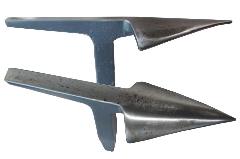 Pexto made a variety of tinsmiths stakes and a great number of sheet metal working machines and tools. Sheet metal stakes are similar to stake anvils but generally are not considered "anvils" except in the most general of terms. Pexto and other maker's stakes were are all designed with a tapered shank to fit into a stake holder. Stake holders varied from simple bench flanges to huge multi hole, multi size plates and long extension arms. Pexto made a variety of tinsmiths stakes and a great number of sheet metal working machines and tools. Sheet metal stakes are similar to stake anvils but generally are not considered "anvils" except in the most general of terms. Pexto and other maker's stakes were are all designed with a tapered shank to fit into a stake holder. Stake holders varied from simple bench flanges to huge multi hole, multi size plates and long extension arms.
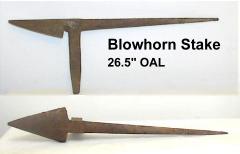 The two stakes shown here (right and below) are those most commonly mistaken for blacksmiths anvils. Besides these are cylindrical stakes, tapered edge "hatchet" stakes, grooved "creasing" stakes, flat stakes, round "mushroom" stakes, bathtub, needle case, candle mould and stove pipe stakes. The two stakes shown here (right and below) are those most commonly mistaken for blacksmiths anvils. Besides these are cylindrical stakes, tapered edge "hatchet" stakes, grooved "creasing" stakes, flat stakes, round "mushroom" stakes, bathtub, needle case, candle mould and stove pipe stakes.
The other misconception is that these are "hardy" tools that should fit the square hardy hole of a blacksmith's anvil. They are NOT. Their tapered shanks will wedge into the straight sided hardy hole and can do damage to the anvil, possibly breaking it off at the heel. Sheet metal stakes are used in tapered stake holders, clamped in a vise (on the straight part of the shank) or mounted into a wood block or "stump". They should never be used as an anvil tool.
In the 1905 catalog the stake and tool numbers run 1, 2, 3. . . Nothing as high as 901. However on the Roper-Whitney web site (roperwhitney.com) under "miscellaneous, forming stakes" that number is listed. The stake there is known as a large "beakhorn stake" 38" long and 45 pounds in weight.
Typically old stakes are selling for about $100 to $150 but you can find them for less. NEW they are more expensive. This one is probably around $500 to $800 or so.
|
|
- guru
- Saturday, 03/24/07 08:23:45 EST
|
Stake prices vs Anvil prices: Folks should note that new OR used stakes are selling for a lot higher than anvils. At $800 for 45 pounds that is $20/pound and these are most commonly cast steel or fabricated. The last price on 45 pound forged Peddinghaus anvils was about $7/pound and this was their most expensive anvil per pound due to its small size.
Some of this difference in price is due to stakes being finished on all the working surfaces which many new anvils are not. Much of the difference is supply and demand.
|
|
- guru
- Saturday, 03/24/07 08:38:08 EST
|
Question: Old Unique Bell liquidgeometry@gmail.com
Question about this old-looking handheld bell, which I found at my former residence, jammed down behind an old radiator here in historic Richmond, VA. This bell seems to have been made out of one single piece of metal and it is quite fascinating. I have had this thing for over a year and finally stumbled upon your website, which seems to have similar qualities and characteristics of craftsmanship, which this piece holds.
Basic Info, Approx. Dims : Overall height w/handle 3.5" diameter 2.0"
Bell Housing height @ 2.0"
* Bell handle has a 3-D dual leaf pattern which splits from the top of the bell
housing, forms a pear shape(side view) from there until it reconnects to form a
S type curl at the top where the leaf tips re-connect, also an inner S shape made
from thin slices, maybe .08, slivered from the inside of each leaf. I can email you
a drawing to another email address when you get back to me.
I am also a professional artist (painting, printmaking, welding, sculpture, ect.... As an artist, just wanted to let you know that the work you have up on site, examples, demos, drawings and website itself are amazing clear and concise. 'Kudos' from one perfectionist to another!
Actually, I need to get a sculpture piece together for a show coming up mid-April, this site seems to be the gold-mine of knowledge which I'm going to need to craft whats in my head for this site specific installment. Hopefully you could suggest an inexpensive way to start out with blacksmithing, tools, access to an anvil, best place to find stock, tensility etc.
I hope we can communicate further about what you might think of this bell, maybe a time frame of when it was produced, and if it could be worth something as an artifact, or antique not that I would want to sell it, Makes a great conversation piece!
Anyway, any help or insight would be appreciated, J P Sullivan
|
|
- LiquidGeometry
- Saturday, 03/24/07 09:10:29 EST
|
Thank you guru, that was excellent information, my anvil is almost exactly like the one in ebay auction 330101088658 (not mine ;)
would the one in the pictures on the auction me more of a general smithing anvil than the one in your picture? or would it be more of a tinsmithing anvil as well?
thanks again
Mike
|
|
MikeK
- Saturday, 03/24/07 10:15:24 EST
|
Stakes caveat-- they are-- or most are, anyway-- cast iron, not forged steel, and CANNOT be struck with heavy blows.
|
|
Miles Undercut
- Saturday, 03/24/07 10:25:06 EST
|
Stake Material: A few are CI but most I have seen were forged and fabricated iron and steel. The old blow horn stake above is forged and forge welded. The later stake is cast steel. The really long stakes are all forged or fabricated steel.
No, these are not smithing anvils. They are too light and springy except for light bending of hot steel. They are designed for sheet metal work. Save your money for a real anvil.
See our Anvil Selection article on the FAQs page.
|
|
- guru
- Saturday, 03/24/07 11:24:26 EST
|
i went to the scrap yard and drug home ninety pounds of scrap thinking it was wrought....then i spark tested it...CRAP i got cast iron. Next time im bringing the battery grinder and sparking it there! at least it was 40 cents a pound and i can take it back.
|
|
coolhand
- Saturday, 03/24/07 11:25:17 EST
|
LiquidGeometry AKA JP Sullivan, First, contact the Central Virginia Blacksmiths Guild (www.cvbg.org). They are based in the Richmond area and have meetings every month. They will be able to answer many of your questions about where to find tools and supplies. In fact, their ex-president is John Elliot of BlacksmithSupply.com. He is right there in Chester and has many of the tools you may need.
At CVBG meets there are almost always one or more tailgaters (sellers of used tools). Then there is the big Dempsey Machinery and Tool fleamarket in Richmond. Ask about it.
I'm not sure about your bell but the guys in CVBG may be able to help on that as well.
|
|
- guru
- Saturday, 03/24/07 11:32:49 EST
|
More Stake Material: The ones that are most commonly cast ductile or cast iron are the light duty silversmiths' stakes that come in hundreds if not an almost infinite number of shapes. The best are made of forged steel but there are a lot of cheaper ones made of CI.
|
|
- guru
- Saturday, 03/24/07 12:04:15 EST
|
On wrought iron: are you sure you can tell the difference beteen WI and CI sparks? They can be similiar at times.
I suggest the partial notch and break test and look for fiberous structure---I carry a bow saw in the truck with a piece of metal cutting bandsawblade in it for scrap yard determinations and dissassemblies.
That stake is a nice one for forming bracelets and penannular brooches on---I picked mine up for US$25 in an OK pawn shop back in the 1980's...It is too soft for steel forging as the dings left by students atest.
Thomas
|
|
Thomas P
- Saturday, 03/24/07 13:10:27 EST
|
I have followed with interest the discussion on horizontal bandsaws as I was thinking of buying one to assist in my power hammer build...after absorbing the info I went to Princess Auto to buy thier 4x6" model ($289 Can) it has a solid cast frame with sealed bearing guides as they were out of that model and wouldnot sell me the floor model they offerd me the 5" swivel head for $399 ...$100 off the sticker price....I set up the bandsaw and used it for the first time today...the first thing I will say is throw away the blade that comes with it and buy a bimetal...but apart from that it is a well put together M/C after a bunch of bolt and allen thightening I did a test cut on 4" square tube 1/4" wall the cut was fast and acurate (for a bandsaw) running only .002 out of square the next cut was cutting the spline end of a 5" axle that I wish to use as an anvil the M/C cut to .003 of square this time...I believe with some tweeking I may be able to get it to run a little closer to square but all in all a good bandsaw...Thank you all for the info that helped me make up my mind to buy one the hours of time and hearing saved not having to cut these two items with a chop saw have allready paid the price of the M/C
Mark
|
|
Mark P
- Saturday, 03/24/07 14:33:14 EST
|
Saws are great tools when they work right. That is cutting as square as I have ever measured on a small saw. Usually the stock supports and stand sag from weight of solid stock is more than that.
To get mine to cut that square in both directions required truing the saw in one direction then the stock stands in the other. If you want good square cutting all the time a permanent setup is required so that stands of feed racks do not get moved between uses.
When a saw is cutting true enough you can get away with sawed surfaces rather than machined.
You don't have to make but a hand full of cuts with a band saw to pay for the difference in price of a chop saw in noise alone much less the rain of sparks and grit. The only time I have use for an abrasive chop saw is cutting material that is too hard to saw.
|
|
- guru
- Saturday, 03/24/07 15:11:26 EST
|
Excuse me if I am being impatient, I posted this yesterday about this time. I got some other advise frome Mike Berube but not as to my original question.
I am currently building a landscape rake to be pulled behind a tractor via the 3 point hitch. I have looked at some from northern tool and they specify that theirs have 1" x 5/16" "spring" steel tines. My question is,
In your opinion will A-36 suffice? My concern would be bending. My intent is to use it for raking up rocks 1/2" to 3" in diameter for a ten acre property. Mostly where we drive. Cost of steel is not such a concern but the ability to temper several 2 1/2' pieces. Thank you
|
|
ML
- Saturday, 03/24/07 16:08:44 EST
|
ML, It is difficult to tell. First, all steel is as springy as any other (mild, spring or tool). The difference being how far the harder steel will deflect and still return to shape. The second thing is how the spring is attached. The maximum load on a single ended piece is at the connection point. This is where it is most likely to bend. There are two ways to reduce the stress at this point.
1) Forge a tapered spring.
2) Use stacked leafs.
The stacked leafs will support the leaf under it and the one under that. . Much simpler than a tapered spring AND the individual pieces are less likely to break.
Since the bending point on these springs is going to be at the attachment point if you provide backups about 1/3 the length of the main spring then mild steel may work.
The devil is in the details and design is everything. The point is that you can get away with a badly designed spring steel spring but a mild steel spring must be made better.
Note that the hardness of the points helps reduce wear as well as help springyness. ALSO note that annealed OR mill run (normalized) spring steel is MUCH tougher than mild steel and may be capable of flexing twice as far as hardened and tempered spring steel.
Spring steel is often sold in the hardened and spring tempered condition. This can be bent (with some difficulty) but it avoids the heat treating. So many manufacturers start with heat treated spring steel which can be sawed and drilled (slower than mild or annealed) then bent to shape. That is the route I would go.
|
|
- guru
- Saturday, 03/24/07 16:42:15 EST
|
Guru: Thank you very much. I now have a couple of options to play with. I very much appreciate your site & you are to be commended for continually helping those of us without your expertise.
|
|
ML
- Saturday, 03/24/07 16:56:21 EST
|
I am now looking at buying an Anvil. Do I go Forge or cast.
Dan
|
|
Dan
- Saturday, 03/24/07 17:29:07 EST
|
Dan, You only have one choice in NEW forged anvils and that is a Peddinghaus. These are currently in short supply as the factory is being operated in spurts. Check with the Kaynes (BlacksmithsDepot.com). If they have one, buy it.
Otherwise they are all cast. Most of the U.S. made are better in my opinion but you also pay for that quality. There are also some good European anvils that are in the same price range. Euroanvils is a good buy for the money but are not the best.
Forged anvils still have a slight advantage over the best cast steel anvils. However, casting quality drops rapidly with price and good cast anvils are close to the price of forged anvils. Generally the lower the price, the lower the quality. At a certain point you get to low quality cast steels that are not much more hardenable than mild steel and not NEARLY as strong. These are mostly the junkers found on ebay. There are also people that sell weak low quality cast iron as cast steel.
In used anvils there are many forged anvils. You get what you find and what you find depends on how long you are willing to look OR wait. The best deals are purchasing directly from individuals. Listings on ebay are there with the intent to run up the price so expect no fantastic deals. DO NOT buy any of the new junk anvils on ebay. You are better off to buy an OLD scroungy beat up anvil that was a GOOD anvil when it was new. There are lots of these to be found at blacksmiths meets. AVOID repaired anvils.
|
|
- guru
- Saturday, 03/24/07 19:55:01 EST
|
Dan: Go to www.ebay.com and then do a search on this listing # 280055300765. May answer some of your questions.
Personally I am not a fan of the currently cast anvils. However, each has their own preference.
|
|
Ken Scharabok (Poor Boy)
- Saturday, 03/24/07 20:37:18 EST
|
Dan,
I own four anvils: A forged wrought iron and steel Peter Wright, an unknkown forged wrought iron and steel side-face London style, a Fisher cast iron and tool steel anvil, and a cast steel Nimba Gladiator. My favorite is the Nimba, by a large margin. Mostly that is because the Nimba style is much more versatile than the London or American patterns, and it is fairly heavy at 450#. That large mass is important when you're doing work with stock over 3/4" square, but I even notice a significant difference on smaller stock.
My second favorite anvil is the Fisher because it is dead quiet. Noisy, ringing anvis are hard on the hearing. Note, the Nimba, if not mounted correctly, is without a doubt the loudest, most penetratingly annoying anvil I've ever heard. Mounted correctly on a bed of Geocel silicone adhesive, it is very nearly as quiet as the Fisher.
I'd recommend you look seriously at the Nimba anvils. They're a fine design, high qualityand they're a 100% made in the USA product.
|
|
vicopper
- Saturday, 03/24/07 21:03:21 EST
|
When you call Nimba, mention anvilfire. They have not been an advertiser for many years but we have sold many on their anvils. In fact, they have gotten as many click throughs on their permanent listing as they did when they were advertising.
Many folks do not like the wide face of the Nimba, while others love the wide face. The feature that Italian style Nimba does not have that many modern European anvils have is the side clip. I have never appreciated the side shelf until I saw how Dean Curfman of Big BLU Hammers uses his. He uses the rounded inside corner for shaping leaves and the gap created by the L shape of the face to straighten work. He uses the side side shelf so much that he had one welded to the side of his Peddinghaus.
My cast steel Kohlswa is a very noisy anvil. However, I find that the noise is telling you when you are working too cold. But striking the horn or heel on the side makes an ear piercing sound louder than any other. You can learn to be very annoying by paying attention to where an anvil makes the most noise.
I have also found that the surroundings make a big difference in anvil noise. Ringing anvils never bothered me at home because I either worked out doors or in a shop with tall ceilings and lots of junk covering the flat hard surfaces. I was at a demo once in a shop with low ceilings and fairly clean walls and the anvil ring was absolutely painful. Ear protection was not just a good idea, it was an absolute necessity.
|
|
- guru
- Saturday, 03/24/07 21:55:53 EST
|
Hardened Tool Steel: In the several posts about tool steel selection I have written here and across the street I have mentioned depth of hardening on thick sections. Air hardening steels harden extremely deeply, and a chunk the size of a grapefruit or even larger will be fully hard all the way through. This can be good or bad depending on the service of the tool. The large tool parts I have seen turn to rubble were air hardened, had they been oil or water hardened the hard material would have spalled off the surfaces in some places and cracked but remained atached in others. As Frank mentioned the tough core of water and oil hardening steels is good for absorbing shock, but in some extremely heavily loaded parts the core which ends up being about 40-45 RC can be deformed in use. This is a bit like a hard steel topped wrought anvil becoming swabacked. If this happens a change to air hardened material can help.
|
|
- Dave Boyer
- Saturday, 03/24/07 22:39:54 EST
|
I am 50 years old and work in a school in central China (close to Himalayas). I always wanted to do some forging work. I have lots of space here and can build a custom size workshop with forge, anvil, lathe etc. Does anybody produce a suggested building plan? How big should it be? I have access to unlimited supplies of either coal or natural gas. For nostalgic reasons I would like a coal forge but would gas be a better choice? Chinese "anvils" seem to be a joke. Is there such a thing as a good Chinese anvil? Importing from Europe or USA would be a very expensive option but I would rather do that initially than end up with a heap of scrap after a couple of months.
FYI the blacksmiths here are like stepping back 100 years!
|
|
Philip Jackson
- Saturday, 03/24/07 23:14:25 EST
|
Philip, The Chinese jumped past the wrought iron stage directly to cast iron long before the West was using cast iron. As a result they started making cast iron anvils very early and have never stopped. Their traditional shapes are very odd to western eyes. Some of this is dictated by the long use of cast iron. It is also due to the lack of development forging lots of wrought iron as was the case in the West.
Just over the mountains in India they cast fairly decent anvils for British resellers who used to have their steel anvils cast in England. Indian tools may be an option for you. However, I know nothing of the trade relations between China and India. A very good line of tongs is manufactured in Pakistan as well. In the US we are using German and Czech anvils as well as US made anvils.
When good anvils are not available but heavy scrap steel is then it is possible to build a make-shift anvil. Mild steel is better than cast iron and can be hard faced if needed or is possible. Often heavy plate and shafting is 40 point carbon steel which is hardenable sufficient to be a decent anvil.
Shop size depends on what you can afford. Space tends to fill up no matter how much you have. A very small one man shop will fit in a 15 x 15 foot space (~4.5 x 4.5m). This is room for a forge, anvil, drill press and a couple benches. A convenient size one man shop is more like 20 x 40 feet (35 to 40 square meters). This is enough space for forge, welding area, stock racks, saw, drill and lathe as well as some heavy benches. I would probably start with 6x6 meters and plan to double that space in a few years.
If your climate and security allow an open air shop you can get away with less (I suspect neither applies where you are). If you must heat in the winter and need to be a full time shop then smaller is better. But if you are going to have students or helpers then you need more space and a way to heat the shop. A forge is a very inefficient way to heat a shop.
Coal is not a particularly tradition fuel. Charcoal is the most traditional fuel globally and is not so varied in quality as is mineral coal. Coal that is suitable for bulk use in a big furnace may be worthless as smithing coal. Only the best top grade coals work well for smithing. If what you have is high ash, less than the best BTU and high sulfur then charcoal is the best route for solid fuel.
Good luck! Sounds like you have an intersting life.
|
|
- guru
- Saturday, 03/24/07 23:45:35 EST
|
10,000,000 - The TEN MILLIONth visit to anvilfire will occur tomorrow Sunday March 24th, 2007 sometime in the afternoon or evening.
That is the accumulated traffic from 9 years of service to the blacksmithing community. In April of 2008 we will celebrate our 10th anniversary and 12 to 13 million visits to anvilfire.com! In that time I have answered an estimated 30,000 to 36,000 questions on-line and at least 2,000 via e-mail. The total answered is probably double that.
In that time to run anvilfire I have had 3PC's, all rebuilt at least once or twice in their life (I just rebuilt the newest from a hard drive crash). There have been three laptops for use in the field. I've worn out one digital camera and I am looking to replace the second that was bought less than 2 years ago. We've also gone through 3 commercial printers, a VCR, video capture device, assorted scanners and other peripherals. I'm driving my 5th used vehicle. I've traveled thousands of miles every year for anvilfire including flying to Calgary Canada and Flagstaff AZ. We have reported on every ABANA convention in our NEWS since 1998.
We are now on our 4th dedicated server and need to move to a 5th (a huge undertaking, since we also host dozens of other sites to help defray costs).
We have had 24 key industry sponsors several of which have been with us from day one. Centaur Forge under the late Bill Pieh was the first, then Bruce Wallace and Bull Hammers (now Pheonix Hammers) then Kayne and Son (now BlacksmithsDepot). The Kaynes have been our longest continuous advertiser.
CSI was launched in 2000 as a support group for anvilfire and had as many as 200 members at one time. CSI memberships kept anvilfire afloat for several years. CSI officialy became a non-profit last year. The goal was to develop enough revenue through memberships to properly support anvilfire.
We are continously making changes and additions to anvilfire. Often when it looks like little is happening we are rewriting or updating old or popular articles. This is a task I could do full time for years. Unlike many other sites we have always kept ALL out content from day one on line. None has been lost due to database or server failures.
What lies in the future for anvilfire? Who knows. . I have stopped making predictions. But we WILL continue for the time being.
|
|
- guru
- Saturday, 03/24/07 23:47:01 EST
|
Blower Idea
I just got an idea for a cheap blower for a make-shift forge.You could use one of those hand dryer things that are in public restrooms. Motor and fan included, plus a nice mountable case. Could probobly find one at a junk yard somewhere...
|
|
- Sebastian B.
- Sunday, 03/25/07 01:04:58 EST
|
Was insipired by a previous post and had to make one. Little Thors hammer for a keychain. A few friends of mine consider themselves Odinists, so they'll enjoy some hand forged Mjollnirs.
|
|
- Nippulini
- Sunday, 03/25/07 08:50:19 EST
|
Pexto is not defunct.
Pexto was bought by Roper Whitney, and rolled into their line.
Many of the Pexto tools were dropped, but a few are still manufactured.
The old Pexto 901 is the large Beakhorn Stake, and it is still available as a Pexto 901 from Roper Whitney.
www.roperwhitney.com under "misc".
I am not sure of the current price, but I am sure it is well over $200.
|
|
- ries
- Sunday, 03/25/07 12:42:33 EST
|
Guru, congratulations on your 10 millionth visitor! Thanks for creating and maintaining a great site!
|
|
quenchcrack
- Sunday, 03/25/07 14:09:00 EST
|
Thank You Guru, for your extraordinary efforts and wealth of information that you have made available to this community! I have visited here, sometimes daily, for a couple of years, and feel like I am personally acquainted with many of the voices here. My question; I have a Kinyon style air hammer, set up more or less with the basic valve arrangement suggested in Ron's plans. I am contemplating using a PLC (logic controller) to control it's functions, as to be able to set stroke length/speed/height/etc, as well as clamping and lockout functions. I'm wondering if anyone here has played around with something similar, and have any remarks about it. 10,000,000....Damn!
Thanks again Guru
|
|
- CharlieS
- Sunday, 03/25/07 17:17:09 EST
|
Guru: Appreciate the feedback, Thats exactly what I was looking for. Once more, excellent site, Take Care, JP
|
|
JPSullivan
- Sunday, 03/25/07 17:29:35 EST
|
PLC Hammer Control: Well. . . First, I am sure it would work. However, you could add a LOT of valves and controls for the cost of the PLC sensors. THEN there is the programming. I've done a bunch of this and it always seems it is harder than one would think.
Treadle input would need to be by radial or linear resolver. Then the exhaust control valve would need to be capable of being throttled by the controller. Ram position is another question. I am not sure a linear resolver would work at ram velocities. For safety you would need an upper (end of cylinder stroke) sensor.
I know they make cylinders with internal resolvers. Would have to research the velocity and durability.
If you are talking about simple mode control then that can be done with a single valve and the stroke length by adjusting the return valve position. Big BLU Hammers has done that.
Thee is a lot of difference in how the limit trip air hammers work and the old industrial air hammers. They had a feedback cam between the ram and the control valve that dynamically adjusted the air flow. Stroke length was changed mechanically by a lever that changed the cam's center of rotation. If you look at a Bull or Phoenix hammer the controls on them work via a feed back arm. There is a LOT that can be done mechanically on an air hammer a lot cheaper than using PLC controls.
|
|
- guru
- Sunday, 03/25/07 19:56:27 EST
|
Thomas, in your response to coolhand yesterday, did you really mean to type that *cast iron* and wrought iron sometimes spark the same? Mild steel and WI, I would expect. I'm only questioning your typing -- if you confirm your post, I'll believe you.
|
|
Mike BR
- Sunday, 03/25/07 20:30:13 EST
|
Nippulini, could yuou sned me pictures of the little thors hammer you made? and also, instructions, i have tried liek 20 times
Cam
|
|
Cameron
- Sunday, 03/25/07 21:17:30 EST
|
Mike BR and Thomas,
I was kinda wondering about the WI and CI spark. They look altogether different to me. I do a spark test for each class, and we always put wrought and cast iron on the wheel.
"To the jaundiced eye, everything is yellow". BOL
|
|
Frank Turley
- Sunday, 03/25/07 21:51:41 EST
|
10,000,000: We passed the ten million mark at 9:00 PM EDT!
I had hoped to plan a contest for the ten millionth (or closest) visitor but have been much much to busy as the number got closer and closer. Its sort of like old age. Those birthdays seem to fly by. I was not yet 50 when I launched anvilfire and I am getting close to 60 now. . .
We should hit the 20,000,000 mark in less than 5 years. We have a 10th anniversary coming up next year. Maybe we will have a 13 millionth visitor contest then!
|
|
- guru
- Sunday, 03/25/07 21:52:22 EST
|
Hi all,
Just started aquiring tools, extremly new to the trade.
I purchased an anvil e-bay. it turned out to be a Peter Wright, I found the stamp when I sand blasted it. My first question- I had a machine shop mill the top-they said this was very difficult used three different tool bits- took off a quarter inch from the tail and 1/32 near the horn to get it flat and level- did I just ruin my anvil? 2nd ? ther are two #5 stamped on the feet of the anvil under the horn-do you know what these mean- there is the weight stamps(1 5 12) under the logo on the side but i haven't a clue about the #5s
thank you
brian
|
|
- brian
- Sunday, 03/25/07 21:53:03 EST
|
Brian:
Likely the 5 is a 3. The middle number represents 28 pounds and thus cannot be more than 3 or it becomes another notch up of the first one (112 lbs). Simply weigh the anvil. If the weight is around 208 pounds it confirms a 3 vs 5.
However, some anvils have been found misstamped. For example say it weighted 264 pounds and should have been marked as 2 1 12. The stamped used a 1 for the first number, realized their mistake and then took care of it by using a 5 vs 1 for the middle number.
Richard Postman tells me the odd marks on some anvils are likely either inspector stamps or perhaps intended to indicate a particular batch of metal or run.
As an example he is pretty well clueless as to why CF&I used an A in front of some of their serial numbers. The last owner said they thought it indicated a second quality, but he notes these seem to be just as good as those with the A. He also notes one anvil crew chief was named Anderson, but likely it is just a coincidence.
|
|
Ken Scharabok (Poor Boy)
- Sunday, 03/25/07 22:44:57 EST
|
I was at a swapmeet today and saw some 1 1/2 in sq. tubing that was twisted. I thought you could twist only solid stock??
|
|
Rudy
- Sunday, 03/25/07 22:49:38 EST
|
Cam, I used MANY heats and upset rod in a vise. I upset to almost 5 times the thickness, then hammered it flat on the anvil. I fullered the length and head out to a sledge type shape. Back to the vise, I hammered the top to angles, then finished off with a few taps for the flat top. Cut the handle on the hardie, drawn out flat, then curled. A small split ring keychain fits the loop. I'll post a pic on my homepage soon and send you a link. The whole project took about 20 minutes and the piece is about 2-1/2" long.
|
|
- Nippulini
- Sunday, 03/25/07 23:01:28 EST
|
Thors Hammer:
Okay, I jumped the gun and took a couple cell phone shots. Pay no mind to the sweaty palm.
http://a677.ac-images.myspacecdn.com/images01/2/l_0cec2be286e5e3a2360691c3d8dc61c4.jpg
http://a314.ac-images.myspacecdn.com/images01/5/l_e82e7ee8451ab1f9ac04e40f4f83a769.jpg
|
|
- Nippulini
- Sunday, 03/25/07 23:15:05 EST
|
Machining Anvil: It may not be ruined but you did great damage to it. It is definitely worth about 1/3 of whatever you paid for it. Old English anvils have a hard steel plate welded to the face over soft wrought iron. Peter Wright bragged about their pure high grade wrought iron bodies and THIS was in fact a fault. They become sway backed much more easy than the "lesser" anvils made from scrap. The face varies in thickness from 1/2" to 5/8" BEFORE the factory ground it. But usually the minimum was 1/2". Removing half of that reduces the plate to much too thin AND removes the hardest part of the face.
There was nothing wrong with a slightly swayed anvil as it is perfectly fine for forging and better for straightening than a flat anvil. These are a forging and bending tool, NOT a precision reference surface.
And all the antique dealers and collectors cringed at the sandblasting. . .
But the deed is done, too late.
Use it as is. If you use it lightly as a hobby anvil it will hold up. Use it like a shop anvil with heavy anvils and sledges and the face is likely to fail. If or when it fails then it will be time to build up a new face with expensive weld repair.
|
|
- guru
- Sunday, 03/25/07 23:55:23 EST
|
Twisting: Rudy, You can twist almost anything. Thin wall tubing must be twisted over a mandrel but thick wall will twist fairly well as you have seen.
|
|
- guru
- Sunday, 03/25/07 23:57:50 EST
|
Thank you Ken and Guru,
Hard mistakes are the best teacher.
more thought and care next time.
brian
|
|
- brian
- Monday, 03/26/07 07:50:16 EST
|
Was that a haiku?
|
|
- Nippulini
- Monday, 03/26/07 07:55:33 EST
|
Jock, Thanks a million for the ten million.
|
|
Frank Turley
- Monday, 03/26/07 09:37:30 EST
|
Machining Anvil: if you *must* machine an anvil. Make sure they turn it upside down and mill the bottom parallel to the face and *THEN* turn it right side up and clean up the face.
There is no guarentee that an old anvil has the face parallel to the base and I have seen several ruined by milling off hardened tool steel just to match up to the wrought iron base.
Think of the face material as gold and try to figure out the method that "throws away" the least ammount of it.
Machinists always want to mill anvil faces---tell them they can mill the anvil face if you can forge steel on the ways of their machine tools!
Thomas
|
|
Thomas P
- Monday, 03/26/07 12:52:46 EST
|
Many anvils were never machined flat to start with. The old forged anvils were hand ground on a huge rotating wet stone with the assistance of some levers to handle the weight. They were hand forged to start and hand finished by eye.
I have seen old anvils that had the face slope to one end or the other an inch or more and from sided to side a good 1/8".
Machining the base first is the easy way to go but it can remove at lot of anvil for no good purpose. Most rough parts must be indicated in to the average surface and wedges, shims or jacks placed under the work. Then you know how much is needed to machine the part and take off the least. You can also decide NOT to machine the part OR to only partially machine the part.
Many modern anvils are flycut flat and left as-is. Some are ground afterwards. Others are hand ground from the rough cast with a big belt sander. In recent years this has caused problems with anvils where the narrow European square horn as been ground with a dropping curve. This is because the grinder takes more off at the narrow part of the horn. Some of these had 1/2" of drop at the tip of the square horn!
The best anvils have a machining allowance of at least a quarter of an inch and it is all machined off to get down to good clean metal. Then the anvil may be lightly ground to take out the cutter marks. The result is a very flat true anvil. But the old wrought anvils were not made this way.
|
|
- guru
- Monday, 03/26/07 14:13:55 EST
|
Speaking of anvils, I'm on the trail of another one that my source tells me "it's last job was used in cracking walnuts". I must rescue this tool from such a demeaning task. As it's been said many times here "Anvils are where you find them."
|
|
daveb
- Monday, 03/26/07 16:16:09 EST
|
a new forge
months, months months back you guys were kind and helped me put together my first forge, a trough forge made out of a habachi grill, a blow dryer and some clay. i thank you guys for all the help youve given me(and its been alot) but i do have another thing i need some advice on...
im trying to build a larger forge, my small one just isnt large enough to heat long pieces of metal. now what i have been thinking is actually digging a forge. instead of building something out of brick or whatever ive thought it would be a good idea dig a rectangular or square pit, provide some route to get oxygen in the fire and use that.
the question is, do you guys with your experience(my experience= less than a year, lol) think that its a good idea to dig a forge instead of build an above ground one? and if said idea is something that might be halfway intellegent for me to persue are there any suggestions you could make for it? thanks guys.
|
|
Isaac Johnson
- Monday, 03/26/07 16:24:00 EST
|
Hey, guys - I wonder if anyone on this site has any good links, information, images, etc. on the works of Cyril Colnik? I have seen what little the abana website has to offer, and their link to see some of his work (the masterpiece gate?) doesn't seem to work so hot. To look at his stuff that I have seen, he was an incredible technical virtuoso!
|
|
vorpal
- Monday, 03/26/07 16:57:32 EST
|
Congrats on the ten millionth visitor, Guru!
The other day a farm advertising circular came in the mail and low and behold there was an ad from "Roper-Whitney of Rockford." The ad showed sheet metal shears and brakes. Two of which stuck in my mind. One was the model 1014 shear (10', 14 gage) which weighed 5050lb and a PEXTO 16 gage treadle shear. Not the least hint about pricing. . .
Somehow, I have never quite understood the machinery industry's reluctance to publish even "list" prices. The only theory I've been able to come up with is the price can vary a lot with how busy the company is and your relationship with the dealer. . .
|
|
John Lowther
- Monday, 03/26/07 17:13:41 EST
|
John Lowther:
My new steel stock provider won't publish a price list either. Prices are changed every time they get in a new stock of something.
If I call for a quote it is only good until resupply.
|
|
Ken Scharabok (Poor Boy)
- Monday, 03/26/07 18:28:52 EST
|
Issaac, google- primal knifemakers- some of them use dug forges
|
|
- ptpiddler
- Monday, 03/26/07 19:13:23 EST
|
Pricing: Some folks set an honest price and stick to it while others leave you wondering. It is a matter of choice. Those that set prices usually stick to them longer than they should. I know one equipment dealer that wants folks to call and have a chance to make a sale before they are scared by the price.
Personally, if a dealer does not have a price then I pass and look for someone that does.
Note that often the manufacturer will not post prices but dealers will. Those that stock inventory and move product often have better prices than those that do not. But publishing prices is still a personal choice.
Some of the pricing question is based on the fact that once a price is in print it can be found for YEARS. However, today on the web prices of finished goods can go up and down like the stock market.
The software that the Kayne's site runs on lets them change any aspect of a product listing via a web portal. They like it because when they run out of a product they can simply mark it pending and it instantly disappears from the public site. Thus no back orders. When the item is back in stock they can mark it live with a simple click of the mouse and it reappears on the site. Price changes are equally simple.
|
|
- guru
- Monday, 03/26/07 21:22:07 EST
|
Dug Forge: This is common in many places. The big difference is how you prefer to work, standing or squatting on the ground. Most of the West considered standing to be more efficient and that custom has been slowly replacing the system in the East of squatting to work. Note that one difference between the two methods is that expensive benches, tables and stands are not need in the system where one works on the ground. This makes it more common in impoverished nations.
Many Western smiths use the Japanese style trough forge which is basically a floor of bricks with two parallel walls about 8" or 9" apart. Air comes in from one or more holes in one side wall next to the bellows. Traditionally these were built on the floor but but Western smiths simply start with a bench and built UP from that so that they are convenient to work at standing. In fact the first one of these I saw was used by a smith in the Phillipines. It had a masonry base to raise it to the proper height and was used in an open air shop.
One advantage of an in the ground forge is the insulation the soil provides. However, you must also be sure you are not building in rich loamy topsoil as it can burn and once an underground fire is started they are difficult to extinguish and may burn for years.
The price is right for a dug forge. A trench, some rocks to make the air tunnel, some clay (from the earth) mixed with manure to help bind it covering the surface of the pit. Either a bellows or a modern blower may be used. If you like to play in the mud and do not mind working at ground level then this is the forge for you.
|
|
- guru
- Monday, 03/26/07 21:38:07 EST
|
Recently I built a micro forge using ceramic plates from a pottery kiln. There are four plates secured together by banding them with steel straps. The fire box is set in a cradle made of angle iron. I am using MAP gas. I have used the forge very successfully five times but today I noticed the plates have cracks in them. They have not come apart but these are more than surface cracks. There have been no pops or snaps that I could hear. I think that the straps are keeping the ceramic from expanding evenly. Is there a hazzard I need to guard against if I continue to use the forge in this condition? I have enough tiles to build three or four more fire boxes and a few ideas on how to build floating joints that would allow the ceramic to expand and contract evenly. I know there is an easier way to build one of these but now it's sort of a matter of pride and stuborness. The forge works great and I would hate to have to rebuild the fire box.
Thanks,
Will
|
|
Will
- Tuesday, 03/27/07 01:37:39 EST
|
Ok i thought WI had sparks that were much longer than CI...but both have few sparks. i could be wrong. The break test works well and ill cut a corner off next time....Chris topp wants 60 euro a square foot for 1/2 plate. are you freaking kidding me? I found a piece of plate i want. it looks like a tank from a steam engine or train car. it has rows of rivets holding the pieces together. Am i to assume that is wrought iron? it doesnt make sense that they would cast it.? Also when did mild steel come into existence, is any steel older than 1950 wrought iron?
|
|
coolhand
- Tuesday, 03/27/07 07:01:24 EST
|
Coolhand,
Mild steel was experimented with in earnest in the 1860's and 1870's, and was in production before the turn of the 20th century, mainly via the Bessemer converter and the open hearth processes.
The CI and WI sparks are distinct. Gray cast iron has almost invisible carrier lines in ordinary shop light. The lines are a dark red color, and you will get an occasional, irregular burst at the end of the shower. Wrought iron has a little brighter color, the carrier lines are fairly straight and have breaks with secondary branches and sprigs; no burstings. You'll sometimes see a dashes on the ends of the carrier lines.
It's best to do the spark test in a darkened room, and with a light touch on the grinding wheel. Don't have the sparks bouncing off the tool rest. Always test an unknown to a known.
|
|
Frank Turley
- Tuesday, 03/27/07 08:27:22 EST
|
Micro Forge Problems: Will, The problem is probably the MAPP gas which burns at temperatures much higher than needed for a forge and much much higher than kiln refractories expect. Having refractory bound up too tight is also a no-no.
Other than the forge falling apart there are no unusual hazzards.
Fired foundry refractories (fire bricks) are resistant to temperatures much higher than kiln refractories (by about 1,000°F ~500°C).
|
|
- guru
- Tuesday, 03/27/07 08:57:43 EST
|
Spark Test: Note that the type of grinding wheel makes a difference. Small fine wheels like on a Dremel or die grinder often make soft fuzzy sparks from almost everything. To get those long tell-tale sparks a coarse wheel is needed. The coarse side of most bench grinders works well but other grinders need testing.
And as Frank suggested it is good to test using samples of known materials as a reference.
Plate was not a common form of wrought iron and is still not. The folks making it are using ancient hand fed machinery making very small lots at a time. Most of it is being sold for high dollar restorations.
That piece of WI plate weighs 20 pounds and the cost is $4/lb. When scrap is costing over $1/lb and it must then be converted to a billet by heating in a large furnace then forge welded under a steam hammer then hand rolled in a two man operation . . . sounds like a fair price to me.
|
|
- guru
- Tuesday, 03/27/07 09:14:24 EST
|
Will:
My experience with kiln furniture (plates, risers, blocks, etc.), from two years of ceramics classes, is that they are designed to work like everything else in the kiln- Heat up slowly and cool down slowly. It might just be that in the open air the plates are cooling to quickly and that is causing stress cracks.
Just for reference the nominal cool-down time on our kilns at the college was something like 30 hours from a full-firing heat. We'd let them sit closed for the first 15 hours or so and then would open the lids about an inch for another 15 hours before finally opening all the way, and even then a well loaded kiln would still be warm inside. As the firing temperature went up, so did the cool-down time.
My two pennies worth
-Aaron @ the SCF
|
|
thesandycreekforge
- Tuesday, 03/27/07 09:23:02 EST
|
Would a coating of ITC be helpful with Wills situation? Not only for a problem solver but maybe as a repair as well.
My 1 penny worth (I'm poor)
|
|
- Nippulini
- Tuesday, 03/27/07 10:18:57 EST
|
Coolhand. What do you need the 1/2" plate for?
In general it is rare to find WI used after the depression in the USA, During the Depression there was a lot reused especially in rural areas due to not being able to afford new stock. After the depression a lot went into the war time scrap drives and new was only made for speciality use as it cost more than mild steel.
Richardson's "Practical Blacksmithing" was written during the switch over in the 1880's and 1890's and has some discussion on the differences in working the "new" stuff vs WI
Thomas
|
|
Thomas P
- Tuesday, 03/27/07 12:04:24 EST
|
ITC, Nip, I have used it as glue but it has not worked well on refractory furniture that has a tendency to come apart from heat. The heat reflecting properties would not help much in this situation.
|
|
- guru
- Tuesday, 03/27/07 12:56:02 EST
|
Makes sense. Hey, I just came back from the Phila. Racetrack stables. I have a customer who wants a horseshoe wreath. In all the stables all I could find was aluminum shoes with steel toes. I eventually found one of the farriers who gave me armloads of steel shoes. My question is, does aluminum REALLY make that much of a difference? The steel shoes he gave me don't seem that much heavier, but they are pretty thin. He liked my horeshoe ring I wear on my pinky, so he told me I have to make him a bunch of small shoes in exchange for the ones he gave me.
|
|
- Nippulini
- Tuesday, 03/27/07 13:17:29 EST
|
QUESTION FOR MR. HOFI:
I know Mr. Hofi checks here somewhat regularly, So I am posting this in the hopes that he will see, or that someone else can answer for me.
I've seen Mr. Hofi refer to the wood used for his hammer handles as "epea" but a search turns up little one "epea" and suggest a search on "ipe" instead. Is this the same wood?
I ask because my brother works for an equipment rental place and they will occasionally re-deck a trailer with thick ipe decking (a pretty costly ordeal). He said he could probably grab me a handful of cutoffs, and I was wondering if this was the same wood.
Thanks all,
-Aaron @ the SCF
|
|
thesandycreekforge
- Tuesday, 03/27/07 14:00:24 EST
|
Will:
If you are using kiln shelf for forge insulation, I am surprised you are even getting a usable heat. The stuff is a _conductor_ of heat... to promote even firing! I use it to line the floors of my forges, because it's also pretty dang tough as far as refractory materials go. Get some Kaowool from the Guru's store and line a bean can or a large mailbox with it. Stick one of your kiln shelves in the bottom and a burner in the side and go to town -- you will be stunned at the difference. And, no more cracking!
Cloudy and cool in Kaneohe, Hawaii.
|
|
T. Gold
- Tuesday, 03/27/07 14:25:37 EST
|
Handle Wood: The wood used in the U.S. made hammers is Hickory from a North Carolina handle maker. It is much better than the stuff Hofi uses. One thing the America's have is first class hard wood.
The truck body place in Lynchburg, VA used to use a mix of maple and hickory. They did not care much as long as it was dense hardwood. Small pieces were used and laminated up so that cut and possible warpage was not a problem. To grade handle wood is either cut from pieces split from the log or special select cuts that the grain is perfectly straight with the handle. Truck flooring is not particularly cut straight with the grain.
|
|
- guru
- Tuesday, 03/27/07 14:42:23 EST
|
Trading for Shoes: Nip, sounds like a bum deal. Most farriers will swamp you will old shoes if you ask for them. . . Aluminium weighs about 1/3 of steel. Take 2/3 of the shoe weight off a horse and it is bound to make a difference. Hey, this is RACING!
|
|
- guru
- Tuesday, 03/27/07 14:46:07 EST
|
Another horseshoe question. Receive a call asking if one of my horseshoe home decor items can be chrome plated. They are mild steel. I suspect answer is yes, but...
|
|
Ken Scharabok (Poor Boy)
- Tuesday, 03/27/07 15:06:17 EST
|
Sandy creek forge: The wood used for trailers that I have worked on is called "apitong" it is very tough wood & expensive.
|
|
ML
- Tuesday, 03/27/07 16:21:01 EST
|
Sandy creek forge: http://www.yvrforestry.com/products.html
|
|
ML
- Tuesday, 03/27/07 16:22:40 EST
|
AH HAH. I did a google image search and Apitong looks much more like what my brother got than the pictures of Ipe. I wonder if I should tell him.... I have a feeling the misunderstanding had something to do with Ipe being sold for residential decking maybe?? Maybe I'll make a handle out of the APITONG and do some scientific testing with it to see how it compares to one of my homemade hickory handles. Otherwise it might make a nice contrasting inlay with the poplar I have for a four-post bed frame that I promised my wife two years ago.... And yes, my brother did mention that it was rather expensive stuff:)
Thanks ML
-Aaron @ the SCF
|
|
thesandycreekforge
- Tuesday, 03/27/07 18:13:44 EST
|
Ken,
Decorative chrome plate is actually a several step process. For a shiny smooth finish, first the product must be shiny and smooth. The plate follows the surface exactly. So once the surface suits, then the part is cleaned, and if I remember correctly a copper plate is applied, and buffed, followed by Nickel plate that is buffed and then the chrome that is buffed. Lots of hand work. But yes the parts can be chromed.
Another possibility, if what you are after is a soft luster, and good weather protection is "Electroless nickel" This is a plate that is applied by dipping and is very conformal to the surface. Good weather protection, and it is much less labor intensive.
Biggest drawback to any of the plates is that any weld cracks or pinholes may bleed rust.
I have made ice blockers that take scrap ice particles from a comercial ice plant and compresses them to a solid block. The compression chamber was heavy wall square tube, and after all the machining and welding was complete, then the electroless nickel was put on and the chamber and door etc were rust proof and also had the usefull surface characteristic of being slicker than snot. They felt oiled even when chemically cleaned. And relatively cheap. I dealt with a shop in New Albany In. Called K & I Hardchrome.
Good luck
|
|
ptree
- Tuesday, 03/27/07 18:16:40 EST
|
What chemical could I use on copper sheeting to give it a blueish apperance?
|
|
Janet
- Tuesday, 03/27/07 18:37:04 EST
|
Not long ago I cracked a brand-new kiln shelf floor in my forge. I think it was because I started it and immediately cranked it up to welding heat (impatient to see how hot the relined forge would get).
I'm not sure if that was because I went straight to welding heat or because new kiln shelf isn't fully fired (or both). Anyway, I broke in the replacement floor with a few gentle heats on the replacement at first. I also bring the forge to a normal forging temperature before cranking it up to welding heat (usually not a problem, since I normally need to do some forging on a piece before I'm ready to weld anyway).
|
|
Mike BR
- Tuesday, 03/27/07 18:54:20 EST
|
Moisture is often the problem with cracking refractories. After a period of disuse a gas forge will give off considerable quantities of water and steam. It is one reason I build mine on bar grating. Water has a good place to drip out. If it steams out too fast things break.
|
|
- guru
- Tuesday, 03/27/07 19:51:20 EST
|
Wow!10 million!Who'd have thunk it back in '98?..Gawd,Jock,I hope they didn't all ask as many dumb questions as I did.As I have said many times before,you have infinite patience and I, for one, am very grateful for that.I have learned lots here and met many fine people.Congratulations and thank you for this wonderful site.
Btw,shipment came thru sometime ago,a seamless procedure. thanks
|
|
dimag
- Tuesday, 03/27/07 21:45:33 EST
|
In those early days we were excited to get 3,000 hits in a month and averaged that for the first 8 months. Today we get twice that traffic in a day!
|
|
- guru Ex-Officio
- Tuesday, 03/27/07 23:27:36 EST
|
Nip,
Big money in horse racing. The shoers on the track are specialists. They are not even called horseshoers or farriers. They are platers, and they nail on plates. That's what they call those aluminum shoes. I think on the big tracks, the plater must serve as an apprentice and eventually must pass a "Paddockmaster's Exam". The horses are normally trimmed to a short foot, so with a short foot and a thin "swaged" plate, the foot hits the ground quicker than if it had longer growth and a regular shoe. It leaves the ground faster, as well. Trainers are very particular about their choice of platers.
Because the foot continuously grows downward and forward, an everyday riding horse gets the shoes pulled every 6 to 9 weeks, the feet get trimmed and the same shoes are often nailed back on, what we call a "reset". If the shoes are badly worn, new ones are nailed on.
The trainers are so persnickety, that they might have a reset the day following the shoeing job. Maybe a week later. The thing is, the foot might be too long; the foot might be at the wrong angle as viewed from the side. Perhaps one plate is askew, the toe off center. Then that one plate gets pulled and corrected. There are other considerations, and it gets fairly involved.
Of course, the plater is an easy scapegoat, if the horse doesn't do well on the track.
|
|
Frank Turley
- Tuesday, 03/27/07 23:49:35 EST
|
dearguru i have just started a amature forge in my back yard an i have made a few knifes but i want to start makeing folded steel ones but the problem is i cant figure out how to fold the steel please if you can tell me an if not thanks for trying
|
|
denny
- Wednesday, 03/28/07 00:11:26 EST
|
Janet:
Cupric Nitrate acording to sculptnouveau.com
|
|
Leaf D
- Wednesday, 03/28/07 00:22:02 EST
|
Hello,
I just finished your Gen X Swordsmith article in progress. Very good work. Book titles are always the first place I like to start, and you have got them in there! I didn't realize how naieve I was to the whole process... I think I will start with some bokken and wooden tantos. then maybe... maybe a knife. I just wanted to say from somebody that loves swords and has no idea how to make one, thanks.
|
|
- John Shepard
- Wednesday, 03/28/07 01:57:09 EST
|
WOW 10,000,000!
That is cool. Must be a proud moment for those (Jock and others?) that started this awesome site. Congratulations.
Mike
|
|
Mike Berube
- Wednesday, 03/28/07 05:44:59 EST
|
Guru
What's with the Ex-Officio next to your name?
Mike
|
|
Mike Berube
- Wednesday, 03/28/07 05:45:58 EST
|
MIke, Whoops. . never had that happen before. That is my CSI title used in board meetings. We add them after our names to help keep who is who sorted out for the secretary when editing the meeting minutes. Speaking of which, we desperately need more volunteer at-large board members and those willing to run for election.
|
|
- guru
- Wednesday, 03/28/07 07:47:23 EST
|
congratulations on 10^6. Looking through the archives, I'm amazed at the repetition in the questions that are asked which makes your dedication all the more impressive. So even though it may seem you've answered the same question 30 000 times, it is very much appreciated!
You mentioned looking for board members. Is there need for technical assistance at all?
|
|
andrew
- Wednesday, 03/28/07 08:09:31 EST
|
Hello,
I was wondering where I could find more information on different types of steel, what they can and should be used for, ect. Would the Machinery's Handbook be what I am looking for? and if so where is a good place to get one?
Thank you very much for your time and help
|
|
ringo
- Wednesday, 03/28/07 08:44:44 EST
|
Sorry, another quick question,
if a higher carbon content adds difficulty to welding the metal, does that include forge welding? Also, are folding metal and forge welding the same thing?
Again thank you all for this great site and all the information that you all provide.
|
|
ringo
- Wednesday, 03/28/07 08:49:17 EST
|
Folded Steel: Denny, this is relatively simple if you can forge weld. You start with two types of steel in pieces about the same size, clamp tie or tack weld them together. Then heat, flux, heat some more, flux again if needed as it come up to welding heat then weld. Draw out to a convenient size to cut in half. Do not draw too much as this just adds to the amount of weld area. Then cut nearly through and "fold" at this hinge and weld again. Repeat the process as many times as you want.
This will produce a fine layered steel with no pattern other than straight lines. This is good for many purposes. Creating patterns is an additional process.
The color difference in the pattern is determined by carbon and alloy content of the steel. Nickel alloy steels are preferred as one of the steels as they show greater contrast between the two steels.
There are more and less efficient ways to do the welding. Producing pieces that when welded more nearly form a cube are good because they hold the heat and the surface area welded is less than a long bar. Another method is to forge and weld narrow pieces to reduce the weld area.
The amount of forging to reduce the steel to the desired shape between welds is huge and a power hammer is highly recommended. Otherwise you need helpers with sledge hammers.
When you are finished you have mystery steel which has the same rules as Junk Yard Steel (see our FAQ).
We have reviews of a number of books and videos on this process and I cannot recommend them strongly enough if this is what you are interested in.
|
|
- guru
- Wednesday, 03/28/07 09:01:21 EST
|
Wrought Prices: There was a complaint about the $4/lb price of English wrought plate from recycled iron. The price Lee Sauder is asking for small lot bloomery iron is $22/lb and that is probably cheap considering the labor involved.
|
|
- guru
- Wednesday, 03/28/07 09:02:05 EST
|
Steel Info, Machinery's Handbook, Welding: Ringo
Machinery's Handbook is a fairly good reference for steels but it is so much more. See our reviews of Machinery's Handbook
We have a number of copies from Paw-Paw's collection still for sale for $25 + $5 S&H (in the US). These include a 15th, 13th and 10th edition. All are in fair to good condition.
There are better books on steel but they are specialized, expensive and rare. You almost never find used copies of the ASM handbooks which go into great detail.
There is high carbon and very high carbon steel. Medium to high carbon steels (less than 1% C) have lower melting points than low carbon steel thus are easier to achieve a forge welding heat. However overheating high carbon steels is bad and the very high carbon are also usually alloy steels which tend to break down and crumble at high heats. High carbon steels should also be worked in a narrower range than lower carbon steels so you work them hot, near their forge welding temperature and then not as low as a red. You can go by feel as the steel gets stiff quickly at heats lower than recommended for forging.
Ringo and Denney, You both need to see our Sword Making FAQ resources list. As John Shepard pointed out, book titles are a good place to start.
John, S. Thanks, few people get to the resources list. It actually was more work to compile than the rest. I am trying to get reviews of the rest of the books listed put together.
|
|
- guru
- Wednesday, 03/28/07 09:24:21 EST
|
I have heard many of the farriers (OK platers) at race tracks have vet degrees and annual earnings of $100K aren't unusual for the better ones.
Several years ago I hauled hay to a stables southwest of Nashville. They trained Olyimpic (sp?) quality jumpers. Noted on most of the stalls the farrier was listed as Dr. So and So.
|
|
Ken Scharabok (Poor Boy)
- Wednesday, 03/28/07 11:24:36 EST
|
"The Hoof *is* the Horse" and when you are talking multimillion dollar horses that fellow better be top notch!
Thomas
|
|
Thomas P
- Wednesday, 03/28/07 12:48:36 EST
|
There are some quality farriers on the harness tracks, as well. There you have trotters and pacers, two separate gaits to contend with, and you're trying to keep the horses from breaking into a gallop. I've swaged and hand turned shoes for pacers, and while I was under a horse working, the trainer was looking over my shoulder about 80% of the time. Picky, picky, and they have a right to be.
|
|
Frank Turley
- Wednesday, 03/28/07 14:19:30 EST
|
how times must have changed. i have never heard of a DVM moonlighting as a farrier. lots of things change after one walks away from the profession.....
|
|
- RetVet
- Wednesday, 03/28/07 15:03:15 EST
|
I think it is a status thing. It is a farrier with a DVM degree not a DVM shoeing horses. On the other hand there are a few farriers that do amazing things curing founder and repairing hoof problems that as recently as 10 years ago vets were putting horse down for.
|
|
- guru
- Wednesday, 03/28/07 15:50:43 EST
|
allright i wasnt complaining about the price of wrought im just saying i aint gonna be the guy who pays for it.....i am making some porch post feet and was going to try and making something funky like six or eight snakes as the feet. So i thought i would find some wrought plate, cut the feet out and forge....now i know the price of wrought im re-tooling. i have a bunch of 5/8 round wrought so im thinking of using that and doing some sort of wacky forge weld where all the pieces meet up under the post..OR im gonna make it out of steel plate and paint the darn thing.
|
|
coolhand
- Wednesday, 03/28/07 16:27:11 EST
|
NOT painting wrought: The worlds last hold out on wrought being rust resistant is the folks selling it just as it was 75 years ago. Wrought rusts just as bad as steel, it just rusts differently. If you read the care instructions on the wrought iron site they recommend cleaning and painting every 3 years or so after annual inspections and touchups. Since a GOOD paint job on steel lasts 20 years there is something really wrong with their recommendations. Keep steel painted with annual inspections and touchup and it will never rust.
If seen fences with wrought pickets rusted in two and gates with paint shells around where wrought USED to be. Neither wrought or the modern CORE-10 are substitutes for a good paint job over clean steel.
SOOoooooo . .. where is the advantage? Only that it is wrought and very soft and easy to work in some cases. Mild steel is much more forgiving AND much stronger. I've worked on wrought fences that felt like they were made out of lead they were so soft. The problem was they were not doing a good job of self support and were bent up pretty bad. Extra supports had to be put in where in mild steel it would have been plenty strong.
Note that pure-iron will give you the same softness benefits as wrought without the problems of grain direction. I suspect you plan to cut snakes out of plate leaving them joined in the center was going to cross the grain of the wrought the wrong way several times resulting in a very weak piece including possible failure while forging.
Wrought has also been used in high contrast laminated steels using wrought and pure nickel. It has lots of uses. I would save it for restoration work or very special pieces.
|
|
- guru
- Wednesday, 03/28/07 17:29:34 EST
|
Serious about Wrought If you haven't looked Lee Sauder is selling his old bloomery furnace. See the Hammer-In.
|
|
- guru
- Wednesday, 03/28/07 17:40:30 EST
|
Guru,
A little while ago (just before your computer went belly up) we had a brief discussion about hammer to anvil weight ratios. In your answer you indicated that 50:1 was a good ratio for a hand hammer and that the ratio would be half of that for a sledge/helper scenario.
Could you explain why the ratio is 1/2 for a sledge versus hand hammer?
Thanks,
Mike
|
|
Mike Berube
- Wednesday, 03/28/07 19:35:29 EST
|
Missing list archives?
I can't see March 8-22 on the archive page. Does it normally take a while to show up?
Mike
|
|
Mike Berube
- Wednesday, 03/28/07 19:38:15 EST
|
They show up when I get a chance. The log here grows so fast I MUST reduce it but the archiving part takes time.
|
|
- guru
- Wednesday, 03/28/07 19:41:33 EST
|
1/2 ratio for sledge: It has to do with worker efficiency and economics. When you are working by hand it is your ONE hand and arm that is doing the forging. A high efficiency is needed to reduce wear and tear. Sledges are used two handed and not on a constant basis. SO. . you can get by with a lower ratio. Thus a 4 lb to 200 lb hand held ratio system works well with an 8 lb. sledge.
But there is a reason that heavy shops had heavy anvils up to 500 and 600 pounds. THESE were anvils for shops that used sledges up to 15 pounds (10 is more typical) on a regular basis. 10lb. sledges on a 500 pound anvil are still working at the 50:1 ratio.
|
|
- guru
- Wednesday, 03/28/07 20:01:26 EST
|
Hey,
for all of you wanting to make the small thors hammers, instead of upsetting a rod, which is anoying, i found that if you use a bolt, of the size you want, heat it to orange and put it in the vice with the head of the bolt about a milimeter above the jaws, and clamp it in, and hammer down, it gives nice shoulders ,a nd enough steel to produce the hammer head, while still giving it a nice look,
kinda cheating, but whatever,
Cam
|
|
Cameron
- Thursday, 03/29/07 00:15:57 EST
|
Thors Hammer,
From a guy who has regular conversation with Thor and makes alot hammers,,,
The recycled bolt is great as its already a shouldered piece to work from, Large building spikes also suffice for this.
Since Thors Hammers historically vary alot in design and any form of hammer (or axe) for that matter can be a reverent symbol of Thor.
I make alot of hammers from files, the tang serves as the handle, where the fileblade widens out becomes the hammerhead. This is basically a cold work operation just cutting off the file and grinding to shape, But I will draw down and forge a loop for hanging to the end of the handle.
Sometimes cross drill the tang for a string I do instead.
Other hammers are made from farrier rasps, This makes for a fairly large hammer if its intended to be a penndant of jewlery.
Its more labourious job as once its tang served for one hammer, I will draw out another 'tang' and repeat the process. Normally will leave the teeth alone but to flatten them somewhat, It gives a sharkskin like appearance to the finished job. Also I harden these large hammers,(oil quench)Now they can be used to strike sparks with flint.
Sort of appropriate as Thor is a creater of thunder and lighting.
The next and last lot of hammers(its about time !)
are made of 2 pieces, The heads are cut from square bar
and drilled for the eye. (small hole, about 1/16-1/8")
The handles are made of round or squarestock. Smaller dia than the heads, but considerably larger than the drilling of the eye.
(The eye drilling is just a expedient and accurate way to start the eye.
I do this for virtually anything I need to drift open)
The handle is drawn to a point, then the heads are heated, the handle points driven into the head as if it were a drift, The point end of the handle is to protrude beyond the eye enough to peen down to lock the handle to the head. From here on its just forging to a desired final shape and a hanging loop etc.
BTW,
Thors name in Swedish is pronounced with the 'h' being silent.
Most English speakers pronounce like a lispy 'sore',
"I struck my thumb and now its thor.."
|
|
- Sven
- Thursday, 03/29/07 05:22:45 EST
|
Guru
Archives - Thanks, I understand :-)
Ratio - OK, now I get it.
Thanks,
Mike
|
|
Mike Berube
- Thursday, 03/29/07 05:42:29 EST
|
These are all great ideas, but I feel like it's cheating. Don't get me wrong, sometimes a cheat MUST be done (I've faked a few forge welds with my MIG). Make a Mjollnir from plain round stock is a great excersize in upset practice and hammer control. If you must cheat, you must... but if you do for this project I feel like you may be losing valuable learning in technique.
Oh, I used to study Norse mythology in college... Mjollnir is pronounced "Meeol-neer", right Sven?
|
|
- Nippulini
- Thursday, 03/29/07 08:09:30 EST
|
Oh, I forgot to add.... upsetting a rod MAY seem annoying Cam, but I think that's why they call it UPSETTING. Plus, it may seem like a pain to make small stuff, but the more you make them, the easier the forging process becomes and the better you get at it.
|
|
- Nippulini
- Thursday, 03/29/07 08:20:42 EST
|
just found a bunch of reel wrought iron at the scrap yard.whats the ideal forging range for this, seems it tends to separate and kinda crumble. you help would be must appreciated.
mateo
|
|
mateo
- Thursday, 03/29/07 08:37:04 EST
|
Tiny hammer.
I've often made rivets by forging the shank at the near radiused edge of the anvil using edge-to-edge blows to get the shoulders. The shank gets rounded by the "square-octagonal-round method. In the heading tool, the shoulder becomes sharper and more cleanly defined. For a tiny hammer, the head could then be shaped. The heading tool could be used again if need be.
|
|
Frank Turley
- Thursday, 03/29/07 10:01:55 EST
|
Mateo,
Some wrought iron is better than others. It depends on how many times it was refined, heated and hammered/rolled. Lots of times, wagon tire iron, for example, is only single refined, and it is fairly "stringy" and possibly red short. Try forging at welding and near welding heats down to a bright red. Reheat.
|
|
Frank Turley
- Thursday, 03/29/07 10:21:08 EST
|
Note to those who may be coming to the Anvilfire Hammer-in on my farm in West Central, TN on the weekend of April 21st. I received a call from a guy maybe 30-40 miles from here he has potentially for sale a large post drill and 2?5 Hay-Budden anvil. He cannot make out the middle number and doesn't have a suitable scales. If you are coming, and potentially interested, contact me for his phone number.
Russ Cashion, who was here last year, called to say he is coming again with a pickup load of tools, including a VERY large mandrel.
You can e-mail me (just click on name) for event details. At the current time ptree will demonstrate wizard heads and the head guru will demonstrate powerhammer tips and techniques.
|
|
Ken Scharabok (Poor Boy)
- Thursday, 03/29/07 11:58:00 EST
|
Hello again I haven't been on at all lately and would like to know how often you refresh your answer forum?
I had a few Q's that I missed the answers to.
|
|
Aaron B.H
- Thursday, 03/29/07 13:18:58 EST
|
Aaron, Questions are usually answered within the hour, sometimes minutes but folks DO need to sleep once in a while.
This page NEEDS to be archived weekly as it gets too large for convenient loading. However it often goes two weeks.
Most current archives may not be posted for a few days.
The Hammer-In is archived monthly and the Slack-Tub pub is not archived at all, the log is dumped daily bout 3am.
|
|
- guru
- Thursday, 03/29/07 14:04:13 EST
|
I'd like to build a side-blast forge. What are your thoughts on these forges and where can I find plans? Also, can these be used with a side draft Hood ?
|
|
Ray Anthony
- Thursday, 03/29/07 17:41:03 EST
|
Does sodium borate decahydrate need to be anhydrous before it can be used as a flux? Also is it hygroscopic?
Thank you
ringo
|
|
ringo
- Thursday, 03/29/07 17:49:05 EST
|
Hi,
I'm just trying to get started in blacksmithing as a hobby, and am having trouble in finding an anvil. There don't seem to be a great many Aussie blacksmiths around here anymore. Ebay seems to have a lot of old anvils of dubious quality, so I went looking for a supplier of new ones. I have come across a manufacturer here in Sydney by the name of Pegley International. Have you ever heard of this manufacturer? They sell both cast iron and cast steel anvils.
Cheers.
|
|
Craig
- Thursday, 03/29/07 17:56:47 EST
|
Ray Anthony,
English suppliers sell side blast forges with a tuyere nose that has a water jacket to keep it cool. If you can't get one of those, use a thick walled pipe with a 3/4" to 1" D opening. I don't know where there are plans. The side draft hood can be used with any coal or charcoal fired forge. It is much better than an overhead hood. It should be nut-and-bolted in place, so that it is removable when large or irregular pieces are placed in the fire.
Craig,
I demoed near Brisbane a couple of years ago using newly cast steel anvils. Alan Ball handles them as well as other tools and books. www.villagesmith.com.au Brisbane is far from Sydney, but at least, it's on the east coast.
Alan also sponsors the annual Hot Iron Muster, where students show up for one week of wild and crazy pounding.
|
|
Frank Turley
- Thursday, 03/29/07 19:00:14 EST
|
Craig,
A post script to the above. A neat magazine/newsletter is "published erratically" by the Artist Blacksmiths' Association N.S.W.Inc. Graham Moyses, Editor, 8 Lake Spur, Laurieton, NSW 2443. (02) 65590220 It is worth getting on their mailing list.
|
|
Frank Turley
- Thursday, 03/29/07 19:08:29 EST
|
g'day craig. You'd be surprised how many aussie blacksmiths there are. The main problem is that we don't apparently like to talk to each other or meet in groups like in the US. I think there may be a WA blacksmith association, but aside from that I know of no others. I'm in SA.
As for anvils, I'd say there's many reasonable looking ones on ebay, but they are not cheap - especially on the east coast. Talk to everybody you know & especially to random people in country pubs. Somewhere there is a forgotten anvil in the corner of somebodies shed with your name on it!
|
|
andrew
- Thursday, 03/29/07 19:16:43 EST
|
Ray Anthony,
go to http://www.countryside.gov.uk/LAR/archive/publications/theblacksmithscraft.asp
and download all parts, its a book on blacksmithing put out by Cosira, in part 2 , it has the best description of the side draft forge that i have ever seen, and a bit about it,
if your new to blacksmithing, read the whole book,a nd once you have tools, DO ALL of the lessons, and also do as many of the iforge items you can.
|
|
Cameron
- Thursday, 03/29/07 19:48:39 EST
|
Since we seem to be somewhat short of fools... ah demonstrators at the CSI hammer-in, I will bring a few other items of interest to demo. I have one item that I have sold almost 200 of, and some other odds and ends. What to find out what the mystery demos are? come to the Woodstock of blacksmithing, the CSI hammer-in.
|
|
ptree
- Thursday, 03/29/07 20:00:11 EST
|
Borax: Ringo, see our FAQ on Borax and our iForge demo on forge welding. In the hydrated condition it is NOT hygroscopic, in the anhydrous condition it is. No, it does not need to be dehydrated to use as flux but some prefer it that way.
|
|
- guru
- Thursday, 03/29/07 20:07:21 EST
|
Anvils in OZ: Pegley stocks and sell cast iron anvils at steelanvils.com. Any respectable dealer of blacksmithing tools would NEVER stock much less sell cast iron anvils. They offer steel anvils on special order. In the US we would call this "Bait and Switch" which is illegal here in most places.
You don't want a cast iron anvil unless you just want it as a prop or door stop.
|
|
- guru
- Thursday, 03/29/07 20:17:24 EST
|
Side Draft Forges:
The original side draft design was the old brick forges with side draft flues. These has a simple brick sized airway from the back of the chimney that provided air to the flat or edged forge hearth. About a foot above this is the flue opening. The fire was often stacked against the chimney wall. These were charcoal forges and there was little smoke so they did not need to be super efficient. Many shops use charcoal without a stack at all.
The British side draft with water cooled tuyeer can also be used a side draft type hood but will be smokier than with a bottom blast.
If you want smoke free with coal you need both a side draft hood with extension OR a side draft hood AND a overall hood with a seperate stack.
|
|
- guru
- Thursday, 03/29/07 20:30:40 EST
|
Hello all--
I'm early in my forging "career" (1.5 years) and am still acquiring and making basic tooling (I suspect that never stops). Top fullers seem to be something that usually go high at auctions or other sources, whereas something like a 2 lb hammer goes cheap. I'm wondering if one could make a makeshift top fuller out of an old cross (or better yet straight) pein hammer by either tempering it to a high temperature (e.g., 1000 F) or just went all the way to its critical temp and cooled it in sifted wood ash. Would this soften it enough to make it suitable as a top fuller? Thanks in advance -- I've learned a lot here.
|
|
DaveM
- Thursday, 03/29/07 21:56:41 EST
|
Fullers: Dave, Yes, you can make all kinds of tools out of old hammers. As-is most hammer faces are a little too hard to be a struck surface. Annealing is not necessary but tempering the face to a good blue or a little better would be recommended. Leave the peen hard, grind to the needed radius.
Note that many of the REALLY cheap Asian import hammers are often poor quality steel and not suitable for making anything out of.
Fullers are a relatively overrated tool unless you need to make a specific inside radius, in that case they need to be ground to specific sizes and marked. They are also good for isolating stock. For heavy drawing they do little good without a striker.
Finding Anvils: Almost any time someone says they are having a hard time finding an anvil they mean they are having a hard time finding a FREE anvil or nearly free. Good anvils are worth good money and unless the seller has some idea of the value then it could be bad karma to prey on widows or the naive. However, occasionally someone will INSIST that all they want is $50 or $100. The last anvil I bought was that way. I even told the fellow it was worth more and the next person to come by would pay him twice as much. But he insisted.
If you ask around about other smiths and where they gather there is almost always someone there selling anvils and they know EXACTLY what they are worth. AND there will be others there that you can consult with. This is the easiest way to find good used anvils. The next way is to seriously LOOK. There are lots of old factories and maintenance shops that had anvils and used them regularly. This is true everywhere in the world. You have to ask, follow leads and be a serious detective about it. I prefer to let the "finders" do the work and buy from them at tailgate sales. It is actually cheaper in the long run unless you REALLY have the knack of a finder. If you are asking here then you are most likely NOT a finder.
THEN the easiest but maybe the most expensive way to "find" an anvil is to just BUY a new one. They are expensive to ship but that cost is going to be there no matter what.
|
|
- guru
- Thursday, 03/29/07 23:44:44 EST
|
i have recently acquired some old sewing machine frames [late 1800 early 1900]best guess cast or wrought tried all the test i can,t tell one i think has a cast line in it.if you heat and beat will it become clear which is which thank jmac
|
|
- jmac
- Friday, 03/30/07 00:12:11 EST
|
i have recently acquired some old sewing machine frames [late 1800 early 1900]best guess cast or wrought tried all the test i can,t tell one i think has a cast line in it.if you heat and beat will it become clear which is which thank jmac
|
|
- jmac
- Friday, 03/30/07 00:13:24 EST
|
jmac; trust me, they're cast, and quite easy to break.
|
|
3dogs
- Friday, 03/30/07 02:52:44 EST
|
I am new to Blacksmithing and I am collecting enough parts to build a forge I have a Champion Blower that has a broken gear in the Gear box. Where would be a good place to search for donor parts? This is a model #40 Champion Blower on a heavy pedestal stand.
Thank's,
Tony
|
|
Tony Cain
- Friday, 03/30/07 08:56:08 EST
|
The Pegley anvils look suspiciously like China ones. Same type of base as on the Grizzly cast iron although on the steel ones they say: 75 kg Steel Anvil - Manufactured in Australia
Overall Diamentions 600mm Long * 100mm Wide (top) * 300mm High
Hardened Forging Surface 405mm * 100mm
Surface Hardness Rockwell C scale (under testing) approx 60
|
|
Ken Scharabok (Poor Boy)
- Friday, 03/30/07 09:02:52 EST
|
Champion Blower Rebuild: Tony, All you can do is find another Champion Blower. The odds are that if it is in good condition then you would be using IT instead of rebuilding the one you have. Some people do makes repairs to these things but they generally have complete machine shops with lathes, milling machines and so on.
|
|
- guru
- Friday, 03/30/07 09:32:17 EST
|
Hmmm, I missed the fact that the second Pegley anvil was the identical photo as the first cast iron one. That is why I assumed they were both the CI. . . .
|
|
- guru
- Friday, 03/30/07 09:34:46 EST
|
But Guru the search for good cheap equipment is *fun* sort of like coon hunting where you walk all over the place tripping over stuff in the dark and every once in a while you "luck out". The problem is that a lot of folks want to be like hunting deer from a stand for anvils---stay in one place, be very quiet and hope one comes in range.
Side blast forges: besides British blacksmithing books there were some examples of tuyeres for side blast forges in Richardson's "Practical Blacksmithing" (late 19th century) as well as "plans" for a such a forge in "Mechanics Exercises" Moxon, (published in 1703).
Thomas
|
|
Thomas P
- Friday, 03/30/07 11:27:08 EST
|
Thanks for the response on the fullers. Setting off portions of stock is the exact use I was looking for.
I have another question about the "yield" when working round stock to rectangular. Most of my recent projects have been woodworking tools -- adzes, drawknifes, chisels. Except for leaf springs, a lot of sources of junkyard high carbon are round, and if I buy new O1, round stock is about half the price per pound of steel than ground flat stock. Which brings me to my question -- are there rules of thumb for knowing how to estimate what size rectangular stock of a given thickness you can work a particular round to? As an example, a 3/4" round has the same cross sectional area as a 1/4" flat about 1.75" wide. But obviously when you hammer it down you're going to spread the material in two directions not just one, so you won't really achieve that. Aside from years of experience, is there a way to estimate the width you'd actually have when you got to 1/4" in thickness? I'm sure there are lots of variables -- for this purpose assume I'm just doing flat hammering, no fullering or other means of directing the spread. Thanks for any insights. Dave
|
|
DaveM
- Friday, 03/30/07 11:33:23 EST
|
I spent a lot of years tramping around looking for anvils. . .
There is an art or talent to it. You are very good at it. I am not. Using the same effort I did many years ago you would have a warehouse full of anvils for my one. . .
I now KNOW how to do it, but it is still an art. You have to ask questions of strangers, knock on doors, follow leads doing the same. . . not things I am good at.
|
|
- guru
- Friday, 03/30/07 11:34:15 EST
|
Had a molar extracted yesterday. Took 1-1/2 hours. I mentioned to my dentist how the first dentists were blacksmiths. He commented on how the blacksmith was also the barber (not the haircutting kind) and how he learned dentistry from one of the old guys. He took real good care of me, so I forged him a tooth out of 3/4" square stock.
http://a242.ac-images.myspacecdn.com/images01/64/l_a73aba5a5e443c729b382cac8584e811.jpg
|
|
- Nippulini
- Friday, 03/30/07 12:22:06 EST
|
Prices: I've had an interesting mail exchange with Philip in China. He has found 200 pound Grizzly CI anvils that sell for $225 in the U.S. at $75 local. That means that with shipping they are paying about $1/pound for a finished cast iron item and have over a 100% markup on them. Apply that to the other cast iron anvils and you have folks selling the junkers making a LOT more than the hard working dealers selling good first class steel anvils. . .
Tooth: Nice work Nip.
|
|
- guru
- Friday, 03/30/07 13:49:32 EST
|
NIP: I am impressed. Looks like a fun project.
|
|
ML
- Friday, 03/30/07 14:19:36 EST
|
Dave M When I want to spread it horizontally instead of along the vertical access I do so. It seems a skill developed with practice as I noticed the new bladsmiths I was teaching only were able to get the spring out about 2/3 the width I was.
So I would take the volume equivelents and apply your skill modifier to it.
Thomas
|
|
Thomas P
- Friday, 03/30/07 15:11:42 EST
|
Spreading width and ratios: Besides the skill factor, the shape of the face of the hammer has something to do with it. A rocker (curve in one direction) hammer moves appreciably more metal perpendicular to the curve than does a spherical faced hammer. With a proper fuller nearly 90% of the material will move on one axis.
Also consider that you are not trying to get a rectangle out of the round, you are usually trying to get a flat diamond. This is half the area of a rectangle the same dimensions.
The thing about working round to the section you want is that its shape helps focus the initial forging force so stock movement is easier than with flat. It acts as its own fuller at first. Thus when going from round to square you should be able to keep a high percentage of the cross sectional area.
|
|
- guru
- Friday, 03/30/07 15:25:22 EST
|
What is a hot cutter?, how is it used exactly?
sorry if this is a stupid question. I looked around and could not find anything about it besides what it is used for.
Thank you for your time
ringo
|
|
ringo
- Friday, 03/30/07 16:04:08 EST
|
Ringo,
It's a little bit "hatchet looking", only the head is struck. You don't swing it. You swing the hammer, hitting it on the head. This is for better aim; you place the hot cutter on the hot steel where you want to cut it. Use the Navigate Anvilfire menu on the right of the page, and go to advertisers. The catalogs will show you the hot cutters. It used on the anvil with a soft metal cutting pad underneath the work, or it is used with the hot workpiece in the vise.
|
|
Frank Turley
- Friday, 03/30/07 17:01:35 EST
|
Nip
That tooth is great! Nice work...
Mike
|
|
Mike Berube
- Friday, 03/30/07 18:48:15 EST
|
Hot cutter: Besides what Frank had to say there are also "cold cutters" which are handled cold chisels. The difference is that the cold cutters are heavy and almost blunt while hot cutters are long and relatively slender. And today with the many hot work steels available hot cutters are much more slender than in the past.
Hot and cold also relate to hardies. Some are short and heavy and can withstand cold working while others are tall and slender for hot work only. As hardies wear down from constant resharpening hot cut hardies become cold cut hardies. . . eventually so blunt they are only good for fullers.
|
|
- guru
- Friday, 03/30/07 18:55:29 EST
|
Blower repair,
Tony, Some gears within blowers can be repaired with minimal workshop resources. But be aware the repair may not last a long time, One just wont know how long until its repaired then put into service.
I suspect the gear is a cast iron, but with machine cut teeth?
(not that machine cut teeth would likely make a difference now as I expect the whole set up is worn down and running sloppy anyway)
Where the tooth is missing can be ground or filed out a slight dovetail shape into the base below where the tooth originally was. A bit of steel can be brazed into the place then filed into shape matching its surrounding teeth. I had good luck with this repair before, Just be careful to run up the blower slowly, then let it coast down. Which oddly enough is the proper method to operate a blower anyway.
Too many people grab the blower handle as if they are trying to crank start an oldfashion car,,, This maybe how the gear broke in the first place.
The following bit may not apply to you, But its to illustrate the extent of ingeniuty needed to repair unreplaceable parts.
Once we used an epoxy mix with abrasive sand to cast our own dressing stones off the adjacent good teeth. This was used to final shape our repaired area as well to clean off the burrs of the remaining good teeth that were dinged up from the broken bit floating about the gearcase.
|
|
- Sven
- Friday, 03/30/07 18:55:56 EST
|
Mr Dempsey - congrats on the huge no of hits! i assume youve not classed the googlebots etc as blacksmihts..., or will you convert them yet...:)
Now, a story of heart ache for you serious anvil lovers/ hunters. I got a bit lucky a couple of years ago and bought a big open die forging co from the receivers ( 8 hammers to 30 cwt )LOADs of anvils, poss 30+ good ones 4 cwt and above, went up (bonney scotland - Lanarkshire) to collect my hammers and all the anvils were gone - nicked by the pikeys, except one, which was welded to the floor plates which is now my worker.
|
|
- John N
- Friday, 03/30/07 20:21:42 EST
|
Broken gear blower repair,
Sorry I read again your comment having a "broken gear". I assumed its a broken tooth.
But if a gear is simply broken assuming you have all the broken bits, Its an easy brazing it together job. Depending on the type of gear, It may need some added reinforcing brazed in the body of the gear.
But either way alot of serviceable repairs for this stuff needs some ingenuity and determination but not need an advanced workshop.
|
|
- Sven
- Friday, 03/30/07 21:26:14 EST
|
Nip, Too Cool Tooth!! You should go to work for the VA, they could use the help!! By the way, is there any way you could make the address any longer? I barely got my carpal tunnel to register (LOL).
|
|
Thumper
- Friday, 03/30/07 21:34:06 EST
|
Thumper, there's this new thing called copy and paste. You should try it. ;)
Anyways, thanks alot guys for the compliments! It was a lot of fun doing it. I started out with an upset, then chiseled the crown parts. The rest was done with angle grinding. When I presented it to my dentist, I said "Here's a tooth that will never get a cavity!"
|
|
- Nippulini
- Friday, 03/30/07 21:40:06 EST
|
Number of Hits: Pages must be loaded by a browser and call the CGI for the counter. Bots generally don't run scripts and CGI's. Our counters don't recount the same IP address over and over again in one session. So a user can visit a dozen pages and it only counted once. If we went by server "hits" the count would be about 1/4 million per day. . . .
|
|
- guru
- Friday, 03/30/07 22:31:20 EST
|
Sad Happenings: Several years ago I traded a 250 Little Giant for a 350 Niles Bement. When the fellow I made the trade with went to pickup the hammer, it and its big brother (a 750#) both had their anvils sold to scrap. . . Only about 18,000 pounds of iron. Very hard to replace.
|
|
- guru
- Friday, 03/30/07 22:34:39 EST
|
Does anybody know of a blueprint for making wood-working chisels? I've made a couple of cold and hot chisels, but now want to make some nice wood-working chisels. The business end is fine, but is there a preferred handle/tang arrangement? Cheap to moderate modern chisels have plastic handles with short tangs. I imagine it's more desirable to have a full length tang extended for the hammer to strike?
|
|
andrew
- Saturday, 03/31/07 02:37:18 EST
|
The classic wood chisel may have a forged socket that the wooden handle fits into. Or, have a shouldered tang like the plastic handle types, Normally a metal collar around the tang to prevent splitting. Also either type of handle often a metal collar at the struk end to prevent splitting also.
The top 2 are socketed type handles,
http://www.wood-carving-tools.com/images/chisels-480.jpg
Here is another socket type handle. My favourite type,
But alot harder to forge compared to the shouldered tang.
http://pic3.picturetrail.com/VOL12/1104763/5305809/67802788.jpg
|
|
- Håkan
- Saturday, 03/31/07 03:24:48 EST
|
OK, I like the socket type & know in principal how to make said socket. How is the handle held in place? I notice your favourite has a particularly long handle, which I presume would make it stronger for levering out chips & digging mortice's etc?
|
|
andrew
- Saturday, 03/31/07 03:52:48 EST
|
Some are pinned in place, But all my chisels are just held in by friction fit of being a tight fit and pounded on.
|
|
- Håkan
- Saturday, 03/31/07 04:43:45 EST
|
Acetylene torches - I've decided to purchase an oxy-acetylene rig, and I was wondering if there were any differences between brands - I've seen quite a price range for sets that by all appearances are the same thing. Do I go with the Harbor Freight cheapie or pay the money for a Lincoln torch set?
|
|
Maolcolm
- Saturday, 03/31/07 05:42:57 EST
|
Maolcolm
oxy-acetylene:
Go for a quality brand. They can be very dangerous and deadly. It isn't worth having a situation over low quality parts leeding to a bad situation.
|
|
- Hit & Miss
- Saturday, 03/31/07 08:33:37 EST
|
Maolcolm:
DO NOT buy a cheap O/A torch set! Go to your local welding supply and buy whatever quality brand name they carry and will support, nothing else. I personally prefer VIctor, but Harris is fine and so is Smith. I wouldn't touch anything else.
The cheapies sold by Harbor Freight, Grizzly, etc. look attractive unti you discover that they are not repairable and there is no support in terms of extra tips, accessories, and so on. They also usually don't have nearly as nice of valves and regulators, so they operate erratically.
If you plan to use the torch for extended periods of time, be sure to buy a set that has two-stage regulators. Single-stage regulators need to be adjusted every so often becvause the secondary flow will change as tank pressure drops with use. The two-stage regulators will maintain a stable secondary flow for much longer periods.
When you buy a set, check to see if it comes with type-R fuel hose or type-T. Type R can only be used with acetylene, while type T can be used with acetylene or propane. Propane is cheaper for use with cutting torches and rosebuds, and you may want to consider it. It takes different tips, but they are available for the major brands. You will want acetylene for welding, though.
Pay the money and get the good stuff; you will never be sorry. You may regret buying cheap stuff.
|
|
vicopper
- Saturday, 03/31/07 09:11:39 EST
|
OA Look the SAME? Sure they do. But the junk stuff is famous for looking great and not working at all, having a very short life and or no support or components. Many cheapy sets come with a couple tips and there are no others made for it. Even the relatively expensive Sears Craftsman set I bought in the 19070's didn't have any more parts or accessories than what it came with. AND I made the incorrect assumption that the set was made by a major manufacture for Sears and that parts would be available. Two years later it was orphaned junk. . .
Go to your biggest major welding supplier and buy from THEM. Ask for Victor, A.O. smith or another well supported major brand. You will NEED to have a business relationship with this dealer in order to get cylinders refilled and purchase other welding supplies. Going to them and explaining that you need adaptors to fit your odd ball Asian no-name brand regulators to his standard US cylinders is NOT getting off to a good start in this relationship.
The Vistor "Journeyman" outfit (if they still make it) was always a good choice. I have bought several for shops I have worked in and wished that was what I had done in the 1970's. If I had. . . then the current tips and parts would still fit.
The thing about OA equipment is that none of it lasts forever and **IT happens. Torches get run over, tips melted, regulators fail, o-rings and hoses replaced regularly, valve seats ruined by over tightening. And THIS does not include additions such as special tips for cutting thin sheet or thick plate, a propane or natural gas tip set, heavier duty regulators for a big job. . . . In a busy shop an OA set that is 5 or 10 years old may not have ANY of its original components. In a hobby shop after 20 years much of a set MAY be new. So imagine that when you go to get tips or o-rings that you find out that you have to buy a whole torch body to replace the odd-ball one you have? Or if you have combined failures (it happens) that it is cheaper to buy a whole new outfit. . . Add the fact that you stiffed the dealer you depend on out of a sale of equipment he would be HAPPY to support and you are asking him for stuff that never existed for your junker set. . .
It is NOT about the initial purchase price. It is about the constant (or less than constant) maintenance.
|
|
- guru
- Saturday, 03/31/07 09:28:17 EST
|
Hmmm. . . simultaneous posts, same advice from 1,000 miles apart.
|
|
- guru
- Saturday, 03/31/07 09:30:11 EST
|
Oxy.
Having owned an early Purox outfit purchased 35 years ago, and then switching to a used Victor about 10 years ago, I am now approaching coot/fogey/geezerhood. Three weeks ago, my acetylene hose gave out. Not only does the rubber decay, but the constant bending at the connecting ends causes degradation and cracks. It is possible to cut the hoses where they are "healthier" and have new brass fittings applied at the welding supply, but it's probably safer to replace the hoses.
|
|
Frank Turley
- Saturday, 03/31/07 09:52:04 EST
|
Chisel Sockets: There have been some technical advance in the design of socketed chisels. The old method was to take a thin piece (or forge it thin) cut into a cone blank (see our MATH FAQ on cones), then curl it up, fit to a slightly upset end on the chisel tang and forge weld the whole together over the slender horn of a stake anvil. These sockets were often too thin in the weld areas and split.
Factory made tapered sockets were made in an upsetter with a huge amount of force that caused the metal to flow up into the dies. This made very strong thick walled sockets that were further refined by machining or grinding.
With hot work steel punches you can punch and drift such a socket but it is a lot of work. However, the results are a one piece tool.
Modern hand made sockets can be made of pipe. However, forging pipe is a real art. Normally you do not want to expand it, you want to make it smaller. In the process the walls get thicker and stronger and in the end they close up into a solid. A power hammer is recommended.
The best chisel mount design is the modern round tang with a heavy shoulder. The shoulder is the diameter of the end of the handle and the round tang about 1/3 with a good radius for strength. A straight or tapered ferrule should be used with wood. I also like to use a short protective ferrule on the struck end of a wood handled chisel to prevent splitting. These often need a couple small brads to keep them from working off. Some folks use wire wrap on both ends.
The traditional tapered tang has the tendency to drive farther and farther into the handle unless there is a large shoulder. A small shoulder will just provide temporary resistance then keep going. In my youth I made some very nice wood working gouges from spring steel but the tang was the failing point. Mine have held up but the set I made for my brother which saw very heavy use would constantly need new handles. They had EMT and pipe ferrules on coke bottle shaped octagon handles. They work hand pushed but failed with a heavy mallet. NEVER use steel hammer/mallet on wood handles.
Although I like the look of tapered sockets they need a very good fit to the handle. I would want to turn them on a lathe. They are also a lot of work.
|
|
- guru
- Saturday, 03/31/07 10:01:43 EST
|
Nip, Thanks for the computer lesson, I never tried to copy and past to the address bar before....shoulda asked my 9 year old grandaughter what to do in the first place.
|
|
Thumper
- Saturday, 03/31/07 12:13:56 EST
|
Nip, Thanks for the computer lesson, I never tried to copy and past to the address bar before....shoulda asked my 9 year old grandaughter what to do in the first place.
|
|
Thumper
- Saturday, 03/31/07 12:13:57 EST
|
HMMMMMM...Posted one message twice with one stroke, I'll have to ask her about that too!!
|
|
Thumper
- Saturday, 03/31/07 12:16:39 EST
|
If money is a problem check with the welding suppler and see what he has in his used/rebuilt bin.
I needed for a one time only job to cut 4 inch plate, talked to my welding supplier and he had a used rebuilt scrapping torch with a couple of tips for half of what a new torch body alone would cost.
|
|
Hudson
- Saturday, 03/31/07 14:44:54 EST
|
"The Complete Modern Blacksmith" by Weygers has a bunch of stuff on making woodworking chisels.
One suggestion from my experience is to make at leat one big beefy chisel with a steel handle to be used for things like digging out rocks or fence wire, going through knots, etc.
Saves wear and tear on the "good" ones.
A good relationship with the local welding dealer is worth money in the bank. Once I needed to cut up 20,000 pounds or so of wrought iron plate and the local dealer "leant" me the large tanks I needed to run a cutting torch all day and just charged me for the gas I used.
Thomas
|
|
Thomas P
- Saturday, 03/31/07 17:39:14 EST
|
I just bought a gorgeous Hay-Budden 159LBS for a song. It has been sitting in a shop, and collecting dust, rust, and general shop grime. I want to clean and use it, but I want to make sure that I clean it correctly. I saw somebody on e-bay said that they warmed the anvil prior to rubbing it down with oil. is this correct, or do I just brush it with a wire brush?
I don't want to screw this up.
-Pete
|
|
Pete
- Saturday, 03/31/07 22:03:41 EST
|
Pete,
Just brush it. Anvils get warm only from hot working hot work.
|
|
Frank Turley
- Saturday, 03/31/07 22:15:10 EST
|
Thanks
|
|
Pete
- Saturday, 03/31/07 22:18:55 EST
|
Pete, clean it and oil it. Do not sand blast it or use rust remover. If you want to paint it, then just clean it with some solvent and spray on a light coat of black paint over the rust. You can sand the face and horn (working surfaces) to remove the rust but do not get carried away. Oil the bare metal when not in use.
The best way to keep an anvil from rusting is daily use. . .
|
|
- guru
- Saturday, 03/31/07 23:26:10 EST
|
|
|
[
CSI - anvilfire MEMBERS Group |
Getting Started in Blacksmithing ]
|