| WELCOME to the anvilfire Guru's Den - V. 3.0 |
|
THIS is a forum for questions and answers about blacksmithing and general metalworking. Ask the Guru any reasonable question and he or one of his helpers will answer your question, find someone that can, OR research the question for you. This is an archive of posts from May 10 - 18, 2004 on the Guru's Den |
|
|
|
T.Gold: Yep, pure iron scales just as bad. Scale has nothing to do with carbon content, it is just iron oxide. Any time you heat iron/steel in an oxygen-containing atmosphere, it will scale. |
| Alan-L - Monday, 05/10/04 00:27:43 EDT |
|
Vance I have been forge welding logging cable for some time. it is wire stranded cable. Flux it up like normal, just alot, to make sure it gets to the center. you will want to spin/rotate the cable as it heats so that the heat also reaches the middle without burning the outsides. try to hammer it evenly on both sides. the key is rotation. I hit 2x then rotate. If you keep it square it is much wasier to fold back over and weld. As to carbon content The Hammer-In as answered that question(that is if your cable is logging cable) |
| Joe R - Monday, 05/10/04 02:41:14 EDT |
|
Ah, thanks for the info Alan. |
| T. Gold - Monday, 05/10/04 03:01:38 EDT |
|
Guru Just managed to read up to your post about the 180mm disc grinder. Vibration is normal, and my shop teacher is one of the best. We have old equipment due to budget constraints but he keeps everything in good safe working order. The vibration from the grinder is smooth, does not visibly shake my arms at all. Even the under-developed freshmen in the class can use it without visible vibration. They can only hang with short bursts though...lol it is a heavy piece of machinery... even I have notice the weight after a few minutes, and I am an all-state defensive lineman...hehe |
| Joe R - Monday, 05/10/04 03:06:19 EDT |
|
Just a note to add to guru's post on motor overloads: in new construction any circuit that is feeding a motor is suposed to be a stand alone circuit (one receptacle on the line, nothing else). This even applies to household washing machine. The current draw for even a light motor at starting is sufficiently high that even a light bulb on that circuit can cause a breaker to trip under the right conditions |
| - Ed Long - Monday, 05/10/04 07:43:22 EDT |
|
I am a dabbling blacksmith whose been using coal for years, and now I want to build a gas forge.I've browsed just about every forge design available for free on the net and your site, specifically Ron Reil's burner and forge designs. I have a limited budget and was wondering if using HICR refractory, a mixture of pearlite and furnace cement(rated 3000F) would be an acceptable alternative to the difficult to find and more expensive kaowool. Would I need to use ITC 100 with the HICR if I wanted to obtain a welding heat without multiple/oversized burners? The info on the HICR can be found at http://www.john-wasser.com/NEMES/MakeICR.html Mr Wasser has used this refractory to melt 1 1/2 lbs of aluminum in twenty minutes consuming 6 ounces of propane. I'm also concerned that building a horizontal-cylindrical forge will limit the size of what I can fit through the door.Do you think this homemade refractory could work in a forge similar to the Whisper Momma? What are the pros/cons of oven-style forges vs cylinders? p.s. If anyone has info on where to get cheap propane regulators suitable for this project please email |
| David S - Monday, 05/10/04 09:22:36 EDT |
|
David, I have bought several regulators at fleamarkets; bot propane and acetylene ones for around $5. You have to check them for leaks; but I've been lucky so far and have not had any bad ones. A adjustable propane regulator is not that expensive (under $30) even if bought new. As I'm sure you know gas grill regulators do not work for forges. Thomas |
| - Thomas P - Monday, 05/10/04 11:29:24 EDT |
|
I am currentley at the HCT in hereford, studing a first diploma in blacksmithing, and I have come across a problem of joining metal other than fire welding or welding |
| John Langley - Monday, 05/10/04 11:30:28 EDT |
|
Q-oils: I bought one 5 gallon bucket of Texaco quench oil many years ago and keep it in an old milk bucket. It has a tight fitting lid on a short chain that can be flipped over in case of a fire and also keeps moisture out. The quench oils will burn but their flash point is somewhat higher than motor oil. Blowers - Coal and coke requires pressure and CFM so some type of centrifigual blower is needed and 250 to 400 cfm is adequate. Squirrel cage blowers "work" to a degree but are not as satisfactory as a paddle-type fan. Squirrel cages work well on gas forges where no mass of coke has to be overcome to allow proper burning of the fuel. |
| - HWooldridge - Monday, 05/10/04 11:48:42 EDT |
|
David S. unless you get you propane for free I would strongly consider the kaowool and ITC 100 combination. The time and cost of getting castable up to heat I found very expensive. If you are a production shop and time is worth more than fuel, the castable is possibly a better way to go. I usually reline my forges about once a year (smithing full time) I buy kaowool by the box (1”, 50 sq ft) and ITC 100 by the pint. I wished I lived in the States and could buy at your great prices, I see you can buy a box of Kaowool here (Anvilfire Store) for $89.75 and ITC 100 for $32.50 a pint, I pay over a $100.00 for the wool and $80.00 USD for the ITC. It may seem like a lot, but the wool will make approximately 7- 20# tank style forges and the ITC will do even more, So a cost of $17.50 per forge. If you factor in that your time is worth $5.00 an hour as hobbyist you have most likely paid for it after 7 firings. Since I have the wool on hand most times, I have made forges in different sizes. In the summer I do a lot of steak turners. So I made a small forge to work on them it uses a smaller burner as well and the shop doesn’t get as hot. Sorry for the long post. |
| - Daryl - Monday, 05/10/04 12:05:02 EDT |
|
Vance Moore, I am not an expert on welding cable, but have had success. I learned from an expert bladesmith at a hammer-in some years ago. His technique was to get the cable warm to red, then ladle on the borax. Lots of borax! Heat to welding temp. Hammer in the direction of the twist to keep the cable tight. If it loosens, just tighten it up by twisting. Flux with borax every heat. You can only weld about 3/4 |
| - ptree - Monday, 05/10/04 12:29:24 EDT |
|
Routers, Firewalls, Windows, and Internet Security One thing I stress to my clients is to know what your computer is doing. Windows NT,2000, and XP have a Task List/Manager that will tell you all the processes running on your machine. You should check this on occasion and learn what should and should not be running. There are a lot of websites that will tell you what a process is and if it is a virus. Just do a search for the process name. Also, make sure your file extensions (i.e. .doc .exe .scr) are turned on and learn what they mean. In Windows you can make sure they are on in Folder Options, it is under Tools or View in My Computer depending on the ver. you are running. A lot of viruses come in emails like this: filename.doc.exe. If you have the extensions turned off all you see is filename.doc and it looks like a Word document. Routers and firewalls allow you to access the Internet but block the Internet from accessing you. If you have a setup like this it is also important that your Internet Address (TCP/IP) setting on your computer(s) are in the form of 192.168.#.#, the 192.168. beginning octet is not accessible from the internet and the last # is unique to each computer. The third # either usually denotes what network segment you are on, but that usually does not apply to home and should be the same on all the computers. Your Router usually gets its address from your service provider and then assigns addresses to your computer(s) based on a set range. If that range does not begin 192.168 you could be opening your gates to the world. Most inexpensive home routers are already set this way and cannot changed. Linksys is a good value and have good customer support and is what I usually suggest for most homes on a 24/7 connection. As always, when in doubt call a pro or the customer support #. With Microsoft they have an extensive Knowledge Base to explain their plethora of problems and some possible fixes. |
| Shack - Monday, 05/10/04 12:37:34 EDT |
|
Daryl, Informational/experience based posts such as yours are very important, and only rarely are they too long. Yours was excellent in all regards. |
| Paw Paw - Monday, 05/10/04 12:43:44 EDT |
|
Thomas thank you for the great suggestion about fleamarkets I will definitely check that out. Daryl - thanks for the good advice,do you double up the 1" kaowool in your freon tank forges? How many linear feet of the 24" wide blanket do I need for this? Would half a pint of ITC 100 be enough? I've found a supplier that sells half pints for $17 Thanks again |
| David S - Monday, 05/10/04 12:48:37 EDT |
|
David S. No I don't live on the computer, but came in to grab coffee, had ice on the slack tub (okay it was outside). I use a minimum of 2 wraps of one inch. On a shell the size of a 20# I think you guys call a 5 gallon propane tank (this is just for sizing I don't cut propane tanks unless some one gives me one cut open) I use just over 7 sq ft of kaowool. It would really depend on your configuration. I think 3"s might even be better, I believe that is what is in Swan forges, and I was leaning on one and then it dawned on be it was on. A half pint of ITC would do several forges. To cure the ITC I use a old electric BBQ lighter like the one the kid used on the door knob of movie "Home Alone". As for forge welding in a propane forge I have no problem with billets but for everthing else I have problems, so I get my 13yr old to do it. |
| - Daryl - Monday, 05/10/04 13:10:59 EDT |
|
Difficult to find and expensive Kaowool??? David, we sell Kaowool here by the foot and by the box. It IS a little more expensive than other refractories but what you get in exchange is high efficiency and light weight. A forge or furnace you can pick up with one hand and walk off with is VERY handy. We also sell ITC products to coat refractories and metal. I have made the mistake of trying to stretch and lighten castable refactory by adding a small amount vermiculite. The result was a weak material that has had to be patched every time it was fired. You CAN do these things but like all R&D they can be expensive experiments. The limitation of gas forges is always the enclosure. To be efficient you need one for every size work. Ingenuity also helps. One of the best forge modifications I have see was a standard long front door with end port forge that was converted to a "C" shape WITH door. Long pieces can be stuck through but long pieces with a big scroll or some odd shape can be but in through the door and stick out the end ports. This was a VERY nifty mod by Dean Curfman, professional smith and maker of BigBLU hammers. If you want a cheap hard refractory forge use firebrick. Stack them or enclose in a frame or box. Be darn sure to turn them ALL so that you have a minimum of 4-1/2" of wall thickness. Turned the short direction they result in a forge that is like standing in front of a wall of flame. It also makes a VERY heavy forge. For melting I have built several little furnaces from Freon cans. These will hold a #1 crucible (3.2 pounds brass) and do a full melt of brass in about 5-10 minutes (5 after the first heat). I haven't measured the gas consumption but it is less than my NC Whisper-baby forge. Furnaces for melting and forging are VERY similar but are best built to the proper configuration for the purpose. One HANDY trick for small melters is to use half or more of the container as lid. This works great with a light weight Kaowool lining. Regular melting furnaces use a small thin lid due the weight of solid refractories. But this is not a concern when you can ligt the whole furnace with one hand. The reason this is so handy is that you do not need two different pairs of tongs to handle the crucible. To remove a crucible from a standard crucible furnace you must have special vertical lift crucible tongs. THEN to pour you need side grip tongs OR a pouring shank. When you lift the top half of the crucible furnace you can use one pair of tonges to remove the crucible AND do the pour. This CAN be done with solid refractory but the top half must be built on sturdy counter balanced arms. A lot of extra (expensive) mechanism. ITC-100 is recommended to coat all refractories to increase efficiency. Kaowool exposed to flame in forges and furnaces should be coated with ITC-100 to prevent spreading of possibly carcenogenic dust. See our FAQ's page article on Gas Forges and the iForge article on lost wax casting. I am working on an article on casting but had a bunch of failures before having successes to show off. |
| - guru - Monday, 05/10/04 13:47:21 EDT |
|
$17 ITC-100: David, ITC-100 is not factory packed in anything less than pints. Those repackaging the product are lible to lose their distributorship if they have not already. We had planned on putting together repair kits with small quantites of the relatively expensive ITC-213 and 296-A but backed off when we were told we would lose our distributorship. |
| - guru - Monday, 05/10/04 13:59:38 EDT |
|
Welding Cable (IE Wire Rope): Vance, If you have any problems with this the Wayne Goddard's "The Wire Damascus Hunting Knife" video is VERY good. Some pointers from the video or DVD: 1) Start with clean cable. Old rusted cable is very difficult to weld. 2) Flux early, often and copiously. 3) Twist the hot cable to close it up before the welding heat. 4) Weld gently at first then heavier to close up. The video has dozens more hints and ideas. It is an excelent companion to his popular $50 Knife shop. |
| - guru - Monday, 05/10/04 14:16:11 EDT |
|
Anvils to Identify: These are for our European friends to help identify. Richard Postman has looked at these but I am not sure he is right. The owner is looking for approximate age and place of manufacture. -guru 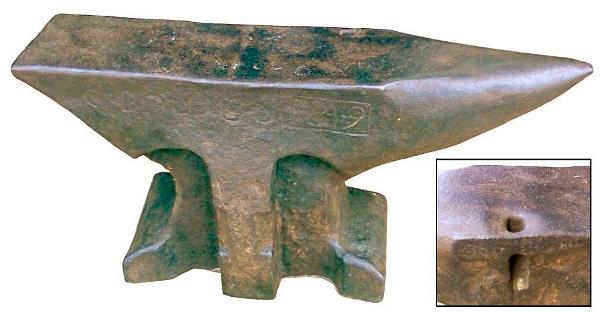 Signed old European anvil I picked up a couple rather unique "church window" anvils this weekend. This one is about 250lbs. and has a name and date inscribed on it (also note the placement of the hardy hole). The anvil reads, C : BOUIUS 1819 I am certain the first "u" is not a "v" since the bottom is distinctly rounded. According to Richard Postman (who saw it a couple of years ago), he feels the anvil is German and the name is one of the previous owners. He feels the date represents when that person obtained it rather than the date of manufacture. Does anyone have any information or an interpretation of "C : BOUIUS" ? What it might mean?" 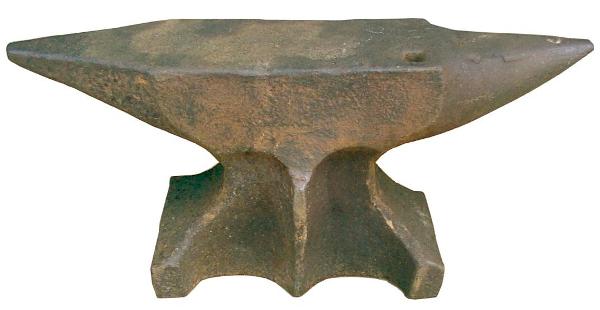 Old European double horned anvil This anvil is supposedly French in origin and is thought to be an armor-makers anvil. It weighs 414lbs. and has very deep "church windows" and is completely flat on the side opposite the "windows". Which means it could lay flat with the windows facing up to use them for dishing and rounding. Anyone have any thoughts? Take .lastname and put it after my first name to mail. |
| Paul P. - Monday, 05/10/04 15:36:32 EDT |
|
Another possible Armourer's anvil Note that this one also can be laid on its back. |
| - guru - Monday, 05/10/04 15:55:19 EDT |
|
Can you tell me what a red short heat is and how I would recognize its effects on a piece of iron? Thanks |
| Gary Hilton - Monday, 05/10/04 16:54:41 EDT |
|
Just out of curiosity, what would be the effect of "doping" the propane supply to a forge burner with bottled O2? Would it lower the propane consumption without degrading the performance of the forge?? What about adding acetalyne to the mix?? |
| HavokTD - Monday, 05/10/04 18:31:10 EDT |
|
Oxygen Enriched Forge: HavokTD, it would run much hotter as well as be more oxidizing. In gas forges oxidation is a problem and difficult to control. Adding oxygen would make it worse. Run a forge like an oxy-propane torch and you will have steel (and refractory) melting temperatures. Hotter gas is already available in the form of MAPP gas a mixture of Propane, natural gas (I think) and acetylene among other things. |
| - guru - Monday, 05/10/04 18:41:57 EDT |
|
would the oxidisation effect be compinsated for by the fact that the steel would be in the fire for a lot shorter time span?? |
| HavokTD - Monday, 05/10/04 18:46:15 EDT |
|
Wow, I need to learn how to spell, sorry about that, all. |
| HavokTD - Monday, 05/10/04 18:46:54 EDT |
|
Red Short: Gary, this is not a heat, it is a condition of metals where they are brittle and fall apart while worked at a red heat. It is usualy caused by improper alloying or oxide impurities. Metals that are red short need to be worked at higher temperatures than a red heat. |
| - guru - Monday, 05/10/04 18:56:45 EDT |
|
HavokTD, Since scaling is already a problem more O2 would probably make it worse. A LOT depends on the configuration of the forge, how much mass it has, preheat, available BTU. . . Many small gas forges do not have sufficient BTU to keep up with the heat loss and thus must be run hard and lean to get hot enough. Running rich reduces the oxidation but also reduces the temperature. Everything must be a balance. If you want a non-solid fuel forge that runs HOT and non-oxidizing you want an oil forge. These run on kerosene, #2 fuel oil and or diesel. They are much easier to run at a carburizing condition (rich) but they stink even worse when doing so. |
| - guru - Monday, 05/10/04 19:03:10 EDT |
|
Thanks, Guru. I was actually just trying to fgure out a way to cheap out on the fuel. :-) |
| HavokTD - Monday, 05/10/04 19:07:55 EDT |
|
MAPP Methane Acetylene ProPane |
| Paw Paw - Monday, 05/10/04 19:10:38 EDT |
|
MAPP...Methyl acetylene-propadiene mixture. |
| - Robert-ironworker - Monday, 05/10/04 23:26:26 EDT |
|
I have a titan gas Kerosene hit and miss engine in 1 HP.I bought it to restore.Both crank shaft babbet bearings are missing top and bottom.I would like to pour new bearings myself.where can I fine info on doing this project?I have babbet.I also have a tourch and a melting furnace and most everything I need.My dad use to do this but he is no longer alive.I am certain I have all the abilities to do this but need some directions.Thank You. George.... |
| George Cook - Monday, 05/10/04 23:44:56 EDT |
|
Forge blowers: Thanks for the info. Will save up for the stronger unit. ET |
| - Eric T - Tuesday, 05/11/04 00:49:00 EDT |
|
GEORGE COOK; All kinds of how-to info on babbit at Lindsay Publications |
| 3dogs - Tuesday, 05/11/04 05:25:48 EDT |
|
A few locations of info on babbit: http://www.jedc.org/wood/Spring_2000.pdf I saw a reference that said the Machinery Handbook had a section on it. I will have to look when I get home |
| Ralph - Tuesday, 05/11/04 09:42:06 EDT |
|
Babbiting: Older editions of MACHINERY'S HANDBOOK (1950's) have in depth articles about babbiting. Later editions have short articles. There are two ways. One is to fit the shaft, the other is to fit an undersized mandrel and then machine or ream the babbit to fit the shaft. The second method was probably used on the engine originaly. I will describe the first. Step one is to find a way to hold the shaft in perfect alignment. In old cast journals the alignment is probably NOT the center of the journals but may be. It will take some reverse engineering to find the alignment. Be sure the journals are very clean and oil free. Ocassionaly it is recommended to tin the journals first. But rough cast journals are usualy OK. SOOT the shaft. A candle works and so does a acetylene flame. The soot keeps the babbit from sticking to the shaft and provides oil clearance. It takes quite a bit of soot. Install and align the shaft. Then dam up the edges. Daming is done with daming compound, a heat sticky heat resistant clay. It also helps to use sheet metal cut to fit the shaft. Warm the shaft and housing gently with a torch. A cold housing will chill the babbit and prevent a good poor. Melt the babbit until it is hot enough to char a pine stick. Continue to warm the shaft and housing, putting more heat into the housing. Do not exceed the boiling point. Skim the dross off the babbit. Pour the bottom halves of the bearings and let chill. An uninterupted pour is best, keep pouring until the babbit stops shrinking and you have a raised surface (if possible). Remove the shaft and trim the bottom babbit flush to the case. Clean and resoot the shaft. Install in the lower bearings and seat with a wooden mallet. Install the bearing caps AND shims. You will need a fine shim set for each bearing a total of about .015" thick. These should ALMOST contact the shaft but not quite. Dam up the caps, heat melt and pour as above. Caps are usualy poured through the oil port. Those that do not have a port must be poured from the end which means having the shaft vertical and clamped in place. Remove the caps and shims. Drill out the oil port. Cut oil grooves with an oil groove scraper (you will have to make your own). A rough babbit surface is often hand scraped and the shims used to adjust the running clearance. This is real machine fitters art and VERY picky work. Often the surface of a poured babbit bearing has surface tension lines (like folds). There is not much you can do about these. For perfect bearings they use the mandrel and machining method to have bright clean babbit. The "machining" was often just a reaming process. But this took heavy alignment fixtures (which were often the pouring fixtures). Good Luck! |
| - guru - Tuesday, 05/11/04 11:22:57 EDT |
|
Guru - Thank you for the helpful advice, after some deliberation i've settled on building a single door freon-forge with a port opposite, now I have to figure how much kaowool to buy from your most helpful website :-) referring to Daryl's post: [I use just over 7 sq ft of kaowool. It would really depend on your configuration. I think 3"s might even be better,] configuration = what factors? Would another inch of insulation save enough propane(over the lifetime) to offset the extra cost and lost interior space? |
| David S - Tuesday, 05/11/04 11:43:20 EDT |
|
I've bought an old cast iron firepot and need some advice about how to make a useable forge from it, I've only used side blown forges before. It is a casting, 3/8" thick about 13"in diameter and is dished(about 3" deep) with a removeable drilled plug,3/4"thick, in the centre (It resembles the bottom of a propane tank). My problem is that it seems designed to sit on top of the forge floor rather than be bolted underneath. Has anyone encountered this design before? I've added a photo to the users gallery, the wrench in the photo is 15" tall. Thanks Bob |
| Bob G - Tuesday, 05/11/04 12:45:34 EDT |
|
Bob, That is not a "fire pot" that's an old flat bottomed rivet forge without legs and tuyeer. See the photos on the Kayne and Son store forge page for what a fire pot looks like. Good fire pots are 5/8 to 3/4" (16 to 19mm) thick. Also the image labled "delamination" is common texture found in anvils made of scrap. Many anvils including all the Mousehole forge anvils were made of welded scrap. In most anvils it doesn't show but ocassionaly there was a lot of trash in the billet and it eventualy corrodes out leaving the texture you see. When old anvils fail it is from bad forge welding. I have seen anvils broken nearly through the center where the welds were bad. |
| - guru - Tuesday, 05/11/04 15:05:09 EDT |
|
George, if your area has a Model A club, chances are they will have access to a mechanic who does babbiting work for the Model A engines. Other Antique Auto clubs would probably have the same access. I don't think the automotive shell bearing came into use until the mid 1930's..... |
| Ellen - Tuesday, 05/11/04 15:41:14 EDT |
|
Kaowool Requirements: I have built several of the propane forges from freon cans but have used scraps and did not closely account for how much was used. To put 2 layers in a freon can forge requires about an 12" x 24" piece to cut circles for the ends. The scrap is used to make the pieces in the ends under the circles by tearing and fitting. Then about two feet by 24" is needed to fill the sides twice (with some left over). So that is three running feet more or less. Propane tank forges are larger and require a little more. I would not try to put three layers in a freon can but three will fit in a propane bottle. Besides the Kaowool and ITC-100 you need a hard refractory brick or two for the floor. In my freon can melters I fit a half of a full thickness or half thickness fire brick into the bottom for the floor. There is 1 to 2" of kaowool underneith and scraps fitted around the square to fill. In forges you want one full layer of kaowool on the sides then a half thick brick floor and then another layer of Kaowool from brick edge to brick edge. The Ron Reil plans call for standoffs supporting the brick but I have had no problem without. It does help to use scraps to fill in between the curve of the tank and the flat of the bricks. You can split the Kaowool into thin pieces for this. A pint of ITC-100 will do several small forges or one large forge and then touchups. Coating the metal surfaces that are going to get hot with ITC-213 will prevent oxidation, reduce rust and act as a primer for ITC-100 if used to glue refractory such as kaowool to metal. |
| - guru - Tuesday, 05/11/04 15:44:44 EDT |
|
Babbitt site: http://www.anvilmag.com/smith/011f2.htm |
| - Mike - Tuesday, 05/11/04 16:38:43 EDT |
|
David S. I think the Guru has answered your questions. 3"s of Kaowool would add to the insulating value of your forge but the biggest energy saver is the ITC, there is also the trade off in inside dimension that you mentioned. I am making and relining some forges now, I would gladly send you some pictures. I am not saying the way I do things is right or the last word. As for material prices, the store here is better than anything I have found in Canada. If nothing else buying here may help keep this site up. I would rather let the Guru answer your questions, I find he gives well thought out answers. I may know that "A" works and "B" doesn't, but not the reason why. |
| - Daryl - Tuesday, 05/11/04 17:27:16 EDT |
|
hi,im an artistic blacksmith in england & have been following the iforge online stuff avidly-my up most praise to all involved- but my question is are there going to be any additional lectures in 2004? |
| matt - Tuesday, 05/11/04 18:14:38 EDT |
|
Matt, We hope so, but a lot of work needs to be done first. CSI could use your help. Click on the link at the bottom of the page for more information. |
| Paw Paw - Tuesday, 05/11/04 18:29:42 EDT |
|
Seems to me that using oxygen rather than air in a forge could make it significantly more efficient. Air is 80% nitrogen, all of which has to be heated to forge temperatute before it's blown out in the exhaust. You might need a very different forge design because of the smaller, hotter flame. I rather doubt you'd save enough propane to pay for the oxygen, though (air has its drawbacks, but it's hard to beat on price). By the way, I'm not sure what Havok meant by "doping," but mixing fuel and oxygen anywhere before it gets to the burner is liable to, well, wreak havoc. |
| Mike B - Tuesday, 05/11/04 19:30:32 EDT |
|
Gas Forges with Air - Some years ago, I modified a Sandia naturally aspirated design by putting a blower on it. In the process, I attached the mix manifold to the chimney back and ran the feed tubes thru the chimney flue so I get some preheat on the mix. It worked well and I am still using it daily. One day, I took the cutting torch and shot some oxygen into the blower intake just for kicks. It made a hotter spot on the floor under the burner but the scale on the steel was so heavy that it looked a little like cutting slag. This was obviously not a scientific test but I suspect a 1/8 or smaller tube attached somewhere in the mix line with a regulator set on very low pressure would allow some adjustment to the flame. It's similar to playing with the mix in a carburetor. |
| - HWooldridge - Tuesday, 05/11/04 20:03:05 EDT |
|
iForge demos: we have a few waiting in the wings. Currntly the problem is TIME. iForge demos take a full 10-14 hour day to prepare, demo and edit. I now spend over half my available time tending to the store and paperwork (bills, stock orders and such) in order to keep things going. I would prefer to be writing articles for anvilfire. This is also going to be a busy travel and NEWS year. We have had one issue of the news covering the Boone HammerFest and NC-ABANA at Oak Hill Ironworks. Another editon is in the works covering the West Virginia Armour-In this weekend and Paw-Paws Mini Hammer-In in NC. After that we have Camp Fenby and the ABANA Conference! Thent there is a slight gap and in October I have a big week long demo with Paw-Paw in Norris TN and then will possibly be going to SOFA Quad State the week before again. . . I also have a dozen book and video reviews waiting to be produced and posted. For over three years the anvilfire workload has been such that I have needed an office manager/secretary. The problem has been mounting daily but there is no money. So some things are not updated as often as I would like. Hopefully the new CSI initiative to become a legal non-profit entity will open some doors. Until then, I just plod along. |
| - guru - Tuesday, 05/11/04 20:36:16 EDT |
|
Hwooldridge, I adjust the mixture on my atmospheric forge almost exactly the way you describe, except I add propane, not oxygen. |
| Mike B - Tuesday, 05/11/04 21:17:02 EDT |
|
Mike, Yes, that's also how I put in propane on my forge - with a small line just after the blower. I was suggesting a second line with O2 to anyone who wanted to play with it. |
| - HWooldridge - Wednesday, 05/12/04 00:06:27 EDT |
|
I would think you'd need a number of small burneres with a hot flame, instead of one big burner. I don't know if the oxidisation would still be a problem. This is still sort of a mental exercise for me, at the moment. Wanted to come up with a few different options before I tried building a forge myself. |
| HavokTD - Wednesday, 05/12/04 01:56:06 EDT |
|
Hi Guys I have a problem can anyone help while forging some damascus (Chainsaw)I flux the job well some might say excessively but when I take it out of the forge and brush the flux off before hammering I try to brush before refluxing and returning to the forge but by then my brush (wire) is useless as it has become one big solid lump of flux and I have to stop forging to smash all the solid black flux off the wire bristles and then my billet has lost its heat how do you guys cope with this problem othe than an endless supply of brushes or an assistant who's job is just cleaning wire brushes as fast as we clog them up. any info greatfully assimilated. Derek |
| Derek - Wednesday, 05/12/04 12:38:14 EDT |
|
Do you know of a source for parts, particulary bearings and an oil seal of a Champion 400 forge blower? If not, how have people been able to recondition them? maybe replace the threaded axle? and use standard bearings? Thanks, Marcus |
| Marcus Wynn - Wednesday, 05/12/04 13:37:16 EDT |
|
Do you know of a source for parts, bearings, and oil seals for a Champion 400 forge blower? Thanks, Marcus |
| - Marcus Wynn - Wednesday, 05/12/04 13:41:24 EDT |
|
Do you know of a source for parts for a Champion 400 forge blwer, kparticularly bearings and an oil seal? Thanks, Marcus |
| - Marcus Wynn - Wednesday, 05/12/04 13:42:46 EDT |
|
Marcus-2 points. A) This is a bulleten board, not a chant. Be patient. B) Check the archives. Blower part questions come up often. |
| Nomad - Wednesday, 05/12/04 14:02:37 EDT |
|
Derek, Sounds as if you are using way too much flux. My wire brushes are never clogged with anything ... well perhaps grass or other stuff if I drop them on the ground.....(g) |
| Ralph - Wednesday, 05/12/04 14:24:41 EDT |
|
Parts for Champion 400 forge blower? source? |
| - Marcus Wynn - Wednesday, 05/12/04 14:30:27 EDT |
|
yes Ralph I think I must be the bottom of my forge is a pool 1/4" deep I am suprised that my refractory base hasn't disolved apparently its pretty well impervious to the stuff I used foseco's pyrocrete 165,for the base and glass matt similar to kaowool and ITC's 100HT for the top of the forge the wire brush (steel bristles) has big black lumps of what look like coal stuck to them when I smash them with the hammer it pulverizes like black glass oh well I'll plod on I spose thanks for the answer mate. ATB Derek |
| Derek - Wednesday, 05/12/04 14:39:19 EDT |
|
Web site's lookin good jock, its been awhile. I've been doing some sculptural work with copper wire from 18 to 8 gauge and ive met with SOME success fuzing pieces together with mapp gas torches ( one fixed, one in the hand) however it's hard to predict how the copper will behave when it already has been heated for annealing or color purposes and sometimes when it looks ready to puddle up it fizzes and begins to break down in what im guessing is a reaction having to do with oxidization. I would appreciate any helpful advice you could give me on the behavior of copper and the use of different parts of a mapp gas torch flame. Thankyou. |
| AdamSmith - Wednesday, 05/12/04 14:40:44 EDT |
|
Derek, look in the FAQ's - A bunch of us got into mtrcycle chain damasus a cpl yrs ago. |
| Ron Childers - Wednesday, 05/12/04 15:03:22 EDT |
|
Hi Ron I'm not having trouble welding only with brushing off the flux Borax one swipe with the wire brush and i have to put down the billet and clean of the brush I know about the motorcycle chain but here in aus you cannot get chain that doesnt have o rings almost every bike comes with them as standard now and there aint that many old bikes ere besides I find you get a finer pattern with chainsaw blades just my opinion you understand others wiser than I may think otherwise. best rgds Derek |
| Derek - Wednesday, 05/12/04 15:27:23 EDT |
|
just outta curiosity, why can't you just toss an o-ringed bike chain in the fire, and burn'em out? they're only rubber, right? |
| HavokTD - Wednesday, 05/12/04 17:57:52 EDT |
|
Marcus Wynn: Speaking as one Marcus to another, let me give you some advice. READ first, post second. As someone has already noted, this isn't a chat room. You've asked your question four times now, and there's almost certainly an answer in the archives if you were to do a search. Secondly, here's the answer you are looking for: There is NO source for the parts you are speaking of. I have two of those blowers myself. Your best bet is to find a second blower and hope to come up with enough parts to make one good one. Regarding the oil seal, however, it is important to note that all of these blowers leak oil to some degree, and they aren't designed to be completely filled with oil. You'll need to oil the blower every time you use it, and maybe more frequently than that if you put in long days. (the other) Marcus |
| tanix - Wednesday, 05/12/04 18:07:03 EDT |
|
Dear Guru, I am looking for an innovative quench liquid, to cool large "castings" from 1300F to room temperature as fast as possible. I do not want to use water based quenchants, as the quenchant usually forms steam pockets in the deep part recesses. The steam reacts with my "casting" and forms hydrogen defects. I've tried several oil based quenchants, but the oil usually catches fire near the part as it is being lowered into the quench liquid. Aside from the fire issues, the oil usually forms soot on the roof, and a carburized coke layer on the surface of the tank. Do you have any innovative ideas for a liquid I could use? Ideally it has high heat capacity, is a good conductor of heat, and very high flash point. I am looking for a faster quench than standard oil products. I've tried a fluid bed of fine particles to cool the "casting", but dead spaces in the pockets results in slow cooling. Thanks, Steve K. |
| Steve Kenner - Wednesday, 05/12/04 18:29:47 EDT |
|
Dear Guru, I am looking for an innovative quench liquid, to cool large "castings" from 1300F to room temperature as fast as possible. I do not want to use water based quenchants, as the quenchant usually forms steam pockets in the deep part recesses. The steam reacts with my "casting" and forms hydrogen defects. I've tried several oil based quenchants, but the oil usually catches fire near the part as it is being lowered into the quench liquid. Aside from the fire issues, the oil usually forms soot on the roof, and a carburized coke layer on the surface of the tank. Do you have any innovative ideas for a liquid I could use? Ideally it has high heat capacity, is a good conductor of heat, and very high flash point. I am looking for a faster quench than standard oil products. I've tried a fluid bed of fine particles to cool the "casting", but dead spaces in the pockets results in slow cooling. Thanks, Steve K. |
| Steve Kenner - Wednesday, 05/12/04 18:30:01 EDT |
|
Derek, I would suggest that you cut WAY back on flux. You may find your welds are cleaner and the end result ( pattern in the billet) will have far fewer inclusions and be much nicer all around.... |
| Ralph - Wednesday, 05/12/04 18:32:26 EDT |
|
Steve K. , Could you be lowering the parts too slowly into the oil? seems as if it were covered quickly you will have less likelyhood of having it flame up. of course I do not quench complex costings and usually parts I quench are less than 1 inch in thickness so it may be different. |
| Ralph - Wednesday, 05/12/04 18:37:19 EDT |
|
HWooldridge, I guess part of my setup *is* like the one in a blown forge, but most of my propane goes through a fixed orifice and pulls a (hopefully) proportional amount of air through a venturi. In other words, a typical atmospheric burner. I've added a second propane line on a separate needle valve so I can bleed in extra gas without pulling in extra air. Your reference to playing with the mix in a carburetor made me think of my setup. |
| Mike B - Wednesday, 05/12/04 19:49:40 EDT |
|
Derek, Most of the guys I know who make chain damascus (and cable damascus), don't wire brush the flux off. They pull the hot billet from the fire and just give it a quick flick of the wrist to sling off the excess flux. If you're using plain borax, it will be liquid enough at weldiing heat to flow right off when you swing the billet quickly. Naturally, you want to know what is going to be in the path of the flying molten flux. |
| vicopper - Wednesday, 05/12/04 21:05:57 EDT |
|
All, I'll be out of town from tomorrow morning until either late Sunday evening, or Monday morning. Y'all behave while I'm gone, I don't want to have to spank anyone when I get back! (grin) |
| Paw Paw - Wednesday, 05/12/04 21:07:28 EDT |
|
Oxy-Propane forge: Ideally, a forge flame should be neutral or VERY slightly off neutral. It doesn't really matter whether the flame is air/propane or oxy/propane or something else, the objective is to have the flame, and the forge atmosphere, as nearly neutral as possible to avoid excess scaling. While air/propane does have a lot of nitrogen in it, the nitrogen is inert and doesn't contribute much to scaling. It does consume some BTu's to heat it, but if yo are reaching a welding heat, then you are getting sufficient heat. The specific heat of nitrogen is very low, much lower than that of the forge body, the steel and anything else in there, so it takes very little extra fuel to heat it. If you use oxy/propane, you won't have the heat loss from heating the nitrogen, but you will have a very hefty oxygen bill. And any imbalance in the ratios will result in a VERY oxidizing flame very quickly. Furthermore, the flame temperature of oxy/propane is so high that you will face a possible problem of spot overheating of your stock and/or your forge lining. One factor that can dramatically improve the overall efficiency of a forge in moderate to heavy use is the residual heat storedin the forge body. Firebrick or kiln shelf floors and/or walls take extra time to heat up from cold, but they hold a large amount of heat that offsets the loss from the nitrogen in air. Furthermore, that residual heat heats the metal by radiatant heating and by conduction with no effect on scaling. Relying on the flame/atmosphere in a forge for all the heating means you are relying on a potentially oxidizing heat source, and one with a relatively low thermal mass. While you are transferring heat to the stock, a lot of heat is being vented along with the exhaust gases. Now THAT is wasteful. |
| vicopper - Wednesday, 05/12/04 21:20:01 EDT |
|
We'll be good top soldier.How many brownie points does a tattletail get? Enjoy yourself, stop at Stuckey's. |
| - Ritch - Wednesday, 05/12/04 22:17:48 EDT |
|
Ritch, Brownie points? For a tattletale? Negative 10 for every report. (grin) |
| Paw Paw - Wednesday, 05/12/04 22:31:23 EDT |
|
Steve Kenner - I've been a metallurgist for 30 years, ran a in plant heat treat shop for a steel mill, worked for an industrial gas company supporting atmospheres for heat treating - I've seen a lot of different setups for quenching - when using oil, some flame is fairly common until the part or parts is fully immersed in the bath. If its a complicated shape with dead areas, you need some sort of super agitation to get flow into the pockets - commercial heat treaters use baths with venturis, pumps, etc. to get significant agitation. If you still have dead areas you'll get pockets where the material won't quench due to the quenchant going to vapor, and the vapor not being an efficient heat transfer medium. The only options I'm aware of for quenching are: oils, water, water based quenchants such as brine or with polymer additives or air. If you want to austemper then some salts, lead etc. come into play. From my viewpoint, if you're getting dead pockets, I'd suggest going to an alloy that can be quenched in still air to meet your hardness requirements - hard to gues more without detailed information on the part. |
| - Gavainh - Wednesday, 05/12/04 22:32:36 EDT |
|
Thought on Quenchant This is going to be way out there, but here goes. Tin. Tin has a melting point of ~230°C and a boiling point of ~2600°C. Quench in molten tin, then oil. This sounded crazy when it ran through my head but... |
| Shack - Wednesday, 05/12/04 23:07:13 EDT |
|
greetings! what a cool site. i just want to ask if i can make spring steel from a 1085 or 1095 steel by heat treatment. thanks! more power to you guys! |
| Richard - Thursday, 05/13/04 03:02:45 EDT |
|
Richard; Yup, you can make fine springs out of 1085 by heat treatment. "Spring steel" as a term,is usually one of several specific alloys made especially for that purpose but for most uses the diff is almost academic. Unless you meant steel that was made in the spring time..that can be identified by having someone with severe hayfever sniff it for 35 minutes nonstop, then counting sneezes. |
| - Pete F - Thursday, 05/13/04 05:28:04 EDT |
|
Steve Kenner, I too am a metallurgist, although my experience is about one tenth that of Gavainh's. In my shop we quench large forgings-20,000 lbs at times. Due to the heavy cross sections and customer requirements we have a quench tank that has many of the features Gavainh described. Our tank holds 50000 gallons and the agitation can be varied from mild to very high. For some critical parts we have developed fixtures that allow us to direct a stream of quenchent down the bore, thereby eliminating steam pockets. We use either water or polymer based quenchents because we to have found oil quenching to be hazardous. In your case my suggestion would be to find a way to get qeunchant into the "dead" areas you describe rather than look for a faster quenchant. A faster quench will not impove the properties of the dead areas because you will still get steam/vapor pockets there. One method you might try is a spray quench, This might provide you with the oportunity to completly flood the part by directing the nozzles into those normally "dead" areas. As Gavainh said, w/o more details thats the best I can do. Patrick |
| Patrick Nowak - Thursday, 05/13/04 08:34:20 EDT |
|
Havok: No. Hang the chain doubled, heat it red with a torch with a fan blowing the smoke away from you and when the "O" rings crumble, brush clean with a wire brush. You need to go ahead and use it before the chain rusts and gets too stiff to work with. Derek, If you whack the billet against something hard, some of the gook should sling off. Then dip it quickly in water and more of it will pop off. Whack it on the edge for adl descaling then go to the belt grinder. |
| Ron Childers - Thursday, 05/13/04 09:09:28 EDT |
|
Shack; somehow I don't think those are supposed to be minuses! Course if you are getting temps more than 2000C below absolute zero the acadamy of sweeden wants to talk with you! Thomas, still grouchy with a tooth ache |
| Thomas P - Thursday, 05/13/04 10:29:18 EDT |
|
Fast Quenches: Steve, The best have answered you question now I will put in my two cents. First, metalurgical quenches rarely need to go to room temperature. They only need to get through the transition phase in the required time. After that the part can air cool. In ferrous alloys that require tempering it is best NOT to allow them to reach room temperature before tempering. This avoids thermal shock AND saves energy. If you are trying to solve porosity problems in a non-ferrous casting then you should consider chills in the mold. I've made zinc castings where the chills were cooled via a heat sink at the same time the rest of the mold was being heated to prevent misruns. Directed or spray quenches have been used since the later 1800's. It was required to make a solid tool steel anvil. Falling water from a mill sluice was used and later pumped water. Very large volumes were required. There have been ocassions when water based quenches required ice water or iced salt water to do the job. However, often the problem is volume and resupply of quenchant. Industry has solved that problem largely with refrigeration and other cooling systems. The only problem is a matter of scale. If the system is not big enough for the part then you need a bigger system. It ONLY money. . . not a technical problem. Liquid metal has been used for tempering and for quenching. Lead in particular. Salt baths are now more common. You did not say what how big (large is relative) or what alloy. I suspect that you have a badly designed casting. Parts that must be heat treated by quenching (in fact all castings) should be carefully designed to avoid big changes in thickness. Where ribs meet a surface it creats a large mass that must often be reduced from the back side with a depresion that looks like a shrink. If this is to be a finished surface then you just have to eat having a larger machining allowance. Ribs that meet are worse and it is recommend they be offset and not meet at the same place (see any book on casting design). Sometimes extra mass is used where you need a thin section and it it then the extra machined off. Sawing can be very efficient. Often a redesign is the only solution to heat treatment related problems. |
| - guru - Thursday, 05/13/04 10:47:33 EDT |
|
Thomas. . . those were tildes used as an approxiation mark! Check you glasses ;) |
| - guru - Thursday, 05/13/04 10:50:35 EDT |
|
I am not technically a smith, but make knives via stock-removal. My question, however, revolves around steel, and you guys seem to know what you're talking about. I have a large supply of big diamond-edge concrete cutting blades. Some are about 21" diameter, and some larger. Most are about 3/16" thick. One person told me it's probably 4130 or 4140 steel. I've experimented with it in various ways. I first cut some test strips, heated them up to non-magnetic, and quenched them in oil. They snapped pretty cleanly in the vise, with a fine grain. So I made a knife, quenched it in oil, gave it a temper, and it just didn't seem to hold an edge. So I made another one, and quenched it in water. No tempering. A new file skates across the surface with almost no bite, and I can't drill it. I cleaned up the blade and did some cutting tests, and it seems to be as good as anything I've worked with. Does anyone know more about this steel, and if I'm going to be disappointed using it for knife stock? Thanks! |
| - Mark - Thursday, 05/13/04 12:38:13 EDT |
|
Mark, See our Junkyard Steel FAQ. These are the kind of parts that will be different steels from different manufacturers and may not be the same this year as last. These steels are specified by performance and bought by price. Even is somone knew EXACTLY what alloy one maker used in 2002 it would not apply to other manufacturers and years. Many things of this type are made from medium to medium high carbon steels (40 to 60 point carbon). All these steels will harden plenty hard but they may not have the toughnes you are looking for at a particular hardness. It was not an edge steel, it was specified for toughness. Using scrap steel is always a gamble. I never saw a decent hand made knife that making it from the best NEW steel would effect the price or the profit margin. But it will certainly effect the quality. |
| - guru - Thursday, 05/13/04 13:25:04 EDT |
|
Saw Blades - Saws were made of premium steel when the teeth were an integral part of the blade but the trend toward carbide and other applied tip applications has allowed manufacturers to use cheaper materials in the body of the blade. This makes a better sawblade for the intended use but not as good for the scrap content to a knifemaker. |
| - HWooldridge - Thursday, 05/13/04 13:38:21 EDT |
|
I apologize; the do look like tildes on "the big screen" probably not so much a glasses issue asa low res monitor issue...there goes the nobel prize... Thomas |
| Thomas P - Thursday, 05/13/04 14:07:49 EDT |
|
Two observations on gas forges from a dedicated coal-fired smith: I have watched a few pro knifemakers working with their forges. All have used blown rather than venturi forges. Why? Ease of adjustment and low fuel consumption. Is your mix lean? add more gas. Rich? add more air. Not hot enough? add more of both. I've seen a very large blown forge run hot enough to melt the kaowool on about 3/4 (that's three-quarters!) of a PSI of propane. Another advantge of a blown forge is you can siphon off some of the air blast (before the gas injector) to create an air curtain across the door, dramatically reducing dragon breath. One well-known smith, when he wants a highly reducing atmosphere and doesn't want to bother with adjusting the air/gas mix, tosses a handful of wood chips in the forge every time he puts the steel back in the fire. Think outside the veturi. |
| Alan-L - Thursday, 05/13/04 15:31:25 EDT |
|
Errata for the above post: advantge = advantage, veturi = venturi. PROOF, then post... |
| Alan-L - Thursday, 05/13/04 15:33:26 EDT |
|
Would old truck parts have any use? I have alot laying around and old oil barrels? Thanks |
| - Bucky Bo - Thursday, 05/13/04 15:57:47 EDT |
|
Bucky Bo: Old truck parts and oil barrels have lots of uses, what did you have in mind? Fixing trucks and holding oil come to mind. ;) Springs and suspention bars tend to be good high carbon steel for tools, axles are good for hammers, small anvils, and other stuff, the aluminum parts can be melted and cast, and I'm sure uses could be found for lots of other parts. Cast iron is probably the least useful steel in a truck, but even that can be useful if you're into the right stuff (the cast iron can be used in smelting to make higher carbon content). Barrels can be used for quench tanks, anvil stands, charcoal retorts, forges, garbage cans, etc. Good luck making use of your junk. :) |
| AwP - Thursday, 05/13/04 16:18:18 EDT |
|
Red Hot I was wondering if all materials glow the same color at the same temp. Is cherry red steel the same temp as cherry red brass and the same as cherry red fire brick etc? |
| Shack - Thursday, 05/13/04 16:33:50 EDT |
|
Yes, something to do with black body radiation I think. But there should be a better (and more accurate?) explanation along soon! |
| Nigel - Thursday, 05/13/04 17:15:09 EDT |
|
THOMAS: Try extra strength Anbesol. Good stuff fer yer sore toofie. It's benzocaine, the same stuff the dentist smears on your gums before he hits you with the needle. Works fer me. I feel yo' pain, Brother. |
| 3dogs - Thursday, 05/13/04 18:25:16 EDT |
|
Hi all, Just wanted to introduce myself. Hobby smith, small work area, but I have a ton of fun doing it. Enjoy this forum and the info that's availaible here, so I joined CSI to help support it. Thanks! Aaron |
| AaronHoldg - Thursday, 05/13/04 19:02:56 EDT |
|
Bucky Bo, As AWP noted there are many good bits in old trucks. As for old drums, do you know what they held? If not, the probability is that there are chemical residues that are lurking inside. Tread with care, lest methlyleethyledeath bite you, or your loved ones. I would always caution persons seeking to reuse drums to ONLY use those that have the original content labels still readable. By the way, plastic drums are often the ones with the nastiest previous contents. Good luck |
| ptree - Thursday, 05/13/04 19:26:14 EDT |
|
AaronHoldg, Welcome to the generous brotherhood of smiths that make this site possible. |
| ptree - Thursday, 05/13/04 19:28:45 EDT |
|
Welcome Aaron, That blue lettering on your name looks great doesn't it! And now you can check out the members forum and see whats been going on, and don't forget to post there too and introduce yourself, etc. |
| JimG - Thursday, 05/13/04 19:57:56 EDT |
|
I found an anvil made by BNC in a junk shop. It is a cast anvil with a weight of 198 lb.s. It has a 1 inch hardy hole, but no punch hole. I would like to find out some information about the anvil. |
| head - Thursday, 05/13/04 20:19:49 EDT |
|
My question is about Hossfeld Benders: The first hole back from the main (center pivot) pin is smaller than all the others. On some benders it is tapped out to 3/8" NC; on some benders it is about 7/16" thru. What's this small hole used for? |
| - Jim C. - Thursday, 05/13/04 20:29:19 EDT |
|
Hi, my question to you is, what is the process to make new galv. sheet iron look rusty. I have thought about muratic acid in a diluted form,or just plain old vinegar.What is the fastest way to make this process happen? Any info will be very helpful. thanks and have a great day. |
| bud - Thursday, 05/13/04 20:42:04 EDT |
|
Galvanized to Rust: Bud, the point of the galvanizing is to prevent rust. When the zinc coating oxidizes it turns grey then white or if oily black. To make rusty you would have to strip the galvanizing. It would take a LOT of acid. The best thing to do is by new clean sheet. |
| - guru - Thursday, 05/13/04 20:49:34 EDT |
|
I have just had built an ornate table stand using flat bar steel. I would like to permanently blacken it to look like the finish on wrought iron steel gates. I'd appreciate your advice. Thankyou Robert |
| Robert - Thursday, 05/13/04 21:00:09 EDT |
|
Hossfeld Hole- Jim one of the pins has a smaller tab on the curved over end which you insert into that hole for eye bending operations on very thin stock. I'm sure it has other uses also but I can't check my manual as I loaned it to somebody. Thanks for reminding me to ask for it back! Welcome, AaronHoldg I hope lots of folks folow your example. |
| SGensh - Thursday, 05/13/04 21:01:54 EDT |
|
Hossfeld Bender: SOMEWHERE in all my junk I have a Hossfeld Catalog which shows all the die setups. Some bend around the center, other are used like press dies. OK Looked at mine. . That hole is for the circular gauge ring to bolt to. It bolts on there and beyond the last hole. |
| - guru - Thursday, 05/13/04 21:05:21 EDT |
|
VICopper I thought your explanation of heat in gas forges was both accurate and well-put. Just one thing to quibble with. I don't think it's really accurate to compare the specific heat of the nitrogen to that of the forge body. The forge body gets hot and stays hot, but the nitrogen keeps changing. I think a more valid question would be how much heat is conducted through the forge walls and lost to the atmosphere versus how much comes out the exhaust. Not exactly scientific, but I can get my hand a lot closer to the side of my forge than I can to the open door. Of course there's radiation too, but no nitrogen could mean an 80% smaller vent area, and maybe correspondingly less radiation loss. I still agree totally with your conclusion that using oxygen would cost much more, not less, though. Of course, I'm slow to catch on to things sometimes. After years of reading your posts, I've only just realized that the second part of your nickname may not relate only to your skill at working non-ferrous metal. |
| Mike B - Thursday, 05/13/04 21:17:54 EDT |
|
I’m in my second year of smithing, and have made a number of the projects from the iForge, and I’m quite fond of the roses. I have made two using the pre made petals and riveting them in place. But I find myself making far more using the “Russian rose” method. I upset the rod and use a monkey tool to square the bulb before drawing out the stock for the petals; the ones that don’t end up in scrap heap are gorges! So hears my question, have you or another smith made one out of Damascus using this method? I love the look of Damascus and have made a number of knives and swords using different patterns, and think it would pout a beautiful twist on a traditional peace. I would be grateful for your any feedback you might have. |
| Kevin Brown - Thursday, 05/13/04 21:34:24 EDT |
|
Welcome Aaron, glad to have you aboard. Anyone else ready to join CSI and help keep anvilfire.com alive? |
| Nomad - Thursday, 05/13/04 21:58:19 EDT |
|
I would like to know what are your alturnitives to a anvil?I'm just a hobbyist and dont want to have to buy an exspensive anvil.Also what is a good first project?thanks for all the help |
| - John - Thursday, 05/13/04 22:04:41 EDT |
|
Mike B, I'll agree with you on all counts. True, the nitrogen form th eair is continually being lost and replaced, but the specific heat is so low that I doubt that the loss is overwhelming. Definitely significant, but cheaper than O2. We agree. As for loss through conduction of the forge walls, that is a function of the R value of the insulation and its thickness. Probably considerably less than that lost to "dragon's breath", though I have no hard facts to back that up. Having a smaller vent area would mean less heat loss through venting, but it would also mean fighting harder to get stock through the access area/vent. If you can put stuff in the forge and close the door, then less vent area would probably make a pretty noticeable difference. Enough to pay for the oxygen? I doubt it, but no dragon breath would be a real plus. However, you still have to have some vent area, and the vent gases might be really, really hot if you use oxy/propane. Might be a break-even situation. I think the real goal should be to get the burner(s) adjusted as perfectly as possible so that the atmosphere is right and the exhaust velocity/volume is as low as is consistent with developing the required heat. Again, more and better insulation will make a big difference. I have also noticed that having a few chunks of broken kiln shelf or firebrick in the forge makes for a more even heat and a less oxidizing atmosphere. I suspect the the additional surface area of radiant objects is consuming more excess oxygen and re-radiating more heat to the work. I have come to believe that having a significantly turbulent flow through the forge is a good objective rather than a negative. Just like a slow blast in a solid-fuel fire will give a less dirty fire. Lastly, you surmise correctly regarding my online cognomen. I am a law enforcement officer in the Virgin Islands when I'm not beating iron or pontificating about abstruse subjects. The former is more profitable, the latter two are more rewarding in other ways. (grin) |
| vicopper - Thursday, 05/13/04 22:06:12 EDT |
|
Oxygen & Forges - In my misspent 30 years part of it was as an engineer in Industrial gases + 1 disastrous year as a consultant with a reheat furnace manufacturer - learned a lot, but not a lot of fun. With Airco, I did a lot of support of oxygen enhanced combustion - sometimes it was tweaking an existing system with up to 10% O2 bled into the total combustion air. Other times, it was using an oxy-fuel burner to assist the heating process. Things that happen with increased oxygen - 1. Flame temperature increases, gas use drops, more NOX is created. Ususally the decrease in gas use would not pay for the cost of the oxygen. (and that's at a cost of $.20/100 cubic feet a fairly typical cost at the time for a large industrial user.) When coupled with a desired production increase through existing equipment, it often paid for itself. 2. Oxy-fuel burners were usually associated with melting projects when they were associated with metals - a typical application is to place one or more in the cold spots of an eletric arc furnace to help melt the charge - basically think of an oxy-natural gas torch with a tip opening of 2" to 4" - impressive in use. Again - much higher flame temperature - NOX generation may be a problem, higher productivity & natural gas cost versus electricity costs were another factor in the equation. The more odd-ball applications were things like putting an oxy-waste fuel burner in as an assist to a cement kiln - again, more productivity, one positive aspect was that you could use contaminated waste oils - temperature and dwell time in a cement kiln was high enough to break down nasty organic chemicals such as dry cleaning fluids to the constituents of oxygen, carbon dioxide, water vapor, nitrogen, etc. (Note the only time I ran a trial on this was using waste oils from restaurants.) Good chemistry & good use but feedstocks were often erratic, and once someone tied in a feedstock they could see prices go from negative(paid to take and get rid of it) to positive. Sorry if I've rambled a bit much - just general experience with oxy-fuel. |
| - Gavainh - Thursday, 05/13/04 22:38:46 EDT |
|
Hossfeld answers - thanks for the help. |
| - Jim C. - Thursday, 05/13/04 22:59:55 EDT |
|
Ten Hammers, I just broke down and bought one of the top of the line Jackson autodark helmets you mentioned on Sunday. $309. Actually, my wife was along and approved the purchase. Recently bought a plasma cutter and needed something a smidge darker than #5. With it set on the "torch" setting, it works well on the plasma with my sensitive eyes. I use shade 12 for welding unless it's low amp Tig. The best autodark helmets have 4 light sensors. Not one or two. Less chance of not darkening I'm told. I think it was worth the $309. No matter how hard I try, occasionally I flash myself in the process of setting up the torch or flipping the old manual helmet down. After using the new helmet for 10 minutes, I was not lifting the helmet anymore. With the big view area and as light as it gets when not welding, no need to lift up the helmet even when welding under the truck inside the garage. It's supposed to go dark in 1/25,000 second, but I just set up my torch position, strike/start the arc with my eyes closed and open my eyes to a darkened helmet. No lost weld position and no eye flash. I am gonna seriously kick myself in the butt the first time I drop it on the floor though. I don't know what I'd do without my vision, and the new helmet with the eyes closed at arc start seems like it will help my chances to see longer into old age. I know too many weldors with the center of their vision burned out. I've been watching and using others autodark helmets for quite some time and I think they are now where they need to be. Personal opinion. Now to add supplied clean air to it for best lung protection and away we go. Oxypropane flame will be far more expensive than air/propane. The amount of heat the nitrogen takes out is considerable though. Oxygen should only be used with nozzle mix burners for safety reasons. An Oxypropane flame with proper mixing can be set to reducing and avoid the scale issue. Getting the proper mixing with the right ratio is the key. Not easy to do in a home built venturi burner. |
| - Tony - Thursday, 05/13/04 23:22:22 EDT |
|
Last Note on Oxy Assist - Or lack of: Since the 1700's it has been a well known fact that fuel efficiency can increased tremondously by scavaging lost heat. Preheating the intake air and fuel with the exhust gas save a LOT of BTU that goes into heating them from room temperature (or less). This is called a recupritive forge or furnace. Note that you NEVER preheat the fuel air mix! AND preheating the fuel requires some careful engineering but is done in some cases. But preheating the air is relatively easy and can be done on solid, liquid and gas fuel furnaces. A thin walled stainless steel heat exchanger can easily raise the intake air to 50% of the exhust temperature. Increasing the intake air temperature can raise the furnace temperature by 100's of degrees F. This can be the difference in achieving welding heat or not. Although the heat exchanger is an additional cost it is a ONE TIME cost. Good recupritive design often uses a shell outside the furnace to pick up heat AND to help cool the furnace shell. Note that one must be careful NOT to recirculate exhust fumes into the burner. This creates copious quantities of carbon monoxide. Damascus Flowers: Kevin, Many pieces of art are produced in laminated steels. For artistic purposes pure nickle is often used with mild steel or pure iron. This produces the maximum contrast. High carbon steels are not needed since the pieces are art, not blades. There are some fine examples in the Dona Meilach book, Decorative and Sculptural Ironwork. See our book review page. |
| - guru - Friday, 05/14/04 00:57:38 EDT |
|
The ARMOUR-IN: I will be on the road tomarrow (Friday) and attending the WV Armour-In this weekend. Was very interesting last year and will report more in the NEWS next week. See ya'll on the flip side. |
| - guru - Friday, 05/14/04 01:01:49 EDT |
|
AaronHoldg, Welcome to the CSI family. I hope you learn as much from being a part of this group as I have over these past years. John, Any heavy chunk of steel with a flat surface will work as an anvil. Most of my work is done in about a 4"X4" square anyway. All of those other anvil features are just icing on the cake! Scrounge around at your local scrap yard. I'm sure they'll have something that will work for you on a budget. As for 1st projects, I always recommend iForge demo #132 (EZ tongs). It touches on many of the basic skills and leaves you with something useful for your next project. To develop a feel for how the metal moves, I lean toward simple S-hooks and leaves. As you get good at those, you can begin to combine the two into more ornate hooks and even candle holders and such. The keys are willingness, practice and practice (intentional duplication). I highly recommend reading and following the shop safety section on this site. Hot metal is not very forgiving if you get careless. Have fun, and be safe! Eric |
| eander4 - Friday, 05/14/04 01:35:43 EDT |
|
Blown forges and fuel consumption: Adding a blower doesn't really affect fuel consumption by all that much. Those forges running on 3/4psi probably have large gas orifices. Some of the large burner designs I've seen just have an open-ended 1/8" or even 1/4" pipe. So, yes, they run on less pressure, but that pressure is dumping a whole lot more fuel. When I was experimenting with a normal venturi burner, I added a blower without changing the .035 mig tip orifice. I was able to reduce the pressure and keep the same forging heat, but it wasn't all that dramatic, 7psi down to 5. No real calculations, but I expect the added electrical costs of the blower offset any propane savings. One big benefit from using a blown burner with a large orifice is safety. You no longer need to have a 35 psi supply available. If that line breaks, you're filling up your shop pretty quickly with propane. |
| - MarcG - Friday, 05/14/04 08:34:20 EDT |
|
Well, I’ve finally caught up on all of the postings while I was away at the Longship Company expedition to the 39th International Congress on Medieval Studies (http://www.wmich.edu/medieval/congress/) at Kalamazoo. Well worth the effort. I bought many books (more books than I had money but the crew provides generous loan terms; of course, if you’re late on a payment, it can get very painful… ;-) mostly on Anglo-Saxon and Viking finds and early medieval technology. I spent some time with AVISTA, the techies of medieval scholarship. (http://www.avista.org/). It is nice to see some folks working on the nuts-and-bolts of daily life. I asked my traditional question on “anvil stones” as to the actual type of rock being used. Nobody ever seems to know; granite, basalt, quartzite, Styrofoam (r)? I did a Google search when I got back, and all I pulled up was some large rock formations and myself on the BBs . Another elusive mystery to be solved. I still have some e-mail to respond to, but should square that away this weekend. Sunny and warm on the banks of the Potomac. Visit your National Parks: www.nps.gov Go viking: www.longshipco.org |
| Bruce Blackistone (Atli) - Friday, 05/14/04 10:07:50 EDT |
|
Something wrong with the setup of my MS Word program line spacing. Looks awkward when cut and pasted. |
| Bruce Blackistone (Atli) - Friday, 05/14/04 10:10:07 EDT |
|
One downside to blown forges is they are easier to blow yourself up with. If the forge is hot and the fan dies while the gas is on, bad things start to happen. A little common sense in lighting helps too, i.e. always turn on the air first. John's Anvil question: Remember not to beat on cast iron, but other than that if it's a big hunk of steel, try it. |
| Alan-L - Friday, 05/14/04 10:52:49 EDT |
|
Thanks Ralph, Ron, Vicopper, For your answers Re: flux removal I dont have a problem with inclusions or cold shuts the only problem is,I wet forge and if I dont remove some of the flux as you all are probably aware when I strike the flux explodes and goes everywhere. I am starting to look like spotty muldoon (a cartoon Character) as when I started off smithing a while back I made the mistake of wearing a nylon shirt under my apron and we all know how fast flux melts through nylon and skin so I had to find an alternative to the steel brush I might try tapping the billet on the side of my "anvil" as was suggested again thanks all. best rgds |
| Derek - Friday, 05/14/04 11:25:09 EDT |
|
John; there are *NO* alternatives to an anvil---BUT, an anvil is a hunk of metal (or sometimes stone) that you can hit hot metal on and there are a *lot* of alternatives to the london pattern anvils that are costly. (though the russial ones from Harbour Freight can be found fairly inexpensively---*not* the cast iron chineses anvil shaped objects they also sell...) Take a look at what the japanese sword smiths forge on---a big rectangular hunk of metal---and their work is generally considered ok... Visit with the neo-tribals and look at their improvised anvils---some cast in a bucket of concrete to add mass. I've done patternwelded billets on a chunk of RR rail and had a broken train copuler that made a great light anvil---all free BTW, asking a RR crew for scraps and explaining that you want to forge with them often works wonders...much safer than scrounging around RR tracks these days!. Alan-L; I've had my blown forge lose power lots of time, all that happens is that the dragon's breath becomes visible yellow propane flame, no biggie just turn the power back on or turn the propane off. How are you going to blow your self up with it? Atli, I guess you are OK until the crew wants to go water skiing...\ Thomas |
| Thomas P - Friday, 05/14/04 11:28:33 EDT |
|
Hi guys One quick question I was checking out "Bill Epps" excellent iforge demo on Tong's and my query is I'm in Australia and I dont have a clue what "sucker rod" is what else would be an acceptable alternative to make Tong's out of. ATB |
| Derek - Friday, 05/14/04 11:44:01 EDT |
|
Derek, "Sucker Rod" is the shaft that operates the piston in an oil well pump, I believe. It is medium carbon steel similar to 1040 as far as I know. Alternate materials for tongs include, but are not limited to, mild steel, car/truck axles, torsion rods, old sign frame rods, etc. For most tong designs, mild steel, called A-36 here inthe US, is just fine. Preferrable actually, since tongs may get hot and then quenched, which might fracture higher carbon steels. If you are making very lightweight tongs, then a medium carbon steel would be better as it would be less likely to deform. For simple mild steel tongs, I use the Dempsey Twist method most often. I start with 3/8 by 3/4 for medium-heavy tongs and 5/16 by 5/8 for light tongs. If I was using a powerhammer for the drawing, then heavier stock would be an option. For drawing by hand, I like to startwith stock that doesn't require so much work. Welding on reins from 3/8 or 1/2" round stock also saves a lot of hammer work. |
| vicopper - Friday, 05/14/04 13:50:12 EDT |
|
Vicopper thank's for the feedback looks like I be visiting a wreckers for some torsion bars, I tried mild steel but the jaws kept bending open in use,like some cheap oriental spanners. sorry the thanks is a bit slow comming just had a power failure for a couple of hrs. bst rgds |
| Derek - Friday, 05/14/04 17:37:35 EDT |
|
Where would I find some info on restoring a blower? I have aquired a "Canadian forge and blower co" blower that is seized up, and I would love any info on fixing it up. |
| SHERK - Friday, 05/14/04 19:08:23 EDT |
|
Sherk, for the most part you are on your own. Many of these older blowers, while they look the same on the outside are different on the inside, even from run to run within a plant. There are no replacement parts made currently. Best advise I can offer is to disassemble CAREFULLY and slowly so you can save as much as possible. Hopefully it is just gunked up and not truely seized. |
| Ralph - Friday, 05/14/04 19:16:54 EDT |
|
Derek, Tongs: if you are having then spread out in use they are made wrong for the stock you are using them on. A correctly fitted pair of tongs take almost no force to hold the stock. When you are holding stock that is too big or wrong shaped for the tongs being used is when you get mis-formed tongs as well as causing injuries to yourself or others due to flying hot metal. |
| Ralph - Friday, 05/14/04 19:19:13 EDT |
|
What would be the best type of protectant for metal that will be outside? I've heard that paste wax alone won't quite handle the weather that great. I did ask someone a little while ago and remember them mentioning beeswax plus about two more things to mix together but I didn't write it down at the time and now I can't remeber just what it was that they used. Any suggestions? Thanks. |
| Chad Anderson - Friday, 05/14/04 20:27:03 EDT |
|
Chad, Where I live, on an island, nothing less than cold galvanizing followed by primer then two or more coats of good automotive paint will last more than a year. The salt air and high UV levels are hard on any finish. In a more benign climate, proper painting will last for as much as twenty years or more. Wax, or homemade varnishes such as the beeswax, linseed oil and turpentine finish that is popular, may only last a few weeks. They may also last a few months if they are in an are that is not exposed to the elements too severely. Those finishes are, however, better used for interior work only. I recommend you use the 90% zinc cold galvanizing after sandblasting or pickling the metal to remove all scale. Then a coat of red oxide primer, then two coats (minimum) of name brand acrylic enamel or lacquer designed for automotive use. If everything is clean and scale-free, this finish should last a couple of decades with only minor touch-up. If it becomes chipped or abraded, then it will begin to deteriorate unless itis touched-up promptly. |
| vicopper - Friday, 05/14/04 20:42:34 EDT |
|
I find that Rust-oleum Crystal Clear works quite well on work that will be left out in the weather. It will wear off after a period of time; reapply as needed. |
| Limbo - Friday, 05/14/04 20:53:02 EDT |
|
Comment on Quenching: Martensite, the stuff you are trying to form when you quench steel, begins to form around 700F. You usually have to quench quickly to get there or another microstructure will form and you will not get the part hardened. Between about 700F and what is called the Mf temperturature (Martensite finish) the martensite forms. The Mf temperature can be be anywhere from room temperature to -100F depending on the exact chemistry of the steel. If you do not know what kind of steel you have, it is difficult to know when to stop quenching. The safest bet for full hardening to to cool it in the quench down to room temperature. However, there are times when you can pull the part out of the quench hot and let it self-temper but youmay not get full hardness when you do this. |
| quenchcrack - Friday, 05/14/04 20:58:06 EDT |
|
I have a 50lb Star hammer (similar to a Little Giant but with leaf springs) that needs bearings and a motor. I'd like to sell it (I'm want to get an air hammer). Any ideas and a price I should put on this puppy. Thanks |
| dief - Friday, 05/14/04 21:21:03 EDT |
|
More on quenching: Pockets always cause headaches. Ever thought about building a quenching fixture that has nozzles where the pockets are? Jet the quenchant into the recesses and agitate the devil out of the rest of it. |
| quenchcrack - Friday, 05/14/04 21:36:34 EDT |
|
Baby anouncement:-) I have a new striker in the family, and he is a brute:-) Liam was born this afternoon at 1:29. He cam on like a freight train and at 11lbs 8.4oz and 22.5 inches long, he has abit of a headstart on all the other babies in the nursery:-) Just wanted to share the joy:-) From a proud pappa:-) |
| Fionnbharr - Saturday, 05/15/04 00:45:00 EDT |
|
Fionnbharr: Congratulations! What a wonderful feeling, and so great he is not only large but also healthy. |
| Ellen - Saturday, 05/15/04 01:19:21 EDT |
|
Atli: I've read of using jade as and anvilstone, mostly in an oriental context. It's tough, hard, often quite smooth and has good thermal shock properties. Not apt to have been available to the Vikings though. John: a hefty shaft set on end makes an excellent low cost anvil. |
| - Pete F - Saturday, 05/15/04 05:25:23 EDT |
|
Nitrogen, once more, I know this had been beaten to death, but I realized last night it was fairly easily to quantify and figured it was worth posting the result. If my numbers are right (and I'll be glad to share them if anyone wants), enough air to burn a pound of propane contains about 13 lbs of nitrogen. Heating that nitrogen by 2500 degrees (f) requires about 8500 btu. A pound of propane makes about 21,500 btu, so the nitrogen is taking something like 40% off the top. On the other hand, it would take about 44 cubic feet of oxygen to burn the same pound of propane. To *save* a pound of propane, you'd need to empty a 120 cu ft cylinder of oxygen. |
| Mike B - Saturday, 05/15/04 08:11:28 EDT |
|
Fionndhar Congratulations to you and your family. May I be the first to say that a membership in CSI, just like Daddy, would be an excellent birthday present. LOL |
| Nomad - Saturday, 05/15/04 11:13:52 EDT |
|
anyone here a hobbiest (or professional)machinist and living in/around Ft. Collins CO? I have some really good brew (the kind with a cork) and some grilled steaks to offer you in exchange for some of your expertise helping me disassemble and clean up a bench top mill/drill I just bought at a local auction here in Maine. It's an Enco 105-1110. I'll be living in the Collins area in another couple of months and need to disassemble this thing so I can get it into the basement of the house. From it's present appearance it has been retired in the barn for a year or two since the last owner passed and several items need some real good attention (like any barn auction piece of machinery). Anyhow, I thought I'd ask if there was any interest. renaissanceman04002@yahoo.com brew is from Canada @ 7 - 9 % steaks from a local butcher or maybe buffalo Jerry |
| jerry crawford - Saturday, 05/15/04 17:31:38 EDT |
|
Fionnbharr, Congratulations! From one father to another, There is nothing quite like being handed you own newborn. I wish you and yours all the best. |
| ptree - Saturday, 05/15/04 17:39:00 EDT |
|
Hello, i was wondering if you know if the top or bottom fuller is more important for spreading out the metal? If someone could please e-mail me a response that would be great. Thank you |
| John - Saturday, 05/15/04 22:25:46 EDT |
|
Fionnbharr; entering crown in 2022? Course start weight doesn't necessarily equate to finish weight. My wife worked with a lady who was 13 pounds at birth and 92 in her 30's. Hope all is well with mom, the lad and you to! Thomas |
| - Thomas Powers - Sunday, 05/16/04 00:18:59 EDT |
|
hey does anyone know how to forge a pine cone? Thanks, |
| Hayes - Sunday, 05/16/04 01:45:23 EDT |
|
Hayes: every time I've tried to forge a pinecone it bursts into flame and embers fly everywhere when I hit it..messy. Ok...it is usually done pedal by pedal(leaf?) and welded in layers around a core. Each pedal is forged to shape and each layer has a larger or smaller length. |
| - Pete F - Sunday, 05/16/04 03:48:23 EDT |
|
JERRY CRAWFORD: If you DO find a hobby machinist, Find out if he has a copy of "Home Shop Machinist" Magazine, for Nov/Dec, 2002. On page 66 is an article about moving that very machine, a Rong Fu, (same machine, different label.) I can't locate my copy, but perhaps someone else reading this post could scan it to you. Or, you could contact http://www.homeshopmachinist.net and request a back issue. |
| 3dogs - Sunday, 05/16/04 04:41:11 EDT |
|
MO' MILL DRILL: Jerry, 'nother option. Go to harbor freight.com, look under the US flag, where it says "item number", and type in 33686. That'll get you Harbor Freight's version of that machine. Scroll all the way down to the bottom of that page to a little green block that says "download product manual" and key on it. Print yourself an owner's manual with an exploded drawing, setup instructions, etc. You're welcome. 3dogs |
| 3dogs - Sunday, 05/16/04 05:00:16 EDT |
|
Brass spoons and forks - a little off topic My wife came home from a garage sale with a beautiful set of unplated brass silverware that was made in Thailand supposedly just after WWII. It's a 12 person setting and there's at least four kinds of forks alone. ( I told her the small ones are for monkey brain :) ) She want's to use them but I was wondering if we should be concerned about lead content and of course she wants to know if they would be dishwasher safe for cleaning. I don't think she plans to polish them up to a high luster, she just doesn't want to ruin them in the dishwasher but any non-toxic cleaning advice would be appreciated too. This stuff is sure looking like good material for a wind chime to me though. thanks Chris |
| Chris S - Sunday, 05/16/04 08:20:15 EDT |
|
champion 400 blower paint I'm cleaning up and was planning to paint my old blower. I noticed that the refurbished one on the Champion CD is painted what appears to be flat black. Is flat black the correct original color, and is there any reason not to paint the inside of the fan housing ? thanks again - C |
| Chris S - Sunday, 05/16/04 08:28:19 EDT |
|
Chris, I wouldn't worry over much about lead content in the tableware. There may be some in the alloy, but you're not going to ingest enough to matter in your lifetime. I would stay away from the dishwasher, though. Dishwashers use a very harsh soap to break down the food and grease, and that caustic soap will very likely tarnish to brass badly in just a couple of washes. Stick with hand washing using Dawn or something similar. They will need to be towel-dried to maintain their finish without water spots. An occasional polishing with toothpaste or tooth powder will keep them looking nice. Avoid the speedy, no scrub polishes as they contain chemicals that aren't good for long-term use or storage, and are probably not all that salubrious for eating, either. If you decide they are only going to be display pieces, then give them a coat of jeweler's clear lacquer to preserve the finish. Of course, you could have them plated with 23k gold and then they wouldn't tarnish at all. (grin) |
| vicopper - Sunday, 05/16/04 10:19:41 EDT |
|
Chris, The "cartridge brass" listed in my Mark's Handbook doesn't have any lead. I wouldn't want to bet my health on an assumption that any silverware made just after WWII was that specific alloy, but maybe there are some grounds for hope. |
| Mike B - Sunday, 05/16/04 10:33:09 EDT |
|
I didn't see vicopper's post before I wrote mine and didn't mean to imply disagreement with anything he posted. |
| Mike B - Sunday, 05/16/04 10:44:18 EDT |
|
Champion 400 paint: I was talking to a guy last week who bought a new-in-the-crate champion 400 from a hardware wholesaler's going-out-of-business auction. It had been sitting in the basement for 75 years or so at the time. He said the paint was a very dark green with the letters picked out in gold. I see no reason why painting the inside of the case would hurt anything, but why bother? |
| Alan-L - Sunday, 05/16/04 11:16:46 EDT |
|
Identifying Anvils; The name BOUIUS suggests to me German, but don't quote me on it. |
| Dan - Sunday, 05/16/04 11:51:42 EDT |
|
right on 3dogs. Many thanks - finding a back copy of HOme SHop is not easy though. I heqard of one from teh Mar.Apr 2004 thattalked about this machine too. Gott start tracking them down. |
| jery crawford - Sunday, 05/16/04 13:16:20 EDT |
|
Fionnbharr congratulations but wait till he is about sixteen or seventeen years old keeps borrowing your tools but does not bring them back or uses your best hammer to break up paving slabs yer luv em but feel like ringing their neck's somtimes. ATB |
| Derek - Sunday, 05/16/04 14:02:55 EDT |
|
sorry insert this where needed "e"in last post bludi spel cheka |
| Derek - Sunday, 05/16/04 14:04:56 EDT |
|
Am having difficulties getting my small toaster oven up to a useable temperature for tempering. My wife does not like for me to use HER oven. I notice that I get a lot of radiated heat from the top and the front and wonder if a blanket of fiberglass top and front might make the difference. Has anyone else had this problem? ALSO-- has anyone out there built or used the "Super Rusty" power hammer? If so what do you think of it? |
| - John M - Sunday, 05/16/04 16:11:03 EDT |
|
Congrats Fionnbhar!! Would'nt take a million for the joy of children.If you purchase his harley now, It will be a classic for him. And you can keep the clutch limber. |
| - Ritch - Sunday, 05/16/04 17:16:04 EDT |
|
Pyramid rollers: I'm thinking of making my own pyramid roller for bending flat stock up to 4" x 1/4". What type of bearings will I need to use in the rolls? |
| Bob G - Sunday, 05/16/04 19:04:27 EDT |
|
John, For very easy to build power hammer, look at the nc jyh on the user built hammer hammer page of anvilfire. Also known as "the green machine" |
| - ptpiddler - Sunday, 05/16/04 19:15:06 EDT |
|
JohnM, If you wire brush the piece and bring it in clean, your wife will probably not be upset if you use the kitchen oven. Find an old cookie sheet to put the pieces on in case some scale flakes off. However, Legally, you own it jointly and you should some say in the matter of use. |
| quenchcrack - Sunday, 05/16/04 19:54:43 EDT |
|
John M, I built a crank actuated spring hammer somewhat like the super Rusty. Mine is about 32#. Not having a lot of experience with other hammers I can't compare. I do use mine a lot. I expect that this style of power hammer is about the simplest to scrounge and build. I anticipate building another powerhammer this winter, about 50#, as I have found a very nice power hammer anvil. I do think my existing hammer suffers somewhat from an undersized anvil |
| ptree - Sunday, 05/16/04 22:24:35 EDT |
|
Hello, I would like to ask what is the chemical composition and mechanical properties of 18 GA steel. thanks! |
| Richard - Sunday, 05/16/04 22:26:41 EDT |
|
Aaron, Welcome to the family! And it really is a family of friends. |
| Paw Paw - Sunday, 05/16/04 22:46:23 EDT |
|
Richard, Your question is far too general. There are hundreds, if not thousnads, of different compositions (alloys) of "steel." Generally, "steel" is an alloy of iron and carbon and any number of other elements. As the alloys vary, so do the mechanical properties. Be a bit more specific in the particular alloy, and one of our metallurginsts can tell you an astonishing amount about it. Without specifics, what I gave you is about all anyoe can say. |
| vicopper - Sunday, 05/16/04 23:00:05 EDT |
|
Fionnbharr, Well done! He beat me by 4.4 oz, but daddy beat him by 3.8 oz! (grin) Give my best to momma and the brand new smith! |
| Paw Paw - Sunday, 05/16/04 23:01:07 EDT |
|
Howdy everybody. I'm new here and I don't want to ask any real dumb questions but I've not seen alot of info anywhere on building your own coal forge. Might anybody know of a knowledgeable body of work on this subject. I've seen lots of info on side blast vs. the regular kind and stuff like that. And lots of info on principles involved. The picture I see in my head, and would like to see in my shop, is a brick forge of fairly large dimensions. I'm a hobbyist about to go pro (due to being laid off) and I'll shell out the dollars to Centaur if I have to but I'd kinda like to build one if I can do it better and maybe cheaper. Better being prefferential. I'd like to put in a manufactured tuyere and firepot but the rest to be made out of brick. By the way this'll be my first coal forge, its been all propane up till now. thanks |
| Matthew - Monday, 05/17/04 01:19:05 EDT |
|
Matthew, Once you have the firepot and all the rest is mostly just to hold those tow, and to provide some bit of work space, to hold extra fuel and works in progress, as well as perhaps a tong rack. Every brick forge I have seen was about 3 or 4 foot across ( a few bigger) All had a space ( an arched opening ) underneath. This was done so that fewer brickes could be used while maintaining structural strength. It also makes a convienint place to have the fire pot ash dump go, as well as a place to toss hot pieces of stock to keep from being underfoot. Will you have a built in brick chimney? Or a metal hood and stack? Will it be near teh shop wall or free standing? Not sure if any design differences are needed but what do I know? Pictures of your progess and finished product would be nice so we can all see how it turns out. |
| Ralph - Monday, 05/17/04 04:10:48 EDT |
|
Matthew, you might go to www.beautifuliron.com |
| - Ritch - Monday, 05/17/04 09:07:35 EDT |
|
Matthew, THE BLACKSMITH, Ironworker & Farrier by Aldren A. Watson has a complete set of instructions for building a shop sized brick forge. The ISBN is: 0-393-3207-x I got my copy from Barnes and Noble for less than $20 USD. |
| Paw Paw - Monday, 05/17/04 10:12:22 EDT |
|
Hello experts, I would like to know how accurately I can estimate the temperature to which my 5.9L Cummins Turbocharged Diesel exhaust manifold has been raised. While for obvious reasons I cannot observe the color of the manifold while driving, I expect that its color at curb rest would give substantial clues in this regard. What can be said about the temperatures it has sustained, based upon the fact that its surface has a bluish cast to it? The temper color chart suggests less than 600 degrees. Is this an appropriate application of the chart? |
| Doug - Monday, 05/17/04 10:29:38 EDT |
|
Pete; Jade for Anvil? Actually, that's one of the first tool incorporating a "luxury" material that makes sense. I guess it would have been reserved for fine work, though. I'll ask my Chinese/German American friend if she's come across anything about it. Fionnbarr: Welcome to the adventure. All of ours were late and large, and started sleeping through the nights ahead of schedule, so you might get a rest soon. He'll probably take up macramé. ;-) John M; Toaster Oven Tempering: An external blanket of fiberglass is what Wayne Goddard uses. I'd just be careful of any plastic parts of the oven that may be in the way and make sure they don't get too hot. Now for my question: Differences in performance of forges, especially gas forges, have been observed caused by altitude and barometric pressure. Has anybody observed any variations caused by humidity? Living in Southern Maryland tidewater, between the swamp and the river, it's real hard for me to judge, but the question came up with a friend the other day (only 80 and we were both dripping) and it piqued my curiosity. Warm and hazy on the banks of the Potomac. Visit your National Parks: www.nps.gov Go viking: www.longshipco.org Camp Fenby; a laid-back medieval arts and crafts weekend, June 25, 26 and 27. Jock and Paw Paw: How'd the Armor-In go? |
| Bruce Blackistone (Atli) - Monday, 05/17/04 10:37:56 EDT |
|
Temper Colors and Temperature: Doug, Yes that is fairly accurate as long as the manifold is a low alloy steel. But even alloy steels come pretty close. However, the colors do not apply to chrome plate or stainless. These change color but I do not know at what temperatures and I have never seen any data on such. The color is fixed at the maximum temperature reached by the metal. The smoother and cleaner the metal the brighter the coloring. |
| - guru - Monday, 05/17/04 11:30:53 EDT |
|
WV Armour-In: As in the past it was a small enjoyable event. The weather was perfect. I took lots of photos and should have the NEWS out in a few days. Humidity and Forges: Logic dictates that the higher the humidity the denser the non-combusting part of the air and the lower the forge efficiency (and temperature). The humidity also soaks into refractory and takes time to steam off before the refractory is back to full efficiency. |
| - guru - Monday, 05/17/04 11:36:10 EDT |
|
While a large masonry forge is really neat; be *SURE* it's what you need and where you need it, becazuse it will tie up a lot of time, effort, space and be hard to change it afterwards! I've seen several shops where the large masonry forge is now used as a stand for a couple of gas forges. Others where the wall had to be modified cause the kind of work they did changed and they needed more room for large/long stock and so had to chop a hole in the wall to fit it. May I suggest you make heavy steel table for your firepot to start, cover the top with firebrick---on edge if you can afford it and work a while that way moving it about until you get the best location figured out. Then build the masonry forge and conver the other to a welding table...also handy for layout of hot objects O-A torch tweaking, etc... Thomas Thomas |
| - Thomas P - Monday, 05/17/04 11:47:31 EDT |
|
Toaster Oven Tempering: As Atli pointed out they require some insulation for this purpose. When modifying anything (especially cheaply made appliances) there may be serious safety issues. The engineers that designed the product expected it to be cooled by the outside air. Many components (including wiring and electrical insulation) may achieve much higher temperatures than expected by the engineer if you make changes. A fire insurance investigator would just LOVE to find the remains of a modified heating device in the ashes of your shop or home. . . a VERY good excuse not to pay. These devices also come in a HUGE range of quality of construction and heat output. Since they are designed to heat low mass porus food items many may not have the capacity to heat a (relatively) large piece of steel. The temperature settings are notoriously inaccurate AND are fudged a great deal to accomodate the closeness of the heating elements (the radiant heat) and the relatively low air temperature (convection heat) and the short cooking times using radiant heat. To use these for anything other than cooking you need a temperature measurment device of some type and then compare the control settings to the measured settings. Wayne Goddard also uses a little rack that holds blades on edge. This is a VERY good idea when the heat is coming from the top or bottom which whould cause warping. If I wanted a small tempering oven I would be much more comfortable building one from refractoy and using scavagened electric stove parts for the controls. Be sure all wiring is the fibreglass insulated high temperature type. . |
| - guru - Monday, 05/17/04 12:14:23 EDT |
|
Atli, I wasn't at the Armour Weekend, I was at the battle of Central, SC. I had a ball, but am extremely tired. |
| Paw Paw - Monday, 05/17/04 12:15:08 EDT |
|
Heavy masonary Forge: Thomas beat me to the warning but I will reiterate. If you build a big steel forge it can be easily modified and changed or scraped and the components used to build another. If you build a big masonary forge that does work well then you are in big expensive trouble. All early masonary forges were ALL masonry (unless they were mud and wattle). No metal parts were used. For a brief period (up to and including today) commercial firepots for iron forges have been fited into masonry forges. This is a hybrid forge and almost all are different One of the advantages of an iron firepot is that they are relatively easy to remove and replace in an iron forge. This may not be the case in a masonry forge unless you use some carefull design. Note that like the toster oven above, iron fire pots are designed to have air cooling to help keep from overheating them. Closing one in where air cannot circulate is a bad idea. I think we would all like to have the romantic brick or stone forge. But they are expensive AND permanent. If you have never used a coal forge or built one then this may not be a good plan. I have built a number of coal forges that I THOUGHT were a good idea that were total failures. Other considerations in coal forge design: Coal ash is a very nasty corrosive. Steel sheet metal evaporates near it and even heavy cast parts can corrode heavily. Stainless or galvanized is highly recommended. Hoods with large openings need HUGE stacks or you will have a smokey shop. Keep the intake small and there will be a good high velocity draw. |
| - guru - Monday, 05/17/04 13:10:26 EDT |
|
Thank you to everybody for all the good advice. You've all given me alot to ponder. The design obstacles are more numerous than I had imagined in my blissful ignorance. I think you may have saved me from an expensive mistake. The permanence (and romance) are big selling points for me, but a poor functioning design doesn't do anybody any good. Maybe a hybrid design, as Thomas suggests. Thanks again. |
| Matthew - Monday, 05/17/04 13:44:04 EDT |
|
Tongs that Bend or Spread: Derek, Tongs that are made too light or have thin places in the joints will spread. This is just bad design and can be cured by welding a little extra metal on the place that is too thin. Otherwise, pay attention when forging around the joint. I have some VERY light tongs for making hooks from 1/4" bar. They are fitted to the stock and alow bent hooks to be held the same. I've made thousands of hooks with them. HOWEVER, almost every time someone else picks them up they get bent. . . They do not require a tight grip but some folks don't get it. When tongs are made to capture work (fit all around) they do not take a gorila grip. However, flat tongs require a heavy grip and therefore the jaws must be made heavier. |
| - guru - Monday, 05/17/04 13:54:14 EDT |
|
Fionnbharr, congrats! |
| - guru - Monday, 05/17/04 13:55:20 EDT |
|
humidity: I use charcoal, not gas, but I've definately noticed an effect. It's harder to get the metal up to temp, and all the ashes want to stick to it. Quite annoying. Brick forge: You could build a regular free standing "brake drum" style forge or similer, then stack loose bricks around it for prettyness, without the bricks actually being mortared or serving a real purpose. that way if there's a problem later you just unstack the bricks. |
| AwP - Monday, 05/17/04 13:57:57 EDT |
|
Matthew, There are all kinds of forges that work well. I'm sure I could build one that works well today but I've studied a ton of forges in recent years. With enough study and avoiding unproven ideas I'm sure you can build one the first time. But you need to study the subject well. The link that Ritch provided to www.beautifuliron.com has some very good information on coal forge design. |
| - guru - Monday, 05/17/04 13:59:47 EDT |
|
Paw Paw, "I had a ball"-------Minie I presume? Did they extract it or leave it in... Thomas |
| Thomas P - Monday, 05/17/04 14:05:46 EDT |
|
I am writing a report and can not find many good references to blade smithing other than knife sales. I need a book, a magizine, and a website. i all ready have a web site, but just simply cannot find anything else. If you could give me any good refrenses at all I would be very appreciative. Thanks |
| Ryan Atwell - Monday, 05/17/04 14:09:29 EDT |
|
Ryan: Check out the books listed on our "Bookshelf" page, especially Wayne Goddard's books: The $50 Knife Shop and The Wonder of Knifemaking. Also, do a search for Blade magazine (a Krause publication, as I recall) and Knives Illustrated for your two magazines. You tend to find them in larger magazine stores. Both magazines tend to be a little gaudy and long on hyperbole, but they also have some good, basic information. Hope this is useful; I'm sure others here will chime in too. Visit your National Parks: www.nps.gov Go viking: www.longshipco.org |
| Bruce Blackistone (Atli) - Monday, 05/17/04 14:43:25 EDT |
|
Thanks Paw Paw and all you other guys that have answered my posts I appreciate your feedback. Maybe one day god willing I may be smart enough to even offer some advice. If I keep reading your wisdom and asking the right questions I am sure that day will come,I mention the questions cos an old timer I worked with many years ago told me he only stupid question is the one you dont ask. best rgds all. |
| Derek - Monday, 05/17/04 14:46:18 EDT |
|
Ryan, Magazine - get the latest issue of Blade. There's always at least one bladesmithing column. Book - though this may surprise you, there are too many for me to list. The "want to make a sword" FAQ on this site has a great bibliography. My personal endorsement to Wayne Goddard's "$50 Knife Shop" and "Wonder of Bladesmithing" and Jim Hrisoulas' "Complete Modern Bladesmith". All available through Barnes and Noble. Steve |
| Steve A - Monday, 05/17/04 14:54:04 EDT |
|
I posted a question about Damascus roses last Friday, and was elated to receive a few tips plus the name of a new book to study. I greatly appreciate the wealth of knowledge that is Anvilfire . com. Being a young man living in S.L.C. I don’t have many ways to further my knowledge of the craft besides the Internet. And this site is worth its weight in gold! I just wonted to express my apparition to Mr. Dempsey, and the rest of the CSI family for keeping this wonderful recourse alive. I hope to join your ranks soon. ??? Dose anybody know the Ammonium Chloride to Borax ratio for one once of flux? |
| Kevin Brown - Monday, 05/17/04 15:03:01 EDT |
|
Tinsmiths tools: I went to view a 2cwt anvil today at my 'local' 2nd hand machine store and noticed that he had a ton (literally, there were over 40 hatchet stakes and 15 creasing irons alone!) of anvil tools in stock. I bought about 30 different stakes but only recognise about half of them. Some, I guess, are specialist tool makers stakes but the price was right. Anyway enough rambling, here are the questions: 1) Are there any books that deal with the work of the tinsmith? 2) The proprietor of the store told me that a few years ago he could not give away, let alone sell blacksmiths tools (except to a man who used to fly in from Switzerland to the UK, and buy all the stock he had). Now they sell as soon as they come into stock. Is this a good indication of the resurgance of smithing and are things similar in the USA? |
| Bob G - Monday, 05/17/04 15:08:53 EDT |
|
http://www.homeandworkshop.co.uk/pb5.jpg Here's a link to about 30% of his stock. And yes I did buy the anvil plus another 2 that he had, they will be appearing on an Internet auction website soon :} |
| Bob G - Monday, 05/17/04 15:14:48 EDT |
|
Derek, Your "old timer" knew what he was talking about. Many people mistake a "simple" question for a "stupid" question, when they are very different things. Trying to help distinguish between the two is why we are here. |
| Paw Paw - Monday, 05/17/04 15:38:12 EDT |
|
James Hrisoulas has written 3 books on bladesmithing: " the Complete Bladesmith", "The Master Bladesmith" and "The Pattern Welded Blade" Not to be confused with Weyger's "The Complete Modern Blacksmith" Thomas |
| Thomas P - Monday, 05/17/04 16:22:56 EDT |
|
Thank everybody for the answers to the oven and power hammer questions. After I try the fiberglass batts I may take the thing apart and try to build a better one as suggested. Quenchcrank - I am married to a wonderful woman, but things mechanical or electrical are her deadly enemies and she does not tolerate using any device in a way that she cannot see in the manual. She mis-set the electronic controls on her oven and when she discovered it she would not let me change it while the oven was still on as she was certain that such action might result in an atomic fireball wiping out north Georgia. |
| J Myers - Monday, 05/17/04 17:43:35 EDT |
|
J Myers, my lady is the same about gas of any kind. Bad experience with a gas oven when we were first married. |
| Paw Paw - Monday, 05/17/04 17:59:57 EDT |
|
From the for what it's worth dept, my brother who is a welding inspector often quotes his favourite poster he's seen on a shop wall. "a stupid question is easier to answer than a stupid mistake is to fix" |
| JimG - Monday, 05/17/04 18:23:13 EDT |
|
I finally finished that hot cutter, thanks to all the advice from folks here. I made it straight and made the cutter part shorter. Works like a dream. Thanks again. |
| AwP - Monday, 05/17/04 19:29:13 EDT |
|
Jim G. I like that! |
| Paw Paw - Monday, 05/17/04 19:36:16 EDT |
|
I don't make knifes as a rule but several friends who are re-enactors would like a copy of or simular style to the "Green River" knife. What steel would be best for this general purpose knife ? I know leaf springs are used for some but I hate to use steel of unknown makeup for stuff like this. I have some good steel sorces in the area and should be able to get most alloys except for the esoteric and alloys like unobtainium :) |
| Mark P - Monday, 05/17/04 19:53:30 EDT |
|
Mark, Seems to me 1084 would be a decent all purpose steel. That or perhaps 5160 since I am betting that they will be used as a camp knife and be used for everything to cutting dinner to prying open stuff..... |
| Ralph - Monday, 05/17/04 19:58:09 EDT |
|
It seems like extra humidity would also reduce the ratio of oxygen to the total air volume and make the forge run richer (reducing). That's probably the only effect you can, in theory, do anything about. |
| Mike B - Monday, 05/17/04 20:09:44 EDT |
|
hey all again! wanted to ask a question regurding forges.I dont have 1 yet and i'm planing to make it.what would be the easyest/cheapest 1 i could build?BTW it cant be for a garage my parents wont let me build it in there:*( oh and thanks for all the help so far guys! John S |
| - John S - Monday, 05/17/04 22:28:13 EDT |
|
Looking for info on finishing mild steel for outside, that is not a paint. I am doing wind vanes and contempory art. |
| PTD - Monday, 05/17/04 23:10:45 EDT |
|
MikeB, Why would high humidity affect the % of O2 in the air? About the only thing I would guess is high humididity would just cause everything to be 'damp' and so need a higher temp to sustain combustion as it would have to drive off extra water. But since I am not a scientist nor do I play one on TV I am only guessing..... Oh and I did NOT stay at a Holiday Inn Express Last night...(grin) |
| Ralph - Monday, 05/17/04 23:34:42 EDT |
|
what is passivation of stainless steel ? what is passivated stainless steel ? what are the standards followed for the process ? |
| subhojit - Tuesday, 05/18/04 00:57:30 EDT |
|
What is passsivated stainless steel ? What is passivation of stainless steel surface ? What the standards followed for the same ? |
| subhojit - Tuesday, 05/18/04 00:58:59 EDT |
|
hey john s most of us here really prefer it if u will use proper puncutatuion and capitalization in ur posts cuz we dont read it 2 good when u run everything together and we cant sort out the wheat from the chaff if u know what i mean and ISTR this has been mentioned before to others and is c u even used caps on the shorthand thing that i dont even know how many people know what that is but maybe they do. to answer ur question i would say that u could build either a gas forge or a coal forge or a charcoal forge all of them can run outside if u want but it would be easier to build them in the garage and then run them outside if u know what i mean. i suppose the cheapest to build is either a coal or charcoal forge from a brake drum like on the plans page but i can build one that will work fine from only a cardboard box and a plastic bag and some dirt if u really want totally cheap like free. i hope this helps you to understand my point about writing etiquette if nothing else and i suppose the guru or someone will give you a better answer on the forge but i have to quit now becuz i just cant keep up this style of writing without cramping my brain. |
| vicopper - Tuesday, 05/18/04 01:04:49 EDT |
|
PTD, If you want mild steel to withstand the weather, but don't wish to use paint, your choices become pretty limited. About the only solution that comes to mind is plating. Either nickel or chrome plating withstands the elements fairly well and wouldn't change the resonance of the steel for your application. I'm afraid that hot-dipped galvanizing with zinc might result in a dampening of the "ring" of steel used for chimes, or I would recommend it for durability. Electo-galvanizing might not have that problem, though. I suggest that you contact a plater in your area for some further insights. If none are listed in the telephone book, you might check with the speed shops or automotive parts places. They usually have a source for getting parts chromed, if nothing else. Good luck in your quest. |
| vicopper - Tuesday, 05/18/04 01:10:09 EDT |
|
John, the easiest and the cheapest would be to dig a hole and put as piece of pipe down to the bottom that you cood hook up a blow drier to. Then use coal or real charcoal for the forge fuel. Not the best starter forge but the easiest and the cheapest! Thomas remembering using the teletypes where *everything* was all caps and your programs were stored on tape---punched paper tape... |
| Thomas P - Tuesday, 05/18/04 01:20:26 EDT |
|
This might be "old hat" for youse guys, but thought I'd share it anyway. Saturday I made a guitar holder deal, it will mount on the wall, hold a guitar for easy viewing and access. We have a large family, and not knowing which child will take a fancy to an instrument, I like to keep them in plain view. Even the one year old gets a kick out of playing with piano keys or picking a few strings. So I thought you proffessional smiths might make and sell them, if there's a market. |
| Jim Donahue - Tuesday, 05/18/04 01:33:01 EDT |
|
G'day, my neighbour has just paid $45.00 for a "Stewart Handy Worker" made by the Chicago Flexible Shaft Co. What a wonder looking contraption it is. It's made up of an anvil on top a set of normal vice jaws and detachable pipe vise jaws, it is also fitted with some gears on the front which seem to be part of a sharpening stone attachment the wheel of which would be placed between the jaws of the vise. Does anyone have any idea's where I could find information on this tool as Iain would love to fabricate the missing handle and find out if there are any extra parts that are currently not present. |
| Shayne - Tuesday, 05/18/04 06:46:58 EDT |
|
Paw paw, et al; An update on the progress of our apprentice, Amanda: She taught her first beginner's class at our state-wide FABA meeting in April. I was glad to see she stressed safety. (There is no activity that is enough fun if the price is the loss of an eye) |
| Ron Childers - Tuesday, 05/18/04 08:11:29 EDT |
|
Ron, Sounds like she's doing real well. I and a lot of others are glad to hear that. Give her a hug for us and tell her "You go, girl!" |
| Paw Paw - Tuesday, 05/18/04 10:17:23 EDT |
|
AMANDA: Gotta love a kid like that! |
| 3dogs - Tuesday, 05/18/04 10:17:56 EDT |
|
Thanks to all for the information/contemplation on the roles of humidity in the forge. I do certain other activities according to weather, so it may certainly be wise to take humidity into account before embarking on a delicate/critical weld. Of course, we can't always pick our weather, and in my location higher humidity is the norm (I tell my “Desert Southwest" friends that it keeps the skin supple and the joints loose. ;-) Jim: I like the idea of the guitar holder. I've seen several "chrome-tube" models on stage with some of my friends and thought that a proper wrought version would certainly look classier. A wall mount would certainly keep it handy for spontaneous music. I have to admit that I have mixed feelings about posts with run-on rambles and minimum punctuation. I frequently berate my elder daughter that the "shift-key" is there to be used. Over at the Armour Archive (a younger and less, er, gentlemanly crowd) I was criticized for suggesting that some young man may want to exercise better writing skill to get his point across. You could be another Einstein, but if I can't read what you're writing, I'll never benefit from your knowledge, and if I can't read your questions, you may not be able to benefit from my humble opinions and research. (Not that we don't make misnakes...) I will point out that it was not 'til after I read VICopper’s comments that I went back and found the original post. My eyes had skipped right over it the first time! If a small-motor-skills-challenged, First Grade flunker like me can get it together, then other folks might be able to make the attempt. Maybe a note of encouragement in the “ABOUT THIS PAGE” block would help. It is actually somewhat painful for me to type, and I do a lot of my work by telephone (which just shows you the high regard that I hold this board in). All of this is meant for encouragement, and not for criticism. “I wouldn’t say anything behind your back that I wouldn’t say to your face. I’d just say it a lot NICER to your face.” (Uncle Atli’s Very Thin Book of Wisdom) Visit your National Parks: www.nps.gov Go viking: www.longshipco.org |
| Bruce Blackistone (Atli) - Tuesday, 05/18/04 10:31:37 EDT |
|
Linotype vs. Babbit: I am going to need to repour the bearings on my 25# L.G. soon and was wondering whether I could use the large amount of linotype I recently was given, or wheter I should use new babbit? Given the hardness of the linotype, it seems like it would wear well for the limited use I give my hammer. Any thoughts Gentlemen? |
| - RC - Tuesday, 05/18/04 10:43:47 EDT |
|
Mark P: They still make Green River knives, and they're way too cheap to copy. Buy some new ones and "age" them. Bob G: Good score! Someday I'll run across something like that, I hope. My feelings regarding punctuation-free run-on rambles: If you can't be bothered to type properly, or at least to *try* to get your text in some kind of order, I reserve the right not to read it. Not that I'm anyone special, mind you. I just like clarity. |
| Alan-L - Tuesday, 05/18/04 11:36:12 EDT |
|
Alan, Do you have a source for Green River knives? |
| Paw Paw - Tuesday, 05/18/04 13:16:35 EDT |
|
Linotype vs. Babbit RC, I do not know the exact alloy of linotype however I think it has a lot more lead than most babbits which are primarily tin. Machinery's handbook has the constituants of the various babbits. Compare them to your linotype if you know the alloy. It will probably work but setting up to babbit is a lot of work and the materials are nothing compared to the labor. |
| - guru - Tuesday, 05/18/04 13:27:07 EDT |
|
Stewart Handy Worker: These all purpose tools were made by dozens of companies in hundreds of types. I have never seen TWO alike. Most were not good for anything but the lightest hobby work and most ended up in scrap piles. They were sold in hardware stores and ocassionaly by big catalog houses. However, when the big distributors sold them they were almost always under their name or special made for them. What this means is that they are not listed in industrial catalogs which is where much information about old tools comes from. |
| - guru - Tuesday, 05/18/04 13:31:43 EDT |
|
Dose anybody know the Ammonium Chloride to Borax ratio for one once of flux? I understand that you can’t forge weld pure nickel without mixing it in to your borax. Many thanks… |
| Kevin Brown - Tuesday, 05/18/04 13:36:48 EDT |
|
Green River Knives: Track of the Wolf (run it together and add a dot com) sells new unhandled blades for about $9 U.S., and several other knife supply/kit places like Jantz Supply and Texas Knifemaker's Supply do as well. Buy a blade and a couple of brass cutler's rivets, add a piar of walnut slabs, and you're good to go. |
| Alan-L - Tuesday, 05/18/04 13:52:25 EDT |
|
piar = pair... instant karmic return, eh? |
| Alan-L - Tuesday, 05/18/04 13:53:05 EDT |
|
Alan, Thank you. I've got TOW in my bookmark file. |
| Paw Paw - Tuesday, 05/18/04 14:26:50 EDT |
|
Kevin Brown, The ratio that Jim Hrisoulas, the Grand High Poobah and premier bladesmith, recommends is 10 parts anhydrous borax to 1/2 part of sal ammoniac (ammonium chloride). Note that he uses anhydrous borax, rather than plain borax. The anhydrous form will not bubble and sizzle from water content the way that regular borax does, but it must be stored in an absolutely airtight and impervioius container or it will re-hydrate in a few weeks. |
| vicopper - Tuesday, 05/18/04 14:55:25 EDT |
|
For welding Chrome and Nickle alloys: High grade flourite (flourspar) powder is added to the flux. Flux grade flourite is over 90% calcium flouride. Between 5 and 10% is added to borax. Ammonium chloride is a general purpose flux. Capitalization: The rules for capitalization vary from language to language. I tend to capitalize things that do not require it. The following is for folks who are English speakers or their first language is English. The easy to remember general rules for English are: 1) Capitalize the first word of every sentence. 2) Capitalize names of people (respect) and places. 3) There are other rules like for words in titles. . . 4) The only exception to rule 1 is when a tradename (like anvilfire) that is all lower case is the first word in the sentence. I THINK rule 1 applies to all languages that use the latin alphabet. Rule two also applies to abreviations in the Metric system where the unit is named for a person. Celcius (acually all the temperature scales) is always capitalized because it is named for a person. Meter is not because it is not from a name. But Pascals, Joules, Newtons, Hertz are all capitalized (even when abbreviated) because they are named for people. So, just apply rule two ALL the time. I often fix the capitalization in the first sentence of posts if they are the first (top) in an archive. Otherwise I let it go. I fix them because the look ignorant and I prefer the first thing that people see is not ignorance. . . My spelling is a little flaky, or as some politely put it "creative" and I understand folks that have have similar spelling problems. Computers are wonderful at spell checking but these dang input boxes do not have spell check. However, lack of capitalization (at least rules one and two) are just plain lazyness. Ocassionaly I ignore questions that are all lowercase or all caps. We learn to capitalize the first letter of a sentence in the first grade. It is the first thing taught when using more than one word. Lack of proper capitalization (by English speakers) makes one look both lazy and ignorant. ALL CAPS is a different thing. As Thomas noted the old Teletype machines used only caps and many people think that is the proper way to use a computer. ALL CAPS is also used in lettering of drawings and when I print I always used ALL CAPS (to my teachers dismay). However, in recent years I have gone to small caps (larger size for capitals and smaller for the rest in all my printed hand writing. This is MUCH clearer than ALL CAPS and meets the rules as if you are using an ALL CAPS font. Although this is not standard on engineering drawings it used to be done on architectural drawings and has a very nice look to it. |
| - guru - Tuesday, 05/18/04 15:10:39 EDT |
|
Passivation of stainless steel- this is a process to provide a uniform coating of chromium oxide on a finished fabrication or forging made from stainless. The chromium oxide coating is what makes the stainless "stainless". Chemically, steel is stainless steel if it has a certain percent of chromium in it, but if not passivated it can rust. Passivation is done by specialist companies- usually platers. If you call the platers in your yellow pages, you can usually find the closest place that does passivation. The stainless is connected to an electrical wire, and submerged in a tank of acid. Large amounts of electricity is run through the piece (my guy uses a 1000 amp 50 volt rectifier as big as a yuppie refridgerator). This strips off the outer layer of the stainless, and removes blackened areas from forging, potential mild steel pollution, and makest the whole piece a dull gray color, kind of like it was bead blasted. If a different recipe of acids is used, often heated (my place has a tank of acid 4'x4'x8' heated to 150 degrees- hows that for a soothing hot tub?) The process becomes electropolishing- also passivates the stainless, but makes it shiny in the process. You could set up to do small pieces at your shop with a battery charger, but due to the lower amperages and voltages of most battery chargers, it takes a lot longer. Also many of the proprietary acid mixes work very well, so I find it easier and cheaper to send it out. do a google search for passivation or electropolishing, and you will find a few larger platers who will do your work for you. |
| ries - Tuesday, 05/18/04 18:20:53 EDT |
|
I bought a book about gas burners after reading a reccomendation in this forum. Problem is I need to order copies for friends but have lost the link to the supplier. Any ideas as to who stocks the book? |
| Bob G - Tuesday, 05/18/04 18:52:43 EDT |
|
vicopper&guru: Thanks for the quick response, I greatly appreciate it. Hopefully now I won’t waste any more material welding with the wrong type of flux. ^_^ If I may: John S, when I first started simthing I had the dream of a grand outdoor coal forge. But came to realize that it just wasn’t practical. I did my home work and with a little help form my mentor ; ) found that Ron Reils Freon Tank Mini-forge (http://www.reil1.net/minifor1.shtml ) was the best way to go for a first forge. It’s very simple to build and will easily reach weld tmp. Plus it’s small enough to move about, and take with you when you move out of your parent’s house. This forge is fairly inexpensive to construct (about $130) and will just about last forever if you take care of it. I’d also recommend exploring the rest of Mr.Reil web site, you’ll find all you need to know about building this grate little forge, burners, ext. Hope this will help….. |
| Kevin Brown - Tuesday, 05/18/04 18:53:57 EDT |
|
Ralph; thanks for the info I will track down some 1084 or 5160, and try a couple out of each to see what works best ( and tempers with out a buch of fuss) Alan-L; I had seen the knifes in TOW and I thank you for the info, but when asked to make something I prefer to actually make it not just act as a middle man for someones elses work. |
| Mark P - Tuesday, 05/18/04 18:54:51 EDT |
|
Bob G; try this addy its first on the list :) http://www.bookmasters.com/skipjack/ |
| Mark P - Tuesday, 05/18/04 18:57:02 EDT |
|
Ralph, I'm no scientist either, but my understanding is that the water vapor in the air doesn't "wet" the other gasses, but just adds one component to the mixture. If there's more water vapor in a given cubic foot of air, there's less room for everything else, including oxygen. |
| Mike B - Tuesday, 05/18/04 19:05:33 EDT |
|
Babbit v Linotype - I used linotype for casting new journals in a 25 lb LG only because that's all that I had and it worked fine. You need to follow all the rules for getting babbit to flow well and eliminate wrinkles in the casting but it served me for several years until I sold the hammer and it is still in service with a buddy of mine. |
| - HWooldridge - Tuesday, 05/18/04 19:54:16 EDT |
|
Greetings - I'm looking for information about different types of metals - specifically, at what temperatures do various metals glow different colors. For example, I was able to locate a table that lists heat colors for steel at various degrees F. I would like to find similar information for other metals like iron, etc. Any assistance is much appreciated. Thanks, Josh |
| Joshua Wells (novice) - Tuesday, 05/18/04 20:08:51 EDT |
|
Josh: I believe the color of the glow is controlled only by the temperature, no matter what the material. It may look different under different lighting conditions, but that is a function of your eye, not the light leaving the object. |
| rwidmer - Tuesday, 05/18/04 20:27:20 EDT |
|
Iron and steel should do the same as they are mostly the same. Not sure how other materials will do tho. Not sure if it is just a function of heat or if it allso has a function of what thte material is. |
| Ralph - Tuesday, 05/18/04 21:29:47 EDT |
|
Mike, Perhaps, but still not sure about this. it will still have the same ration of O2 avalible to burn. BUT the extra water ( moisture) will make the ignition point of the combustable that much higher, so the overall effciency will be lower. At least that is what I think |
| Ralph - Tuesday, 05/18/04 21:32:03 EDT |
|
Does anyone have a set of instructions for hot forging a frog? I know I've seen them somewhere, but darned if I can remember where. They aren't in IRON MENAGERIE. |
| Paw Paw - Tuesday, 05/18/04 21:44:38 EDT |
|
Bob G.: is the book "Gas Burners for Forges, Furnaces and Kilns" by Michael Porter? If so it is published by Skipjack Books. |
| Ellen - Tuesday, 05/18/04 21:50:07 EDT |
|
If so it is available on Amazon.com. |
| Ellen - Tuesday, 05/18/04 21:51:35 EDT |
|
"If so it is available on Amazon.com. " But sadly not available on Amazon.co.uk. Skipjack were reliable last time I used them and packaged the book as educational material to avoid inport tax. Overland mail was slow though... |
| Bob G - Tuesday, 05/18/04 22:10:45 EDT |
|
forging a frog, If your not in a hurry I can look through the back issues of The Rivet for you Pawp, I've seen on in there I think. but this could be a couple week job.......... Jim (still admiring the pretty blue his name is) |
| JimG - Tuesday, 05/18/04 22:38:33 EDT |
|
Jim G., I'm not really in a hurry, and I'd much appreciate it if you would be so kind. |
| Paw Paw - Tuesday, 05/18/04 22:59:45 EDT |
|
I am a new student of blacksmithing and have taken a beginners course . I am also a farmer and live in a rural area and work with a whisper momma forge. I want to build a coal forge this summer and need plans . My barn is open air and made of tin, shed type. electricity is avaiable .I would like to build a masonary type structure and incorporate it in the barn area , any help would be appreciated, thanks Chris Bryant |
| chris bryant - Tuesday, 05/18/04 23:08:57 EDT |
|
Joshua Wells, If you are referring to the glowing colors of metal heated above a "black" heat, then all metal are the same temperature at the same color. Look up Kirchoff's Law in your physics textbook. Also called the Black-body Radiator Law. Basically, anything at a given heat gives off the same color spectrum, whether it is iron or asbestos. |
| vicopper - Tuesday, 05/18/04 23:09:07 EDT |
|
Chris, THE BLACKSMITH, Ironworker & Farrier, by Aldren A. Watson, ISBN 0-393-32057-X has a complete set of plans, including dimensions in Chapter 10. I paid less than $20 from Barnes and Noble book stores. |
| Paw Paw - Tuesday, 05/18/04 23:23:20 EDT |
|
|
|
|