| WELCOME to the anvilfire Guru's Den - V. 3.0 |
|
THIS is a forum for questions and answers about blacksmithing and general metalworking. Ask the Guru any reasonable question and he or one of his helpers will answer your question, find someone that can, OR research the question for you. This is an archive of posts from May 1 - 8, 2006 on the Guru's Den |
|
|
|
Water in the slag tub, I read some were must be stagnet. basically O2 free how can i acheive this? I'm having problems with my slag tub water and i have just moved my shop to a new location and am having trouble setting up a few things. Haven't been on for a few days all this rain we got I've been mowing like crazy. I'll have to look what a roman knife looks like some time. I am hoping to move to germany some day. By the way does anybody know what chain mail is made out of? OR were I can get the materials to make it. I have a friend who makes it but I cant get ahold of him. Ps I made a hughe mprovement this weekend. I made me a new pair of tongs FInally. |
| - Tyler - Monday, 05/01/06 11:46:53 EDT |
|
Tyler, a little bleach goes a long way. It will kill almost anything. Doesn't take much either. Also, if you google "chan mail" there are several demos on the web. |
| Mike H - Monday, 05/01/06 12:18:24 EDT |
|
Its "Slack" tub as in to slake one's thirst. Slag is various types of burnt metal or silicous waste from smelting metals. Yep, A cup of bleach in the slack tub (about 20 gallons of water) will prevent mosquitos from breeding. However, it will greatly accelerate corrosion in metal tanks and should not be used in galvanized tanks. Water is about 6 parts oxygen by weight and hard to remove. . sounds like an old wives tale to me. You should regularly dump and refresh the water due to bacteria growth though few of us do. The bleach helps keep down the bacteria too. Excessive disolved oxygen from areation gases off in a few days but is not enough to have any effect on quenched parts. Chain mail was mostly made of wrought iron wire. Today it is made of low carbon steel wire and stainless wire. Theatrical and reinactment mail is often made from aluminium wire as it is easier to work and is much lighter weight. I have also seen it made from copper. |
| - guru - Monday, 05/01/06 12:54:01 EDT |
|
Ken, I just replaced the pressure switch on my air compressor Sunday. The contacts had gotten so bad that it would not come on. I had to go press against them with a stick to get it to cycle. I found the switch at a local place for $36. It is a universal switch and worked just fine on my 5HP compressor. I can't believe how much better my compressor runs now that the motor is getting the proper juice. If you want, I can pick one up and send it to you. Email me to discuss particulars if you like. FredlyFX http://fredlyfx.com |
| FredlyFX - Monday, 05/01/06 13:57:39 EDT |
|
rthibeu- Im talking about a set of gates made from 1"1/2 x 1/2" flat bar frame with 3/4" infills, with a bow top and arrow head finnials.Im grateful for any suggestions. |
| mark - Monday, 05/01/06 14:54:14 EDT |
|
Mark - how many do you have to make? |
| - rthibeau - Monday, 05/01/06 16:02:30 EDT |
|
So you need an anvil.... [This is NOT an advertisment of any kind] Have you heard the Guru and wise folks here say that an "anvil" doesn't ahve to be an Anvil (tm) to be useable? Well, to illustrate the point, a friend and I, benefitting from the wisdom of that statement and the generosity of Thomas Powers, made an anvil from a chink of scrap in the woods. You can see a few pictures here: www.mkarmory.com Click on the "That Anvil Story" link in the bottom right. Thanks again, Thomas, Dan loves his new "anvil." We'll be having a little forced air bonfire in a few weeks to shape the horn and harden the top face. BTW, total cost... $25 for welding. MikeM-OH |
| MikeM OH - Monday, 05/01/06 16:59:20 EDT |
|
In addition to the oxygen inherent in the water, most water has dissolved oxygen in it. The feed water for steam boilers is (or at least should be) de-oxygenated by heating it to near boiling before injecting into the boiler. As I understand it, if the feed water is not de-oxygenated the life of the boiler will be severely compromised. If you look in a pot of water which you are heating, bubbles will form well before the water starts to boil. The bubbles are the dissolved gasses coming out of solution. |
| John Lowther - Monday, 05/01/06 17:06:30 EDT |
|
Sorry for wasting band width. I didn't notice the guru's last paragraph. |
| John Lowther - Monday, 05/01/06 17:09:30 EDT |
|
rthibeu- Just one at a time for different size drive ways etc. also railings using similar materials but most different shapes and sizes. |
| mark - Monday, 05/01/06 17:10:46 EDT |
|
I'll post this just in case it helps someone (if not, a laugh at my expense won't hurt anyone). I have a 5 HP Sears compressor I bought reconditioned about 15 years ago and have used occasionally since. I was never happy with it. It didn't seem to put out as much air as it should, ran continuosly with relatively small loads, and the motor would overheat and shut off. I fooled and fooled with it, even adding a housing and small electric fan to pull more air through the motor. Ten years later, I took it apart for something else, and found a long crack on the back side of the aluminum tube between the head and the tank. Five minutes installing a piece of copper tubing made a world of difference. When the compressor was running, the leak was almost a knock, and I hadn't picked it out of the general clatter. When it stopped, the check valve at the tank (which I hadn't realized was there) kept it from leaking. |
| Mike B - Monday, 05/01/06 17:49:05 EDT |
|
Mike, Great article! Great anvil! I have made the link hot. This is the perfect reuse of that fork. When done you had about 130-140 pounds but because of the shape it is as effective as a much much heavier anvil. I'd do as little as possible to the "horns". Keep thinking out of the box. . . |
| - guru - Monday, 05/01/06 18:15:19 EDT |
|
Sears Compressors. . . Mine had (still has) a defective capacitor starting switch. Makes the power for blocks around pulse like you would not believe. Had the power company going house to house looking for the problem many years ago. . I do not know how it keeps going because when most capacitor start switches stick the motor flames out in seconds. Same compressor had missing reed valves. I know they were missing because when I went to put new ones in one side did not have threaded holes for the self threading screws. . We bought it on sale. Do you think maybe Sears knew they had a bad batch when they put them on sale? |
| - guru - Monday, 05/01/06 18:21:12 EDT |
|
I would buy tools of any sort from Sears only as a last resort. Craftsman does not mean what it used to. Getting them to okay a Harris factory rebuild of a set of Craftsman 2-stage oxy-acetylene regulators was an adventure in modern retailing. We may have sold it but we don't know what an O/A regulator is, and we don't care, was the general picture. Likewise, the chuck kept falling out of a big Chinese drill press I bought from them. Sears could not have cared less, took it back without a question. |
| Miles Undercut - Monday, 05/01/06 18:30:18 EDT |
|
Re forklift tine anvil: I cut that round bar with a hacksaw and drug out my tine by myself from a forklift I had found pushed off a bluff face where a foundry used to discard their junk it was quite a trek to the nearest road I could access. Now what are you going to do with the other piece? I moved my tines (I have another smaller one) but have been waiting for access to a hammer like Patrick's to forge the base into a point for a stump mount like several renaissance, Roman and viking era anvils I have seen. I have always been free with my scrounge locations only asking that folks treat them with the respect that I did! Thomas |
| Thomas P - Monday, 05/01/06 18:35:43 EDT |
|
I was wondering how to make a steel or iron tube. I understand it was a very hard process and required many welds. Anyone ever made one? |
| - Brad - Monday, 05/01/06 18:41:39 EDT |
|
Need more info Brad- Its easy to make a tube- you roll flat sheet into a circle, and weld the seam. I have done it many times, in material ranging from 24 ga to 3/8" in thickness, and in quite large lengths, in a variety of metals. Of course, you need the appropriate tools for the size and thickness you are making- could be a stake made from round bar, or a huge power plate roll. Could be welded with an oxyfuel torch, or an automated seam welder. Or are you talking about something completely different? |
| ries - Monday, 05/01/06 19:20:54 EDT |
|
In taking the compressor apart I believe the problem is with the combination on/off and pressure switch. At least under it is where the air seemed to be escaping and there is a hole in the bottom of that unit. Switch is marked Furnas Electric Co. 034-0091, Cat. No. 69LM109137R. On 90 PSI/Off 120 PSI. I did a Google on Furnas and first hit was a company in St. Louis which says they sell replacement parts. Have contacted them. Might be able to salvage compressor yet. |
| Ken Scharabok - Monday, 05/01/06 19:29:58 EDT |
|
Brad, I welded up a phony rifle-gun barrel for ol' Turner Kirkland's Dixie Gun Works Museum in Union City, Tennessee. The barrel was exhibited to show the sequence used by the gunsmith. I used Swedish wrought iron. The end was 6" of flat skelp. Then, I forged 6" of rolled and butted iron. The next 6" was the welded tube, round in section. The next 6", I rough forged into an octagonal section. The final 6" was draw-filed and polished outside, and drilled out to about ½" inside. A helper held a tapered mandrel of H13 steel, about 14" long. He quickly inserted it for each welding heat, so I was welding over the "relatively cold" mandrel for each heat. The mandrel was withdrawn after each weld was made. I first saw this method in the Williamsburg Foundation video, "The Gunsmith of Williamsburg". This year, I welded up a pistol barrel the same way, excet when welding an entire length, you start in the middle and work both ways of the middle. The two rolled edges meet as butt joints. No scarfs are used, because the thin tapered end will leave a shut on the inside of the barrel. |
| Frank Turley - Monday, 05/01/06 19:33:18 EDT |
|
Ken- I don't know if there is a GRAINGER located near you but they stock replacement switches for air compressors-may not be same brand but are comparable-you may have to set up a cash account in company name-make up a company name |
| - ptpiddler - Monday, 05/01/06 19:33:28 EDT |
|
I've been looking for a piece of 1045 6" sq. x 12", but can't find anything but big round bar and lower carbon steel. If anybody does know where I can find some let me know, but otherwise I'm going to use mild steel with a tool steel or carbon steel plat welded to the top. What steels would be best for this? O-1 would be the most convenient and best for me, but would it work well? Also I know very little about modern welding. What type of welding should I ask them to do when I take it to the welding shop? Thanks |
| Tyler Murch - Monday, 05/01/06 20:40:16 EDT |
|
It's for an anvil by the way! |
| Tyler Murch - Monday, 05/01/06 20:41:03 EDT |
|
Thanks for the reply Thomas, QUOTE...this seems like a spot on task for a hot work tool steel like H13---any particular reason you want to use mild?...end I have no idea what to use so if mild steel cant work I will use the H13. Thanks again, Franklin |
| Franklin - Monday, 05/01/06 20:46:26 EDT |
|
More Tube and Pipe Making: Starting with a short heavy round a hole is punched or drilled. Then the round is drawn out by forging or pressing. Then if it is going to be made into long tube or pipe it is drawn through reducing dies. No welds. This method is used for a variety of products especially filled wires like flux core welding wire and solder. High grade solder is made from a solder plug with multiple holes which are filled with rosin flux then sealed. The whole plug is then pressed and then rolled and then drawn into solder wire as small as 1/32". The entire length may have one to five holes with flux. Hundreds of feet may be made from one plug. Most production hot drawn pipe is made by pulling through a funnel shaped former or drawing die with an optional mandrel that extends into through the funnel a short distance. The metal is drawn in at welding heat and the pressure between the drawing die and mandrel weld the pipe. Flat goes in, pipe comes out. Frank! I remember that Dixie gun works article! Did not know it was you. ;) |
| - guru - Monday, 05/01/06 21:07:00 EDT |
|
Glass Shears and tools: Franklin, There are many hot work steels. Almost any air quench or high carbon steel will work. Thomas is probably overestimating the temperature of semi-molten glass. Early glass work tools were wrought iorn (unhardenable) and did fine. Shears such as used for sheet metal should work. However, if you have a knife edge then you will need a higher carbon steel. A2, S7, H2 through H27 are all air quench steels and are tempered in the molten glass range so the heat will have no effect. Many smiths prefer S7 becasue it is said to be easy to heat treat. However, anything with odd shapes like shears can be tricky. Heat slowly to work, do not thermal shock or work too cold. |
| - guru - Monday, 05/01/06 21:13:31 EDT |
|
Fork tine anvil: I forgot to be specific about this... Dan went hiking for teh fork, carried it out, did all the cutting, and is doing the finishing... all I did was drive the van. Since DAn doesn't frequent here, I'm posting the link for him. I have a great deal of respect for Thomas' effort after picking that thing up myself... WOW! Now, the other piece is about 70-80 lbs in an almost straight bar, with slight tapering near the point. That one will be cut into 2 pieces and welded together to double the width, with the tapered point sticking out 6 in longer than the second piece. That point will be reshaped into a more traditional stump mount to be a second anvil. While hald the weight of the first one, it's still a very efficient shape. I'll pass the compliments on to Dan... he worked like crazy to haul that thing out, and now that its done, he's hammering like crazy. Being all 5160, the rebound is CRAZY. I'll get out the ball bearing and ruler next time I'm over there. |
| MikeM OH - Monday, 05/01/06 21:33:46 EDT |
|
Playing catch-up here, since I was tied up with a Viking display at the Calvert Marine Museum this weekend. Dislocation and Work Hardening: Lydia (from Camp Fenby) sent me a link from Lawrence Livermore Labs (where my father-in-law used to work back in the '50s): http://www.llnl.gov/pao/news/news_releases/2006/NR-06-04-08.html It may be old hat to some of our folks, but it certainly helps explain things to me. :-) |
| Bruce Blackistone (Atli) - Monday, 05/01/06 22:36:14 EDT |
|
Tyler: there isn't a good way [other than a forge weld] to weld a plate on the end of a bar to make an anvil. What is needed is a weld that goes all the way to the center of the parts, that would be 3" deep from each side. That is doable, but it isn't practicle. A possible solution would be to build up a layer of hard surface or tool steel weld deposit and then grind it flat. Another posibility would be to use it as is. The round bar might not be so bad, use something else for making corners. |
| Dave Boyer - Monday, 05/01/06 23:18:36 EDT |
|
Thanks, guru, for the suggestions on using the 20 Mule Team borax straight from the box. I think that the failure was due to a combination of factors: no iron filings, too little flux (so the dancing foaming effect caused intolerable loss), as well as the unfamiliar forge. While I was at the conference, I saw someone else's welding setup: a tray and a shaker can. This allows an abundance of flux to be used, then reused. It probably would have helped. So, I will skip the coffee grinder idea and stick with the 20 Mule Team borax and just sprinkle more of it at a hotter start. Also, I think that the iron filing make thing less slippery. |
| EricC - Tuesday, 05/02/06 01:35:52 EDT |
|
Scott, on quenching. Hi. I will try to take advantage of your generous offer, and realize that collaboration between scholars is one of the quickest ways to learn. My question is about some quenching advice that I read on www.navaching.com. (forge/heattreat.html). The advice was that nearly any steel could be quenched in brine if the precaution was taken to keep the cooling slow for the martensite transition. This kind of makes sense, since the volume change is larger than the volume change associated with contraction on cooling the relative softer austentite. Thus, slowing the cooling rate after the nose at 900F should protect from the larger stresses at the phase transition. But again, I have heard stories of people cracking steels by accidentally quencing in water and withdrawing before the color disappeared. It has, however, never happened to me. I did a little web searching, and came up with several references on a process called "Intensiquenching". The license holder claims a similar thermo-mechanical mechanism for allowing a brine quench. He has done extensive modeling, and I have reviewed independent FEA DOE studies that tend to corroborate the results. Furthermore, by searching on Intensiquench, it appars that several heat treating companies have licensed the process and are offering these services. Does this make any sense? Sounds interesting if it does. No oil (at least for thick cross sections). Thanks, Eric |
| EricC - Tuesday, 05/02/06 01:45:16 EDT |
|
Anybody have any idea how I can turn a 35 ton punchpress into a forging hammer? The flywheel on the old PP is wobbly and I think unsafe at any speed. |
| Ken Marshall - Tuesday, 05/02/06 02:35:31 EDT |
|
Ken M: I think it would be difficult to fit a spring & toggle in the space available, There is an air spring hammer in the home built hammer section, that aproach may fit better. Something other than solid linkage needs to connect the crank and ram, as I guess You know. How much stroke does the punchpress have? |
| Dave Boyer - Tuesday, 05/02/06 02:56:35 EDT |
|
The standard material for offhand glassworking tools' working parts right now is D2. This includes shears and jacks and other such things. I reckon that you could do all the relevant shaping cold with a bench grinder and belt sander and you would not need to heat treat the stuff -- braze on handles just like the pros do. I have some shears made up from leafspring that I have yet to assemble and use... need to get around to that. |
| T. Gold - Tuesday, 05/02/06 05:26:27 EDT |
|
i wish to make a sharpening steel and or redo one i have thats worn out, id like to find out the best way to do this. id also like to know the best way to magnetize a sharpening steel.any help would be grately appreciated. andrew |
| andrew - Tuesday, 05/02/06 05:55:58 EDT |
|
id like to find out how to make a sharpening steel and or redo a steel that i have that is worn out. and id also liketo find out what the best way to magnetize a steel would be. cheers Andy |
| andrew - Tuesday, 05/02/06 05:58:28 EDT |
|
Sharpening Steel: Andrew, These have a special ground texture that is going to be hard to produce I believe. Magnetizers work by various methods. The only one I have seen in action was a laboratory magnetizer. It was a large coil to place the part into. The power supply had a place for a very light duty fuse made of aluminium foil. It was plugged in, the fuse went "pop" and the short sudden electromagnetic surge magnetized the part. Note that the ability of steel to be permanently magnetized is determined by its hardness. Carbon free pure iron is magnetic but cannot be magnetized. That is why it is used in transformers and solenoids. The best magnet steels are high carbon nickle alloys. |
| - guru - Tuesday, 05/02/06 08:43:58 EDT |
|
Iron Filings in Flux: Some folks like this and others do not. If your goal is to produce laminated steels then you DO NOT want to use iron filings as they contaminate the weld and dirupt the pattern. The iron filings must be clean steel or CI. Offal from a saw is the best. Never use grinder swarf. Even though it seems like iron powder it has a high percentage of grinder grit which is a refractory material that will not melt or disolve in the flux nor help the weld. One recommeded source for iron powder is an automotive brake shop. They generate many pounds of ductile iron chips turing disks and drums and are usualy glad to give it away. Just be sure that they have not been using a grinder attachment on their brake machine. |
| - guru - Tuesday, 05/02/06 08:51:14 EDT |
|
Punch Press to Hammer: Ken, a punch press and a power hammer are two completely different machines. The punch press mechanism is designed to go full stroke EVERY time. Stopping it short will wreck the mechanism. The frame of a punch press, while very heavy. is not designed for the repeated impact loads of a hammer nor is there anvil mass where it needs to be. An anvil needs to be there to resist the impact. Mechanical conversions are difficult as Dave mentioned. Probably the best would be to convert to an air hammer. This means scraping everything except the frame and ram and adding a seperate anvil and brackets for the air cylinder. A very small ton ot two ton punch press was used one the plannishing hammer built by Ted Banning. This hammer used a double spring mechanism to absorb height variations from different thickness materials. It is the only punch press to hammer converison that I have seen that worked. |
| - guru - Tuesday, 05/02/06 09:11:55 EDT |
|
Filings and swarf: Isn't a magnet covered with paper a good way to separate the filings and swarf from contaminates like grinder stone particles and fiber fragments? Is there any way to use swarf that has cutting fluid on it? |
| - Nippulini - Tuesday, 05/02/06 09:26:26 EDT |
|
Andrew. Knife steels. The only reference that I know of is 20th Century Toolsmith and steel worker. After annealing, Holford recommends draw filing with the file cuts in line with the steel length. Before hardening he covers the surface with ½ wheat flour and ½ salt mixed to a paste with water. This protects the steel lines when hardening. Some auto supply stores carry simple "magnetizer-demagnetizers". I have one made by Alsaco in Cleveland, Ohio. They're usually recommended for screwdrivers. Mine is a metal football shaped piece about 2" long with a 1 1/8" hole through it. You demagnetize by dragging the tool over the exterior of the thing. You magnetize by running the tool through the centeral hold and withdrawing it...or you can leave the magnetizer hanging on the screwdriver shank, and it will give a little more strength if you want to hold a screw in position for driving. After hardening, I think I would at least boil the steel in water for a while. The old timers say that boiling will "take the sanp out of the tool" (less brittle). |
| Frank Turley - Tuesday, 05/02/06 10:02:38 EDT |
|
TGN, A magnet will sort out some of the non-iron grit but they alos pick up the burnt iron and scale. Grinder grit can be seperated but it is not worth the effort and most is burned. |
| - guru - Tuesday, 05/02/06 10:54:26 EDT |
|
Just out of curiosity. If I heat forge the armor I make and don't temper it. Would it by an chance affect its strength? I know this is probly a stupid question but I'm just wondering. I don't do alot of tempering. By the way a family member came up to me after they found out i do black smithing and want me to make them a cast iron head bord for there bed. I told them I don't do blacksmithing I do armor smithing. But I would try my best to do what they wanted. Were would I acquire cast iron or some sort of metal that resembles cast iron? and how would I forge each piece into a spiral? |
| - Tyler - Tuesday, 05/02/06 11:44:33 EDT |
|
When I was a kid, I had a job in a meter company. I calibrated aircraft instrument meters. The magnets we used back then were alloys called AlNiCo, for Aluminum, Nickel, and Cobalt added. These things were really hard and did not dent. I could fracture them with a pair of needle-nosed pliers if I wasn't careful. The magnetizer we used was a big coil-based thing that clamped the magnets between two jaws and we hit the foot pedal. One time a girl with braces was looking too close to it when she hit the pedal and it sucked her face into the clamp. No damage, except to her pride. And we demagnetized using a hand-wound cable attached to a Variac. Real high-tech, but it got the job done. If you ever want to have fun with magnets today, get some of those Rare earth magnets, neodymium. I got a stack of 1/8-in X 1/2-in from eBay for a few bucks. You can get a blood blister if you get some skin stuck between both halves of the stack. But that's only part of the fun :-) |
| - Marc - Tuesday, 05/02/06 11:45:48 EDT |
|
Cast Iron: Tyler, both you and your family member have a technological misinformation problem. Cast iron is CAST, not forged. It is a hard, brittle, weak substance that cannot be worked under the hammer. Many decorative things have been made of cast iron including railings and beds. The process is to make a pattern, then a mold and then pour the liquid iron into the mold. It is most suitable to making many copies of the same item. Wrought iron beds are made of wrought or mild steel. Brass beds are made of brass tubing OR brass plated steel tubing. Decorative iron beds often have brass elements on the iron as well as repousse' in any suitable metal. Decorative iron beds may also be made of stainless or aluminium and often have gilded parts. See our review of Beds and Bedroom Accessories |
| - guru - Tuesday, 05/02/06 12:20:00 EDT |
|
Heat Effects:Yes, heating plate effects its strength. Much armour plate work becomes work hardened as it is worked. This makes it much stiffer and a little harder than normal. In some cases work hardening is desirable in others not. In sheet and plate work it is often required to heat the plate to anneal it to remove work hardening in order to continue working otherwise cracking may occur. Predicting when annealing is going to be needed is difficult requiring a LOT of experiance thus planning on a degree of work hardening as a finishing step is also difficult. Generally in mild steel plate a small degree of work hardening is beneficial. A high degree would make it brittle and suseptible to brittle fracture. |
| - guru - Tuesday, 05/02/06 12:29:42 EDT |
|
Tyler hot working steel will affect how hard and tough it is. What exactly happens depends on the alloy and exactly what you did. In general hot working will leave the metal softer and less likely to break but easier to dent. In general steels with higher carbon contents will be "tougher" than lower carbon content steels even when not quench hardened and may have very nice properties if normalized. Thomas |
| Thomas P - Tuesday, 05/02/06 15:58:19 EDT |
|
Hi Guru. What do you know about large Chambersburg steam (or air) hammer foundations? We've had problems with the wooden part of the foundations starting on fire because of hot forging slag falling between the cracks on the oak. Is there talk of anyone specially treating the wood, coating it with something, or maybe covering the wood with sheet metal to protect wooden hammer foundations? -Michael |
| - Michael W - Tuesday, 05/02/06 17:23:17 EDT |
|
Hammer Foundations: On C frame hammers it is common practice to cut the wedges in a straight line and fabricate a snug fitting sheet metal guard to cap the wedges. It needs to fit the anvil well. A borax and water solution can be used on wood to reduce its flamability but it will not prevent someplace with heavy burn through from catching fire. On large open die operations there was a man that kept the dies clean and lubricated as need be and also chased hot bits and pieces. Dies were often swabbed out with water and the same brush could chase smouldering embers. I've never heard of it used for this purpose but ITC-100 has been used to coat plywood to make a temporary door for a large furnace. The point was to reduce heat loss while a new door was being preped to fit or old one repaired. It did not keep the edges from catching fire but it held the heat at bay long enough. . .  In blacksmiths shops with woden floors it is not unusual to see tin nailed down to the floor in hot zones. |
| - guru - Tuesday, 05/02/06 19:02:02 EDT |
|
im having troble finding an anvil got any were thay might sell for cheap |
| robert tejeda - Tuesday, 05/02/06 19:16:07 EDT |
|
I dont think Micheal was talking about wedges, although I could be wrong- I think he was talking about the Oak Cribbing that Chambersburg recommended putting under the hammer- lots and lots of huge beams. I know when Russell Jacque built the footing for his 750 lb chambersburg, he put in thousands of dollars worth of white oak cribbing down that huge hole. And it would indeed be a nasty thing if it caught on fire- kind of like a coal mine fire. |
| ries - Tuesday, 05/02/06 19:25:06 EDT |
|
Eric, I am not a PhD but I play one on TV. You can quench some steels in brine down to what is called the Ms or Martensite Start temperature. You then withdraw the steel and let it slow cool where it slowly transforms from austenite to martensite. The formation of martensite starts at about 700F and is not a time dependant function. You can hold the piece at an intermediate temperature and it will only transform partially to martensite. The Mf or Martensite Finish temperature may be well below zero. That is why cryogenic treatment is sometimes used. |
| quenchcrack - Tuesday, 05/02/06 20:11:55 EDT |
|
Tyler: There are a whole lot of bits & pices that can be purchased out of the "King Arcitectual Metals" catalogue. If they find elements they like You may be able to assemble them into a bed for them, or at least make a headboard & footboard for a regular bed frame. Some may call such a thing funkey, others cheesy, a few might just call it a piece of shit, but then again somebody may like it. |
| Dave Boyer - Tuesday, 05/02/06 21:09:24 EDT |
|
Andrew: A half assed method of coaxing a little more life fron a dull steel is to etch it in acid, which should leave a roughened surface. I don't know why You would want to magnetize it, but wraping with heavy household wire, 1 INSULATED strand a bunch of turns to make a coil and a quick pulse of DIRECT CURRENT like from a car battery will magnetize it. The tinfoil fuse is probably a good safety feature, if connected more than a split second the wire will get REALLY HOT and then BURN OFF. Demagnetizers are a coil with alternating current run through tem, the work is passed through or over the coil depending how it is made. The pass through type comes in small sizes for tools held in the hand up to huge omes that a submarine can drive through. |
| Dave Boyer - Tuesday, 05/02/06 21:30:42 EDT |
|
Tyler - for affects of heat treat on real armour get a copy, or use the inter-library loan to borrow a copy of Alan Williams "The Knight & the Blast Furnace" My W.A.G. - if you quick cooled a 1050 or 4150 piece of armour, (hit it with several fans) you'd probably end up with a mostly bainitic structure - should be fairly decent for SCA type armour. Arrange the fans to make cooling as even as possible - maybe heat treat at about 500 F to minimize stresses and increase toughness after the normalize. Note - you need steel with some carbon in it, not normal hot rolled or cold rolled mild steel. |
| - Gavainh - Tuesday, 05/02/06 21:52:29 EDT |
|
Novice with a bit of Architecture/handyman background currently attempting to invent. I am trying to make a 6" flat spring shaft with a slight curve/bend (similar to a metal rake tine). I was thinking of starting with a 3/8" wide strip of .030-.040 Tempered & Polished Spring Steel. How does one make an approx. 6 degree bend at one end without making it brittle yet holds the bend? Do you heat the area before bending? Or bend it and temper the bend after? And is my choice of starting materials a good one? I would appreciate any advice or a place to research for more information. Thank you all, Eric |
| Eric - Wednesday, 05/03/06 01:30:59 EDT |
|
Thanks, quenchcrack, for the confirmation. This sounds interesting to try out, especially with O1 as was suggested on the www site or even 5160. Maybe I will give it a try sometime when I have a known source and a fairly thick section. |
| EricC - Wednesday, 05/03/06 01:45:07 EDT |
|
Micheal W. It is usual practice to have the whole area around the hammer checker (chequer ? sp) plated right up tight to the anvil block, this makes skating hot billets accross the floor / bogey access etc etc much easier and safer! As Jock mentioned a cap made from angle iron is fitted over the wedges between anvil and baseplate. We also seal the timbers with bitumen (odd really as its obviously flamable) or a 2 part polysulphide 'rubber' sealant (thioflex 600 PG or similar) - these prevent ingress of scale & water into the timbers or foundation mat. Really there is no excuse for a gap big enough for anything flamable to get under the hammer baseplate. Good 'housekeeping' is free, and if there isnt a mountain of scale around the anvil you can spot any problems early :) |
| John N - Wednesday, 05/03/06 06:07:56 EDT |
|
Robert T, go to a meeting of your local artist black smiths assn |
| Ron Childers - Wednesday, 05/03/06 07:31:01 EDT |
|
Plate John, In the US it is commonly called deck plate or checker plate. The old Machinery's Handbook article on hammer foundations recommended 6 to 8 foot "Georgia pine" set verticaly for drop hammers and concrete with a 3" wood pad for steam hammers. Drop hammers in this case probably being board drops. The wood foundation is sealed with tar or creasote to prevent rot and has dirt packed tight around it. No fire proofing is mentioned. In the old Niles Bement Pond literature timbers are stacked horizontaly for the anvil. Concrete piers are used for the hammer with wood timbers to pad. The piers leave the sides of the anvil timber surrounded by dirt which "can be removed for access as needed". No mention of water-proofing or fire-proofing. No mention of foundations in my Chambersburg book other than Korfund pads for self contained hammers. |
| - guru - Wednesday, 05/03/06 08:50:19 EDT |
|
Anyone know anybody in PABANA? I've e-mailed a request for a membership application a week ago and haven't heard anything since. When I get the funds more together (divorce settlement coming in the end of May), I will join CSI. |
| - Nippulini - Wednesday, 05/03/06 09:00:53 EDT |
|
Robert Tejeda, there are no cheap new anvils bought from commercial sources. Buying anvils from other smiths is not the cheap way to go either---we know what they are worth! The cheap way is to either settle for a large chunk of steel from a scrap yard (see the forklift tine anvil link just up the page a bit) knowing that most of the world's blacksmiths don't use london pattern anvils yet do great work anyway. Or asking everyone you know/meet until you find an anvil just taking up space and biting shins in someone's garage or basement. These will often be a good deal if you can evaluate them as to quality. Thomas |
| Thomas P - Wednesday, 05/03/06 11:22:03 EDT |
|
Nippulini-- this is the era of The New Rude, in which one does not respond to Email. I Emailed SOFA for info re Quad State last week, haven't heard a peep except for an automated receipt. SNAFU as another era put it. |
| Miles Undercut - Wednesday, 05/03/06 11:39:32 EDT |
|
Thanks for the input every body. I figured if i heated my plate armor to much and tried to temper it then it would either A.) crack or B.) become very brittle and easy to break. Ok on the cribbing he hprobly wants to know about what he can do to fire retart it. But thats my interpretation. I will get the book gavainh mentioned and read it. |
| - Tyler - Wednesday, 05/03/06 12:11:17 EDT |
|
Responding to mail: I respond to almost all my mail if there is a suitable response. However, at least twice a month a write a nice response to a question and then the return mail bounces. It is almost always a bad e-mail address. Then there are the spam filters. I have none because they do not work. Most filter out almost as much real mail as spam. . . so why have e-mail at all? Speaking of SPAM. I watched a video clip of a top security guy from Verisign giving a speach at Google this spring. He said the same things I wrote about in 2002, that SPAM is a key part of the majority of all Internet crime, especially identity theft. I said more and the "experts" have not yet caught up. |
| - guru - Wednesday, 05/03/06 12:26:58 EDT |
|
Well a lot of smithing groups have only a volunteer to deal with their e-mail, they get sick or go on vacation and you are out of luck. This is combined with a lot of people who don't read their e-mail every day---shoot we don't pick up our USPS mail every day here, I try not to let less "well connected" people get to me. Now if you are running a business with a web presence then having someone checking and answering email is one of the business costs like having a receptionist or a phone with an answering machine. Short yourself there and you are tossing business down the drain. SOFA had a few prominant members that were against having a website to start with. Thomas |
| Thomas P - Wednesday, 05/03/06 13:18:25 EDT |
|
Miles, in that Other Era it seems FUBAR was also an acceptable definition as well...... |
| Ellen - Wednesday, 05/03/06 13:45:24 EDT |
|
To the Guru(s),To respond to your Responding to mail... I for one appreciate your efforts to even having an active site! It just good to know that there are people out there keeping the entraprenurial spirit alive! Your website was a link on many other metal working websites (well respected by others too). - and hope my email wasn't one of the bouncers - Thanks |
| Eric - Wednesday, 05/03/06 13:56:15 EDT |
|
Ellen We use words like hecky darn, ahh sugar, horse apples here. We don't like acronyms that are specific to vulgar language usage that our kids can understand. I call it harlot mouth. |
| - Burnt Forge - Wednesday, 05/03/06 13:57:30 EDT |
|
Guru Exactly what Eric said. This is a great site with wonderful resources and you work hard at it. A+ |
| - Burnt Forge - Wednesday, 05/03/06 14:00:27 EDT |
|
Miles! If you are going to SOFA this year it might be a reason for me to go again! Bouncing mails. You never know and since they leave no other way to follow up all you can do is flush the question and answer. This last bounce was from an elementary school teacher that wanted to know the origin of the word "blacksmith" for her class. . . |
| - guru - Wednesday, 05/03/06 14:21:54 EDT |
|
Burnt Forge, it's only vulgar to a vulgar mind. Could mean fouled up beyond all recognition. Same as SNAFU. |
| Ellen - Wednesday, 05/03/06 14:40:12 EDT |
|
Jock, I am deeply flattered! The thing about Email, voicemail, faxes, customer service 880 numbers, etc. is that people locked in the past like me think they exist to further communication. They don't. They are just a thickening of the corporate carapace, more shielding to spare them the onerous chore having to deal with (Ewww!) the public, their (Ughh!) customers. Try finding a CONTACT US button, much less a phone number or street address for a lot of these outfits on the web. Thomas-- anyone who can fog a mirror can manage to post meeting details. Ellen-- I am trying to get into synch with the tenor of the times, so I hope you will understand if I ain't gonna respond to that post of yours. |
| Miles Undercut - Wednesday, 05/03/06 14:44:20 EDT |
|
Spam-stuff posing as meat Internet wise- Stuff posing as mail. Now is it just me or is "meat" not susposed to have a jelly like sustance on top of it? I was thinking in my 4th hour class today. What all extras go into steel/ high carbon iron? (besides Carbon) Robert You can also do a serach on the internet for old abandoned farms and see if you can find any around there. thats how I found my 2nd anvil. We used to have old RR tracks run on our property and I found a chunk of rail the RR left behind so I barrowed a cutting torch and made the 2nd anvil. Works pretty well. For anvil Stumps/Mounts does anyone have any preferences for types of wood? I heard from some other sources on the Internet Elm is good and OAk to for use under that type of use and beating. |
| - Tyler - Wednesday, 05/03/06 15:15:52 EDT |
|
Hey All, I have a chance to buy a used "Canadian Farriers Anvil" they say that it is over 130 Pounds, and it will cost 500 dollars Canadain, no noticeable chips in the face, and it looks very good, Is that a good deal? |
| Troll - Wednesday, 05/03/06 15:23:51 EDT |
|
also, sorry to post twice, but, they also have 70 90 and 125 pound anvils , the site is , WWW.HoofNail.com its the hoof and nail farriers supply shop in calgary, out of all these sizes what would you say is the best kind, thanks |
| Troll - Wednesday, 05/03/06 15:25:07 EDT |
|
hi,my name is dave and i live in wales UK i have been trying to e mail jerry allen to se if he is still selling the plans for his power hammer.butt cant get a reply.can enywone help thanks dave |
| washtub dave - Wednesday, 05/03/06 16:05:30 EDT |
|
Lets everyone keep the common slang language clean. It is plain vulgar. Most acronym slang is well known in our culture and not recognized just by a vulgar mind, but most folks since we are surround by the perverse use of language in most employment and public arenas. This isn't other forging forums. I think it should be kept clean here as per Jocks rules. Jock please back me up on this one. Now back to forging. |
| - Burnt Forge - Wednesday, 05/03/06 16:06:18 EDT |
|
Yep, we try to keep it clean here. Issaac Asimov was fond of pointing out that authors that could not write without explictives did not have a very good vocabulary. To prove his point he wrote several books of dirty jokes without the seven deadly words. |
| - guru - Wednesday, 05/03/06 16:26:20 EDT |
|
CA Troll, If you are not a farrier then a farrier's anvil is a bad choice. 500 is a bit steep for a used farriers anvil but it may be an OK deal in the Great White North. In Calgary you have a number of smiths and a blacksmithing association. They would be the ones to ask about prices and suppliers. You also need to consider that this is coming up on high farrier season in Alberta and the stampede is in July. There are a couple suppliers up there that carry Czech made anvils that are at least as well made as the farriers anvil but the weight is in the middle under the face where it needs to be for forging. Farrier's anvils tend to have a lot of weight in that oversize horn. This makes them center light and tend to tip when you work on the horn. |
| - guru - Wednesday, 05/03/06 16:32:57 EDT |
|
My recent flood of SPAM is pointing to web pages on the ROOT of Yahoo servers and redirects to the spammer's web site. To put accounts on the ROOT of these servers can only be done inside OR they have been hacked. |
| - guru - Wednesday, 05/03/06 16:38:04 EDT |
|
Ellen-- I think since I started this, I ought to apologize to the group. Attn.: Group. Brethren and sistern, blacksmiths, welders, hard solderers, jewlelry makers, silvesmiths, tinsmiths, armourers, wheelwrights, foundryworkers, swordsmiths, blademakers, apprentices and associated tradesmen and craftspersons and all sundry lurkers. That was just a terrible lapse of taste I committed, a serious breach of etiquette and I know how shocking it was to your sensitive ears and not only to your ears, but to the ears of your mothers and grandmothers and your children and grandchildren, to find such language used in such a refined environment. I have gone out to the back kitchen and used the Fels Naptha, not that perfumy Camay, and washed my mouth out with soap. It shall never happen again, I promise. (exits offstage left, giggling) |
| Miles Undercut - Wednesday, 05/03/06 16:40:27 EDT |
|
Stumps: Tyler, Asked and answered here on April 29th. I use a fur or pine box with plywood sides. It is light and sturdy. The hollow center keeps it from rocking. I used one outdoors long enough that it rotted out under me and I had to replace it. I used the same design and have built a dozen more like it. See our anvil stand iForge demo, it shows all types. |
| - guru - Wednesday, 05/03/06 16:43:36 EDT |
|
SOFA, I noticed they have posted the page for this year and I have added it to our Calendar of events. Miles, its "ONLY" an 8-9 hour drive for us. . . Usually do it in one shot. Pooped out last year and made the return two days. |
| - guru - Wednesday, 05/03/06 16:59:01 EDT |
|
Re: Large Chambersburg Hammer Foundations: I see in old Chambersburg drawing that they recommended giant oak cribbing almost 10 feet deep below the anvil, but the cost is very high. Instead, Chambersburg recommended years ago we use a vibration absorbing material made by Fabreeka. Our anvil sits atop a layered mixture of sheetmetal and Fabreeka sheets. This layered shock-absorber sits atop a large concrete pade. The actual hammer frame rides on two long 1' x 1' x 6' oak timbers treated with creosote. The two oak timber runners span across two other concrete slabs that straddle the anvil foundation. Our problem is that there are small holes in the floor between the baseplate of the hammer frame and the steel floor/cover plates surrounding the baseplate. The hot slag has a tendency to fall into those gaps and slits in the floor onto those two oak runner beams that support the baseplate sometimes causing a fire. So, John N above mentioned various treatments or coatings and I quote: "It is usual practice to have the whole area around the hammer checker (chequer ? sp) plated right up tight to the anvil block, this makes skating hot billets accross the floor / bogey access etc etc much easier and safer! As Jock mentioned a cap made from angle iron is fitted over the wedges between anvil and baseplate. We also seal the timbers with bitumen (odd really as its obviously flammable) or a 2 part polysulphide 'rubber' sealant (thioflex 600 PG or similar) - these prevent ingress of scale & water into the timbers or foundation mat. Really there is no excuse for a gap big enough for anything flamable to get under the hammer baseplate. Good 'housekeeping' is free, and if there isnt a mountain of scale around the anvil you can spot any problems early :) " You're telling me there should be no gaps in the floor? The forgers in the shop keep the hot slag swept up and cleaned but I don't know if we have 'checker plating.' What exactly is checker plating? Also, how do you apply bitumen to the oak, and what exactly is 'thioflex' sealant? |
| - Michael W - Wednesday, 05/03/06 17:01:47 EDT |
|
I'm sorry, the timbers are 12' long. |
| - Michael W - Wednesday, 05/03/06 17:23:46 EDT |
|
More Stumps: The BEST stumps are the free ones that are already cut exactly the right length for you. I've picked up a couple at curb side that were too short. . . If too long then you need a chain saw. I have a number of pine stumps from really big pines (over 20"). They are surprisingly heavy, crack free and make good stands. Hardwoods are best if they are going to be your anvil such as for dishing or delicate hot work. But pine works for this as well. |
| - guru - Wednesday, 05/03/06 17:44:34 EDT |
|
One of Winston Churchill's dispatches as a Boer War reporter was about the correct military usage of a certain intensifier (always between adjective and noun; never before the adjective). He went on to win the Nobel Prize for literature (never mind arguably saving the free world with his tongue). But Jock wants to keep the site accessible to the broadest possible audiece, and that requires keeping it "clean." |
| Mike B - Wednesday, 05/03/06 18:08:42 EDT |
|
I think checker plate usually passes as diamond plate in the U.S. |
| Mike B - Wednesday, 05/03/06 18:11:04 EDT |
|
Jock-- Thanks, but when I checked, the Quad State date and location were up, but nothing further. I don't want to drive halfway across the continent to find I have to pay some outrageous fee such as ABANA wants for its seances to get in. Hey-- Impostor ALERT!!! Some vile wretch has appropriated my pseudonym and even my fake Email address to post fraudulent messages here over my fake name. He breached the decorum of the forum by employing a gutter acronym and as if that were not bad enough, after BurntForge remonstrated, which was only meet and proper, had the unspeakable effrontery to post a second phony note pretending to apologize. This has got to stop. We all know that such not only diverts our young from their blogs and IMing but it leads to such flapdoodle as Cracked Anvil and his endless prattle about electric anvils, pocket lasers and the hazard to domestic tranquility posed by scrao piles. We cannot tolerate such inane diversions from the serious and vitally important business of this venue-- how to mount leg vises, where to find anvils, whether post drills are still valid in today's fast-moving world, etc. |
| Miles Undercut - Wednesday, 05/03/06 18:28:40 EDT |
|
Nippolini, If by PABANA you mean PABA the Pensylvania Artist- Blacksmith Association the next meeting is on June 3rd at Kutztown, PA. You can join right then. The main demonstrator will be Randy McDAniel but it is their Blacksmith Day open to the public so there will also be two other demo stations most of the day. I'll be traveling for a few days so I may also be guilty of no response if anyone emails me before the middle of next week. |
| SGensh - Wednesday, 05/03/06 19:28:39 EDT |
|
SOFA Fees: Miles, I think the fees for SOFA have been $45 for the past couple years. Or at least that is what I paid last year. It may be discounted if paid in advance. Burning Timbers Hmmmm m. . . Typical installation with stringers under the hammer. The said coatings are usualy applied prior to installing the hammer. Thioflex is a brand name. A google search brought up the product at the top of the search. This is similar to the product Uro HOfi has his hammer heads installed with. Very durable stuff. The deck plating can be plain steel but it helps to have some traction protrusions or friction product on the plate. I'm sure there is a Building code or OSHA requirment for steel decking. Often there is a ledge on the hammer for the plates to rest on so that they do not need to be a perfect fit. A sealant like Thioflex would keep the plates from vibrating and making noise with every stroke of the hammer. Silicon caulk would do the same. The same can be applied in gaps between the anvil and hammer frame. On some of this I am working in the dark not seeing the exact installation. However, many forge shops had wood floors that fit right up to the hammer and were built on top of the support stringers. Swabbing or mopping down to keep the humidity in the wood up would prevent smouldering. As I mentioned borax is used to treat a number of substances to make it fire retardant. A fairly high temperature resistant paint such as a two part epoxy will greatly reduce the exterior flamability of wood which has a char point of only 350°F. Products like the silicon mentioned are good for 800°F. I seem to remember epoxy is quite high. We just had a discussion on specifications, standards and codes in the Hammer-In. I seem to remember the last time I worked in a Nuclear plant that some general plant code that applied to not just Nuclear plants but many other industries that required fire retardant lumnber in plants. . . In our case is also had to have it painted with a high temperature epoxy. |
| - guru - Wednesday, 05/03/06 19:49:40 EDT |
|
Thanks Guru for the reply to my glass tools question. I am using mild steel to make a jack, but the blades seem to wear out over time and I wanted to see if there was a way to harden it but I can use something harder I guess. Franklin |
| Franklin - Wednesday, 05/03/06 20:15:13 EDT |
|
test |
| Ellen - Wednesday, 05/03/06 20:53:31 EDT |
|
While the Erie's we had in the valve forge shop were steam drop hammers, they used an oak pad between the anvil sub base and the concrete pier. Looked and smelled of creosote. As we are in the primo oak timber region, not too expensive. I believe these timbers were 12" x 12" by what ever lenght was needed. I would guess the little baby hammers of 1500#s were about 2 or 3' thick with the big hammers probably 10 to 12' thick. When a hammer was dug out the hole looked like an open cast copper mine, it was so big. We had packed dirt/scale right up tight to the anvil, so nothing could get to the timbers, and they were many feet down anyway. To my knowledge there is no specific mention in the OSHA standard re: checker plate. I suspect that the general duty clause wou be invoked if the inspector felt that a slick plate offered a hazard. |
| ptree - Wednesday, 05/03/06 20:56:31 EDT |
|
I just got an anvil from a friend. It is of exelent quality (rings nicely) but was left outside for a few years Its face is pitted about 1/8 in. deep. Is there any way I can smooth the hammering surface without comprimising it? |
| - BNC - Wednesday, 05/03/06 21:56:39 EDT |
|
S Gensh: I guess I will see it in the newsletter, but can You give details about the June 3rd meeting in Kutztown? |
| Dave Boyer - Wednesday, 05/03/06 22:23:55 EDT |
|
Yeah, I meant PABA... oops! My attempt at crossing PA with ABANA. Heh. Anyways, I will probably be working that day. |
| - Nippulini - Wednesday, 05/03/06 22:30:58 EDT |
|
2 part Pollysulfide: This product was invented to leakproof aircraft fuel tanks. After mixing a chemical cure takes place allowing thick layers to fully cure, something that doesn't happen readily with silicone or polyurethane caulk like Hoffi uses. It is oil proof when cured. Epoxy has a temp limit of 400F in structural aplications, not sure of ignition point. |
| Dave Boyer - Wednesday, 05/03/06 22:36:36 EDT |
|
Interesting to note that Miles and Ellen got jumped on for a couple of old acronyms, while Dave Boyer's VERY explicit scatological terms were ignored. Sauce for the goose and all that, I suppose. Personally, I can abide the acronyms better than I can tolerate outright expletives tossed in gratuitously. And the "e-slang" of the callow youth who post without punctuation, spelling or grammar are an absolute affront to MY sensibilities. Even the coarsest Chaucerian epithet is preferrable to that. |
| vicopper - Wednesday, 05/03/06 23:30:11 EDT |
|
Pitted anvil face: BNC, All you can do is grind, grind, grind. You may be surprised how shallow the pitting really is. For this kind of grinding you will need a heavy duty 7 to 7-1/2" angle grinder for the rough work and a belt sander or 4-1/2" angle grinder with a surface flap wheel for the fine work. You will also need safety glasses, ear plugs and should have a leather apron to protect you and your clothes. Do not try to remove 100% of the pitting or discoloration. Old anvils typicaly have a 1/2" hard steel face that may not be hard all the way through. The more material you take off the softer the anvil will be. The pits will show black spots that sometimes go quite deep but an not large enough to feel. It is counterproductive to try to chase them away. If you have never used an angle grinder before the do not grind on the flat of the wheel. They grind with the wheel at about a 45° angle to the surface. To prevent making dips and cuts you must keep the grinder moving constantly at a steady speed. Work length wise (wheel across the short direction moving the grinder with the length of the anvil) making numerous side by side passes, then short wise then diagonal then perpendicular to the diagonal and then length wise and repeat. Alternating directions will help keep the face flat. If the face has any dips or low spots pay attention and don't grind there! many people use these tools without LOOKING at what they are doing. A lot of people do not like the heavy grinders like the DeWalt Wildcat grinders becuase they claim they are hold to hold the weight. However, when grinding flat or horizontal surfaces you can let the weight ride on the wheel and the weight works FOR you. After the heavy grinding you can smooth out the grinding marks with the flap wheel or a belt sander. When smoothing steel like this 180 grit is FINE. You do not want finner grit. If all you have is a belt sander start with the coarsest belt you can get (60 grit?) Then change to 120 or 180 to finish. If you keep the cord out of the water and preferably keep the tool pluged into an outdoor GFI you can wet grind/sand the anvil. This makes the abrasive last MUCH longer and you will use about half or less of the belts you would use dry. Just splash some water on the surface and go. As it dries apply some more. When you are 100% finished with the face then grind the sides of the anvil for about the top 1" smooth. Then last smooth and re-radius the corners if they are now sharp. For dressing horns I prefer the belt sander only. It can be used perpendicular to the long axis and rocked back and forth. The results can be incredibly smooth and all sorts of flaws removed. You will want to turn the anvil upside down and finish the bottom of the horn for the last 2 or 3 inches. Note that it is normal for the tip of the horn to have about a 1/2" to 5/8" (13 to 16mm) flat. Do not try to make it sharper. If you do not have or cannot borrow these tools then you might try renting them. |
| - guru - Wednesday, 05/03/06 23:49:43 EDT |
|
I guess I need to apoligise, I DID use the first of the original 7 words You cant say on TV. |
| Dave Boyer - Wednesday, 05/03/06 23:53:33 EDT |
|
vicopper-- I was hacked. Security was somehow breached in the Email system here in my secret mountain lair. That was some fraudulent cur pretending to be I, with the arrant temerity to post a fake message using not only my fake name, if you can imagine such a thing, but my fake address, too. If there is anything I hate even more than coarse language, it's a faux fake. |
| Miles Undercut - Wednesday, 05/03/06 23:56:01 EDT |
|
More Hammer Foundations: These have changed greatly over the years. I believe some of the old very deep foundations were intended for coastal areas where soils were not very good for this type application. Later hammer foundations were often huge concrete lined pits that where intended to float in the soil. Synthetic materials seperating the anvil from direct contact with the concrete. There are also inertia block foundations where vibration transmission is a problem. These have a huge block of concrete that weighs about what the hammer and anvil together weigh and is supported on springs and shock absorbers. For mechanical hammers the manufacturers recommended heavy concrete foundation blocks. Today many people run 100 pound air hammers on an un reinforced floor where a decade ago the same folks were digging huge pits for 25 and 50 pound Little Giants. For small hemmers the heavy foundations are not absolutely needed but they add efficiency to the hammer, reduce noise and vibration transmission. |
| - guru - Thursday, 05/04/06 00:01:30 EDT |
|
i must confss thet i dont think using acrnums 65 yers old ta be ofnsve not so mch as thiss type of murdurr to ore langwitch not evn tha s wurd dave b ussed abuv dont ya think to, huh? |
| Ellen - Thursday, 05/04/06 01:43:07 EDT |
|
do you have any articles in print on International Technical Ceramics Inc and their range of products. I would like to learn more. |
| ed higgins - Thursday, 05/04/06 06:28:51 EDT |
|
Just one note of caution on the Guru's anvil sanding detail: Take the dang dust bag off the the belt sander first! Sparks against the cotton bag cause fire! Don't ask me how I know! |
| Bob H - Thursday, 05/04/06 06:55:22 EDT |
|
I am looking for an anvil with a slightly curved top surface. Can someone give me an idea of where to find this? It will be used for hammering bronze cymbals, so the curved surface allows for the curve in the cymbal. I basically know nothing about anvils or where to find them. I've seen some 'stump' anvils that have the curved surface, but they are only 1 1/2" wide, and I would need something a little wider than that. Any help is appreciated. Thanks, Todd |
| Todd Crites - Thursday, 05/04/06 07:45:14 EDT |
|
Hello, Do you know where the trademark "Euoranvil" anvils are made. China? Europe? U.S. I have iron and I'm now looking for a steel anvil at a reasonable price. Euroanvil was the best I've seen. Any thoughts?? Thanks a bunch- L.P. |
| Lucas Patsch - Thursday, 05/04/06 07:56:31 EDT |
|
Ed Higgins, Go to the Anvilfire Store on the pulldown menu at the above right. There is information linked on that page. Todd Crites, Check some of the suppliers that advertise here, such as Pieh tool company or Centaur Forge. They sell metalsmithing stakes from Peddinghaus and others that should do what you want. The old Dixon #9 pattern raising stake would do the job nicely if you want a convex anvil, as would a large mushroom stake. If you want a concave anvil, look for an old Peter Wright anvil, as many of them, particularly in the 100# size range, were sagged in the middle by people using big hammers on them. A little concavity goes a pretty long way when planishing. Lucas Patsch, Euroanvils are made in Czechoslovakia, as are a number of other anvils these days. They are available through Blacksmith Supply, an Anvilfire advertiser. Go to advertisers on the pulldown menu to find them. |
| vicopper - Thursday, 05/04/06 08:28:15 EDT |
|
Does anyone know the value of a Fisher anvil from 1912? |
| - Brad - Thursday, 05/04/06 08:45:37 EDT |
|
Here's a crazy question, I hope there'a a reasonable answer. Why is it when I am forging, the workpiece takes a "thumbprint" of the hammer the way a print ought to, but the anvil face that may have some tiny pock holes in it causes the work to have "reverse" pockmarks? IN other words, if you pushed a piece of clay over the anvil face you'd get little bumps where the holes are. But with metal I am getting more pock holes. Is it trapped air? I kind of like the appearance the steel gets when it picks up these little anomalies. |
| - Nippulini - Thursday, 05/04/06 09:10:23 EDT |
|
TNG, Normally that is from scale under the work. It is the reason some smiths use water on the anvil. The steam blows the scale out from under the work. It is not a common practice and can be very noisey (as loud as a rifle discharge) if the work is slighty concave. |
| - guru - Thursday, 05/04/06 09:37:21 EDT |
|
FIsher Price: Brad, Anvil prices vary greatly depending on size and condition. Generaly anvils have no greater collectors of antique value strictly by age unless they are over 200 years old. Some later anvils are collectors items but do not sell for a great deal more than a "user". Condition includes wear and tear, rust pitting, edge chipping, losse or seperated welds. Real anvils in very poor condition or poorly repaired can be worth as little as scrap iron. Example. At our recent CSI Hammer-In a fellow had a 1600's or 1700's hornless English anvil. They are a beautiful shape and highly collectable. However, most are badly swayed from heavy use. This one had been sandblasted and machined about 1/2" removing almost all the steel face plate and leaving square corners. Value? Only $50 to $100 as a curiosity. If it had not been machined and left with rusty it would be worth $800 to $1500 as an antique. Your Fisher in good condition may be worth two or three dollars a pound. In bad condition including ANY seperated welds, $50 tops. |
| - guru - Thursday, 05/04/06 09:48:53 EDT |
|
Concave Anvil Surfaces: Todd, for working sheet steel and especialy non-ferrous the absolute best thing is a hardwood stump. Shallow depressions can be carved or burned into the wood. The radius wants to be larger than the finished product and should be no more than about 1/5 of the circumference. The advantage of wood is that it is less likely to mar the work. However, you CAN impress the wood grain into soft metals like copper or pure aluminium. The stump shown in the linked NEWS article has seen years of heavy use. Example in use on steel Note that softwood like pine also works for this purpose and if you do not have access to sections of tree trunk you can purchase 2 by 10's or 2 by 12 framing lumber and laminate up a block. Use a good glue and screw the laminations together as well. I use predrilled and counter sunk holes and keep the screws away from the exterior (work) surfaces. Then I clamp as well while the glue sets. I've found one of the easiest ways to make depressions is with an angle grinder or body sander. The radius of a 7" or worn wheel is about right for most of this type work. You can also carve them with a gouge but do not make them too deep. Blacksmiths often make a depression on the fly when they need to make a spoon shape. They just take the thin heated metal and start working it on a piece of wood. As the wood burns the depression is formed. The other tool that is used for this purpose is called a "swage block". Note however that most available have too deep of depressions. After a piece is dished in a depression it is worked over a mushroom or ball stake to finish. These are readily available and can also be fabricated from large ball bearings or trailer hitch balls. |
| - guru - Thursday, 05/04/06 10:20:14 EDT |
|
Lucas, We have been using a Euro Anvil HARD over 5 years in a production shop- we are happy with it |
| Ron Childers - Thursday, 05/04/06 11:07:18 EDT |
|
Thanks for the input on the stumps. On the hacking, it is a fellony last time. If you can on your computer do a system search of all internet files. But first find out what your IP # is. That way you can report The Hacker to the police Then they should take it from there to catch him/her. About the E-slang. Do my eyes decieve me someone hates the slang of todays youth just as much as me? |
| - Tyler - Thursday, 05/04/06 12:09:27 EDT |
|
Hi i'm trying to buy a "rose" type punch for riveting brake linnings on my old fordson tractor,the rivets are copper and i'm told this is the tool for the job, but where will i find one ? help!! mike |
| mike mead - Thursday, 05/04/06 12:29:03 EDT |
|
Michael - Foundation. Is this an 'A' frame hammer then? We use the Thioflex or bitumen to seal around the base of the anvil (around the fabreeka pads) - not seal areas around the hammer baseplate as you describe. (though if the flash point of the thioflex is high enough it may work in this application) I would check before useing epoxy as I recall once its lit it stays lit! |
| - John N - Thursday, 05/04/06 13:06:25 EDT |
|
tyler cant u c how mch shrtr this is than typing all out like b4 helps if u skp al punctuation & caps |
| Ellen - Thursday, 05/04/06 13:09:25 EDT |
|
TGN - I dont think its air since its almost infinatly compresable ( I read a paper on the subject in drop forging a while back ) Metal does have a tendancy to want to move up rather than down for some reason, (but I dont know why). When making dies for drop hammers its common practice to put the deeper impression in the top die ~ might be related in some way? Ill try and dig the paper out if I get chance. |
| - John N - Thursday, 05/04/06 13:19:53 EDT |
|
Ellen-- raise the back sight a bit. |
| Miles Undercut - Thursday, 05/04/06 13:52:26 EDT |
|
I was watching a tv show about restoring classic cars, and saw them bending metal pipe for an exaust system. I want to know what keeps metal from cracking or tearing when they put it in the bending machine? Thank you |
| Mark - Thursday, 05/04/06 14:01:02 EDT |
|
I don't type like that when I am on here or atleast I try to correct my self when I do. I know how confusing the abbreviations can be. Ellen Thats a very confusing letter you wrote took me about 5 mins to figure out the whole message. Thanks for the brain teaser. And by the way even though its shorter it makes you look like an idiot typing like a person who dropped out of the 5th grade or so. I should know the answer to marks post but I am drawing a blank. I watch alot of the old classic repair shows. |
| - Tyler - Thursday, 05/04/06 15:08:49 EDT |
|
Pipe bending: Mark, It is simply the way the pipe is supported and gripped. Then they do not make bends tighter than is possible and on tight bends the dies push some material in (the pipe is no longer round) so that the pipe does not wrinkle. Other than that it is the fact that steel is ductile and can be bent, stretched and formed cold. |
| - guru - Thursday, 05/04/06 15:09:04 EDT |
|
Texturing: TGN, Besides normal scale some folks increase the texture by slightly overheating the steel, then lightly forging to breakup and embed some of the scale then reheat to melt the uneven scale then forge and repeat the process several times. The end result is an evenly "burnt", "distressed" or aged surface which some folks like. I am not crazy about it because it looks like the faux texturing applied to rolled steel hinges and other 1960's chic items. ort anything made by cold rolling and labeled "colonial" by production hardware makers. |
| - guru - Thursday, 05/04/06 15:17:30 EDT |
|
Gotta watch those Fisher-Price anvils; They'll melt on ya every time. (ye grynne) |
| 3dogs - Thursday, 05/04/06 15:25:54 EDT |
|
"Rose" Rivet Punch Mike, This is a standard "hollow rivet header". About the only people I know that use these any more are leather workers. I looked in McMaster-Carr and they had standard rivet sets but they will not work on brake rivets. Normally these rivets need to be headed using a press to assure good alignment so the read forms evenly. The end of the tool looks like a little doughnut was pushed into it. The metal should roll over without splitting (making a rose) but when the rivets are too long or the tool is worn the metal often splits. The last time I needed brakes hand done I found an old timer with the tools that knew how to use them. The last time I needed this type of rivet set was for snaps on a convertable top and I made my own. . . |
| - guru - Thursday, 05/04/06 15:33:19 EDT |
|
Guru, sounds like a smaller version of a grommet setter---I have some grommets for my tarps that use a 2 piece form one is the anvil and theother has the center tapered "spike" and the curved former around it. Thomas |
| Thomas P - Thursday, 05/04/06 16:33:59 EDT |
|
im having trouble finding anvils do you know of any place i can go to |
| robert tejeda - Thursday, 05/04/06 17:42:07 EDT |
|
Robert Tejeda, I believe that the answers to this question from the previous several times you have asked it still hold true. If you are not going to read the answers why bother to ask? Thomas |
| Thomas P - Thursday, 05/04/06 18:44:48 EDT |
|
Tyler: glad it kept you entertained. But I must plead not guilty. It appears a poltergeist assaulted my computer in the wee hours and committed the dastardly (is that o.k?) deed! Miles: I've got the sights set perfectly. Point blank range. Mike: Tandy Leather sells all sorts of neat leather working punches, and they have an online catalog. Perhaps one of those would suffice for the task at hand. Also, you might check with a couple of the online tractor parts and tools suppliers. Some of those old beasts from the 30's and 40's are still being run every day. |
| Ellen - Thursday, 05/04/06 19:19:20 EDT |
|
Ellen-- Sorry. From here it looked like the shots were going a bit high, over the target's head. |
| Miles Undercut - Thursday, 05/04/06 20:41:18 EDT |
|
Miles, could be, shouldn't think too high but mebbe I'm wrong. Wouldn't be the first time. At last count I was at mistake 3,710,846. And still climbing. Grin! |
| Ellen - Thursday, 05/04/06 20:59:01 EDT |
|
For old Ford parts and tools a good place to go is Little Dearborn in Minneapolis, MN http://www.littledearborn.com/ Thats where we get parts for the 38 Ford cabover tower truck |
| - Hudson - Thursday, 05/04/06 21:25:41 EDT |
|
Hey, that's my line, Ellen! I'll expect a royalty check in the post forthwith. (grin) I must admit that Miles' coaching line was one of the best of its type that I've seen in a long time. Always a pleasure to watch a master at work or play. I will cheerfully borrow that quip, (with all due attribution, of course) for use in my own repartee. |
| vicopper - Thursday, 05/04/06 21:48:48 EDT |
|
Dave Boyer, I don't have the last PABA newsletter with me but it's listed in there. (I'm down in North Carolina for a flat die class at the powerhammer school) I'm sure there will be more details in the new issue. Brake rivet tools- try Big Flats Rivets web site. They list the copper rivets for brake shoes but I don't remember if they have tooling too. |
| SGensh - Thursday, 05/04/06 22:03:33 EDT |
|
Mark : To elaborate on Guru's answer, annealed steel has about 20 to 25% elasticity, formed parts of all types count on this in order to be manufactured. This is refered to as "formability" or "workability". The part will work harden while being formed, and if a severe enough operation is being done anealing may be required to complete the part. |
| Dave Boyer - Thursday, 05/04/06 22:23:21 EDT |
|
What does anybody who knows about JB weld think about using it to attatch a tool steel plate to a piece of 4" sq x 24" mild steel? To be used as an anvil. |
| Tyler Murch - Thursday, 05/04/06 22:24:43 EDT |
|
Tyler, Brittle glue that only has 1/20 the strength of what you are gluing. . . About the second or third sharp blow the entire plate would pop off. |
| - guru - Thursday, 05/04/06 23:00:18 EDT |
|
¡Muchas gracias! |
| Miles Undercut - Thursday, 05/04/06 23:00:42 EDT |
|
Tyler: Work right against the end of the mild steel, dress it with a grinder as needed. |
| Dave Boyer - Friday, 05/05/06 00:07:51 EDT |
|
Many years ago as a child my dad always took bush hog blades to the only Blacksmith in town to have the heated and beat a edge back on them, well the Blacksmith passed away and I can't find anyone that does that art any more. I was wondering the process in a short version of how that was done and I am wiling to try that for myself. If you could please expain the process from beginning to end including the tempering and what to use for that. It seem that I now have and excess amount of blades that are in need of sharping and grinding is an option but you can only get about three sharpening of a blade then it is junk iron. I don't ever recall my dad ever buying any blades. This is an art that is dying away and I wish as a child I would have paid more attention the process. Thanks BW |
| B. Wheeler - Friday, 05/05/06 08:58:11 EDT |
|
On SOF&A and Quad-State: If you have attended any of the past three (I believe) Q-Ss you will be sent a registration package in July or August. If you haven't, you can send a postcard to Quad-State 06, P.O. Box 24308, Huber Heights, OH 45424-0308 and ask to be put on the mailing list. |
| Ken Scharabok - Friday, 05/05/06 09:09:35 EDT |
|
I recently picked up a small (4") post vise and hand operated drill press. While both seem servicable, I'd like to learn more about the proper setup and use of the drill press. The post vise jaws seem a bit skewed and I'd like to see how, if practical, to align them. Are there any good reference books or other resources you would suggest? |
| Dennis M - Friday, 05/05/06 09:45:17 EDT |
|
What is the best way to heat work without a forge? Can it be done with a propane torch? |
| mark - Friday, 05/05/06 10:16:10 EDT |
|
Rich: will you accept cash for your royalty? I happen to have some facsimile confederate currency around.....grin! Miles: I have greater fear of a ricochet than overs and unders. By the bye, your email addy considers me undersirable. Probably excellent judgement on the part of your software. Grin! |
| Ellen - Friday, 05/05/06 10:17:53 EDT |
|
Mark: To heat what? To heat a small piece of 1/4" rod, a propane torch will work. But to heat a piece of 1" rod, forget it. And the larger the piece and the longer the heat needed, then you will need more heat applied. That could be a rosebud torch, and a reflective backer. Tell us what you are going to heat, and what you intend to do with it. |
| Bob H - Friday, 05/05/06 10:27:31 EDT |
|
B. Wheeler: I'll give you the short version as I see it then stand aside for the corrections. Your blades are a high carbon steel, I'm not sure what kind, but this technique should be close enought. Get the area of the blade to be sharpened hot(yes one end at a time), and hammer an edge back on the blade. This will move the nicks and dings back into postion so not so much of the blade will have to be ground away. Now do the same to the other end. You'll want to be at a good forging temperature and have some decent hammer control. A good forging temperature will be just beyond bright red but no higher than orange, which is 1725 F. These colors need to be observed in a darker area, not in direct sunlight. Do NOT hit the steel if it falls below cherry red (1375F). You'll get cracks in the finished steel. Likewise if you hit it too hot. You might want to practice the hammering technique on a bar of hot rolled stock or cold rolled, low carbon steel ahead of time. When the blade is shaped to your satisfaction, heat back up to non magnetic (you can get a dandy "pocket magnet" at an auto parts store for $5 to $10 that exends to 24" or so to keep from burning yourself). When the magnet does not stick at all to the blade steel, quench it quickly in a steel buck of vegetable oil (I like soybean oil myself) OUTSIDE your shop in case it bursts into flames. Agitate it in the oil to cool it off to 900 F or so (no color). Have a fire extinguisher handy, in case. The sooner after forging the edge you temper the blade the better. Sometimes they break just sitting there waiting to be tempered. Repeat with the other end. Touch up the edges with a grinder to remove scale, and to expose some shiny steel. Heat slowly (oxy torch, propane weed burner all work well) until the blade is a nice straw color. Remove the heat and let cool. Some folks will advise a blue color. I expect you'll learn a bit by experience. Now, the reason no one does this commercially anymore is liability. If the darn blade breaks, you've tempered it too hard (needs to be drawn to a deeper color). Flying pieces can be dangerous, but if you are using this on a decent sized farm tractor you are aways away from the blade and it is encased in a steel housing. Still there are risks. You have to decide if you want to take them. Good luck! |
| Ellen - Friday, 05/05/06 10:37:29 EDT |
|
BW that's a long list of stuff; I'm afraid I can't type out what would be at least a day long course to show you. Unfortunately there is a large liability problem too as the failure mode of a misdone blade can be very nasty. I've very hesitant to encourage folks to do so when I can't even see how they are interpreting my instructions. Have you checked any of the old "farm Shop"manuals that used to be used as textbooks for the shop course for an Ag degree? Thomas |
| Thomas P - Friday, 05/05/06 10:47:00 EDT |
|
OK Ellen's braver than I am; just let me say parctice on old leaf springs as they will react much more like the blade than will mild steel. Thomas |
| Thomas P - Friday, 05/05/06 10:49:13 EDT |
|
Mower Blades: Please take the words of libility issues above seriously. Generally no one will do this work any longer because of the hazzards. In fact you own insurance company may not back you if you or anyone else is hurt. |
| - guru - Friday, 05/05/06 11:24:50 EDT |
|
Vise and Drill Repairs: Dennis, There is nothing very specific on these subjects other than some minor articles. This is the kind of stuff that you learn general mechanical and machine shop practice for. The makers of these tools also did not provide instructions. They expected people with mechanical skills to be purchasing and using them. Note that these drill presses usually came mounted on a board about the size of a full sized 2x4 or a little larger. This allowed the flywheel and the crank handle to rotate and to make it easier to ship. However, there usualy is no clearance beyond this surface for your hand to grip the crank handle. So these machines must be mounted on a post, usualy a 6 x 6 or larger. The leg vise can probably be straightened cold under a press or in a much larger vice. I prefer straightening under a press because of controlability. Sneek up on the amount to bend rather than over do. |
| - guru - Friday, 05/05/06 11:35:55 EDT |
|
Mower Blades: On the other claw, I've used old mower blades in a number of projects where liability is not an issue- simple knife blades for Viking Age knives (sharpen often), backing plates, lock plates... Anyplace a high-medium carbon steel would be useful. Some small comfort if you decide to buy all new blades, from time to time, for safety and/or liability reasons. Warming and overcast on the banks of the Potomac. Visit your National Parks: www.nps.gov Go viking: www.longshipco.org |
| Bruce Blackistone (Atli) - Friday, 05/05/06 11:44:40 EDT |
|
Vise and Drill Repairs: Guru, Thank you for the prompt reply. The drill press does seem straight forward. It is still mounted on a board as you noted. It does have a lever driven from the crank which will advance the quill down as the drill is driven. I can use my 20T shop press on the post vise, and as you note, sneak up on the alignment. Thanks again. |
| Dennis M - Friday, 05/05/06 12:45:15 EDT |
|
Rusted finish? I would appreciate some guidance on how to obtain a rust finish on outdoor/indoor work such as railings. It would be of great help. Thank You. |
| Louis - Friday, 05/05/06 13:41:40 EDT |
|
Alright, I know someone will be irritated for this, but I'm new here for the most part. I am 18 years old, and want to become a swordsmith.I have no real experience with a forge, but I am willing to learn. I already read the article on swordmaking, I know everything about that. Don't take that the wrong way, I don't mean I know everything. I know I need to train first, I know a sword is a weapon, I know a sword is not a toy, I know you should make a wooden model first, and I know it take a lot of skill to make a sword. I need to know about some books I should study while I practice. I need to know how to smelt steel, forge weld, alloy, and I would apreciate some knowledge on how to make a gun barrel. I am willing to take the time to learn and practice, even if it means years out of my life. I have looked in the library for a few books, but it was all on practical skills (I know I need to learn it) though I wanted to find books on bladesmithing, smelting, gunsmithing (different thing, I know, but a barrel must be forged, right?)any suggestions? Also, about how much does it cost to make a more traditional forge, without gas lines or anything like that, and where I might be able to find an anvil? I'm sorry if I've shown any disrespect by posting this, I know you should show respect to those with more experience than you. |
| Malcolm Hamilton - Friday, 05/05/06 13:59:22 EDT |
|
Malcomb, best long term advice I could say to learn basic smithing first. Why? Mostly you will need to learn basic metal moving, as well as safety. Will need to practice heat-treatment cycles for any of the maerials to be used. And if you are so many you will start to use 'mystery metals' ie stuff found lying about. THEN start with smaller knives. Learn to FINISH them. But then I am not a true bladesmith. I have made a few knives, but it is not one of my main focus areas |
| Ralph - Friday, 05/05/06 14:09:30 EDT |
|
Louis, vinegar or any otther mild acid. But be sure to wash it off GOOD, and nuetrlize. Or put outside.and let the dew and nature handle it. Remember iron's natural state is "RUST TO DUST" |
| Ralph - Friday, 05/05/06 14:14:18 EDT |
|
A cool idea I picked up from Doug Wilson... Use duplex nails to rivet candle cups. Cut the top head off, and use the bottom as a stop. |
| - Tom T - Friday, 05/05/06 14:19:41 EDT |
|
B.W. thats not a great idea to do that to a brush hog blade. I always look at thing in this perspective. IF it moves roughly at the rate of death or it can hurt you/kill you DON'T do it your self. Not only that you have to have the blade perfectly balance other wise it will vibrate your brush hog so badly you wont walk straight for atleast an hour that and it can wabble off and go flying several hundered yards. You should really look into a set of high carbon steel blades given there more expensive they will last alot longer than your ordinary iron lawn blades. By the way most factory blades aren't steel there iron. Found that one out by looking the owners manual. Thats my 2 cents worth on this topic. Malcomb At least you did go and read the sword making forum which saved us alot of time. But just so you know by the time you learn the basics to make a 1st time sword it will be atleast 2 years minimum. At least thats what it took me to make my 1st suit of armour and I do realize that making a suit of armour and a sword are different but still there alot of similarities. But there is one book I could recommend for you Alex Bealers The art of blacksmithing. You can get that book through your internet library loan. Plus you need to acquire alot of tools. And on the traditional forge It will cost you ALOT of money to make one. Plus you have to factor in the cost of fuel and what type of fuel your using and the materials your using. I do how ever have a charcoal forge which works pretty well for heating good sized pieces of steel and softer metals. Get on a ABANA site and look up a local chapter they should be able to tell you were to acquire a anvil. |
| - Tyler - Friday, 05/05/06 15:23:44 EDT |
|
Ellen-- see note re: hammer |
| Miles Undercut - Friday, 05/05/06 15:28:36 EDT |
|
Bob Wheeler, Most of the bush hog blades that I've seen in the last fifteen years have been made of medium carbon steel, often with alloys added for toughness. The manufacturers are even more concerned about liabiity than the gurus here. If you follow the advice ellen gave you, you should probably be pretty safe, although I might agree that a blue temper would be safer than a straw. when you go to forging the edge back to profile, have the blade right at the edge of your anvil so the hammer hangs partly off the anvil face when it hits. This way you can get right down to it without risking putting little smiley divots in your anvil face. Normalize before heat treating; heat the entire blade to jut barely non-magnetic and cool in still air. That will reduce any grain growth and relieve stresses prior to hardening and tempering. If your blade is a full-length rigid blade, as opposed to the jointed "flail" type, then ou should draw the temper of the blade center to pretty soft or it may fracture from the stresses of centrifugal force and the stress concentrator of the mounting hole. Please note that I give the foregoing advice of my own volition and not as a representative of Anvilfire or any other business; I am unafraid of lawsuits as I am indemnified by poverty. :-) |
| vicopper - Friday, 05/05/06 16:18:04 EDT |
|
Malcolm Hamilton, Dr. James P. Hrisoulas, swordsmith and author of several excellent books on bladesmithing, is the holder of a Doctorate degree in Metallography. That may give you some indication of what you should study, and about how long to expect it to take before you have significant knowledge of a subject. Start with general blacksmithing and learn that for five years while you study everything you can find about blacksithing and bladesmithing. After that, spend five or more years making knives before you bother trying a sword. Whe you can do the blades pretty well, you could try to get on as an apprentice to the gunsmith at Colonial Williamsburg, if they're still doing that. If not there, somewhere else. In another few years you might be ready to make a barrel or three. That's not an exact prescription, mind you, but it should give yo an idea of what it really takes and how long. As for books, read them all. every single one yo can get your hands on through bookstores, online, used book shops, club libraries, the Library of Congress' Inter-Library Loan system, everything. The more of them you study, the more you can learn. They all have something to offer. I don't want to recommend just one book and have ou make the mistake of thinking you can learn it all from that book alone. Read 'em all! |
| vicopper - Friday, 05/05/06 16:29:21 EDT |
|
Bush-Hog Blades: While I was teaching in Illinois, we were in a meeting in the principal's office. A student was mowing with a bush-hog style rotary finish mower just outside when a blade gave way, cracking on both sides of the pivot hole. The blade came through the 8" block wall, went across the room, between us and hitting no one. It went most of the way through the block wall on the other side of the room. I was scared! We bought a flail mower. I use a Ford 917 flail mower here at home. I would not forge on a bush hog blade. I use the steel to make things where there is little possibility of injury. Ellen is that a flail mower on the back of your tractor? |
| - John Odom - Friday, 05/05/06 16:42:54 EDT |
|
Bob Wheeler, Please disregard the post recommending buying high carbon steel for bush hog blades! Therein lies the road to perdition, for sure. The author of that suggestion is perhaps confusing a PTO-driven 50 hp tow-behind wielding a fifteen pound, 1" thick blade six feet in diameter with a cute little 25cc ladylike weedwhacker. Or perhaps I am the confused one...After a few decades of beating ferrous and non-ferrous metals I confuse more easily than I did forty years ago. (grin) |
| vicopper - Friday, 05/05/06 17:15:47 EDT |
|
Malcolm, why do you need to know how to smelt iron ore and make steel? Medieval smiths used to *buy* their metal, sword shaped "trade or currency bars" are almost an icon of the iron age even japanese bladesmiths buy tamahagane from the smelters there of. Now it's a lot of fun to smelt iron; but I worked with a group that took about 10 years of experimenting to get enough iron/steel from a smelting run to make a sword---the early ones were more like fish hook ammounts... Now your questions: Cost of a traditional forge US$0 to thousands *depending*. Where to find an anvil---over there---not knowing where you are at how should we know where to tell you to go? Or are you willing to spend several hundred dollars shipping it. On how to find an anvil: we have answered that question about once a week for the last several years, may I commend the search function to your attention. As for books: "The Master and Uses of Fire in Antiquity" will have info on iron ore smelting. "Iron and Man in Prehistoric Sweden" was what the folks I worked with started from "Steelmaking Before Bessemer Vols I & II" will cover how they converted iron to steel. Dr Hrisoulas' books (The Complete Bladesmith, The Master Bladesmith and The Pattern Welded Blade) will cover a lot of what you want to know but will make a whole lot more sense if you know how to smith before you read them. If you want to short circuit the process take as many of the classes at The American Bladesmith Society School---though you will probably find yourself going back and learning the whys of the stuff you might learn by rote afterwards. Thomas a bit testy as we just spent enough money to buy a triphammer on plumbing problems and trhe insurance company is telling us it's "normal wear and tear" although the section of the house that is 3 times as old has no problems... |
| Thomas Powers - Friday, 05/05/06 17:28:57 EDT |
|
Hello, I'm just getting started in blacksmithing and am in the process of trying to aquire my first anvil. I have located a few being sold locally and plan on going to take a look at them this weekend. At the moment there are two 85# fisher anvils and a 175# anvil simply listed as "old". Most of the books I have read have suggested that an anvil weighing at least 100# is desirable, so the 175# is my first choice. However, in the event that the 175# anvil is not in suitable condition for use, should I consider buying one of the 85# anvils or am I better off waiting for something else to become available? Thanks. |
| Staven Galonska - Friday, 05/05/06 18:25:23 EDT |
|
Bush Hog Blade continued: Well when I posted my bit about forging blades, I took B. Wheeler's comment that his father took them to the town blacksmith to mean that this was a farming type bush hog or rotary mower. Now we are talking blades about 6' long, quite thick, and usually two of them. My entire answer was predicated on that assumption. Sorry! Assumptions are often wrong. It this is a lawn or garden tool, a new blade probably isn't going to set you back much, and soft metal is standard for safety purposes. I wouldn't begin to heat or forge or heat treat any rotary blade I was going to be walking behind or close to in any way. And yes, I visualized a mid sized farm tractor, like the one I own....57 HP diesel, using PTO to spin the blade. |
| Ellen - Friday, 05/05/06 18:36:47 EDT |
|
Staven, my 91 pound anvil has seen a lot more hot steel than my 500# anvil as it goes to demo's where I get to forge all day where the shop time is limited due to a whole lot of stuff. The 85# anvils are a bit light but as fishers will be nice and quiet. If the 175# is not suitable getting a small one and getting to work while waiting for a larger one to drop into your lap is a very good way to go. Thomas |
| Thomas Powers - Friday, 05/05/06 18:54:15 EDT |
|
I had a friend who was a blacksmith in the Rio Grande valley in the 50s. He reforged BIG bushhog blades, and never had one break. But that was another economic and legal time. I wouldn't do it today, and I doubt if He would even if he were alive and able. |
| - John Odom - Friday, 05/05/06 19:04:13 EDT |
|
Thanks Thomas! It's actually Steven, not Staven. I guess I should have proofread my name in addition to the message I posted. I am hoping that the 175# anvil will be okay but I'll definately keep the smaller anvils in mind. |
| Steven Galonska - Friday, 05/05/06 19:11:09 EDT |
|
Light Anvils: I just reviewed a set of popular video tapes on blacksmithing. One of the first things the smith says is, "All you need is a little 65 to 75 pound farriers anvil.". Then he proceeds to wail away at a little 1/2" square bar with all his might while the anvil bounces and dances around wasting at least half his effort. It would be almost comical if it were not so sad. So how do you write a review of such a work? Good blacksmiths anvils have proportionately more of the weight under the face in the body than in the horn and heel. The older English and European patterns were good examples of this design. The better American pattern anvils are a little narrow of waist and springy so you want to work dead center over the waist. They were designed when ALMOST every blacksmith was also a farrier, and wheel wright and. . . So they are an early farriers pattern. Modern farriers anvils have almost half the mass in an over sized horn that makes them easy to tip. The very thin waist and base make them too springy for forge work except for the light stock they were designed to work. For forging they are very inefficient. Small farriers anvils are designed to be a "portable anvil", almost an oxymoron. That old Fisher is a pretty good pattern. The heavier 175 is perfect for a small blacksmith shop. The 85 is not a bad weight if the only work you are going to do is very light (door hardware, locks and such). |
| - guru - Friday, 05/05/06 19:46:43 EDT |
|
Responses to Sword Making Article: I get a LOT of letters about this article. The majority are "I never laughed so hard. . . good information". Followed by "I wish someone had set me straight like this before I wasted a lot of time and effort". A few, "Thanks for the resources list". Then there are a few rants including one guy that between explictives tried to convince me that making a "sword" by cold straightening a truck leaf spring was entirely proper. I started to reply that all he had achieved was to make a curved bar a straight bar, so now what? Spent a lot of time on the reply then tossed it because there are some people that want to go through life stupid. . . Or maybe he was THE GUY that wrote that article about using a sledge to cold forge a sword from spring steel. . . But there are a small number EXACTLY like the posting above. Full of "I know everything but I don't know everythings" as well as plenty of disrespect while claming they respect your opinion. These are the folks that the article is largely pointed at. It is one of the most read articles on anvilfire (80,000 views in 3 years) and I REALLY need to fill in the projects. . (shop time). But as popular as the article is only 23% make it to the resources page (it is linked 1/5 of the way down the page AND at the bottom AND as a seperate link on several pages such as the FAQs page). IF any of these folks that claimed they had read the article had really done so with enough attention to learn ANYTHING they would have gone to the resources page. Every resource we have ever recommended is listed there along with a synopsis of every one and full reviews of most. It took me about three weeks to put that list together, write the snopsies and setup the links. They come feigning respect but lie about having read the article. Repeatedly they come to this page, say they have read the article and one or more of us list the SAME REFERENCES that are on the resources page. They truely want us to make magic and and as the title says "Poof you're a Swordsmith" When I pull out words like snopsies and feigning you know I am upset. Please just point these folks back to the Sword making article and ask them to read the resources list. It in turn points to Atli's sword articlce bibliography which is also VERY good. ------------------------------ The article is not perfect. I have added to it over time and will continue to do so. If any of you want to add to it or write another view on the subject or side bar articles please feel free to send it to me. |
| - guru - Friday, 05/05/06 20:52:56 EDT |
|
I wrote a couple of times before with query about fashioning a knife, I've since cleaned it up a bit and put in a fuller, in my opinion it's a decent start for a beginer. That said I'm soon to add my handle and I'm curious if there's some respected formula related to how the whole should be balanced respective to it's weight? |
| Grant - Friday, 05/05/06 20:08:19 EDT |
|
Blade Balance: Grant, In my opinion there is no such thing OR there is proper balance for specific uses. It is a subject that bladesmiths and blade afficiandos will argue about to the end of time. Certain long light blades like swords and rapiers are balanced just beyond the guard or ricasso. The balance point is the center of gravity around which the blade will tend to rotate. But with blades like full tang knives changing the balance is impossible. The tang already weighs twice what the blade does THEN you add handle material. . . You should take this question to a blade forum but try to define it in detail first (TYPE, purpose, length and width of blade, type of tang, guard, OAW. . .) |
| - guru - Friday, 05/05/06 21:10:35 EDT |
|
Ellen, It seems that you took my post to be freferring to yours, which I most assuredly was NOT. YOur post was correct and appropriate. You and I are both thinking of the same thing when we say "bush hog." My warning post was directed at another who posted that high-carbon steel would be preferrable, and also posted that mower blades were "iron"; another fallacy. I only wanted to warn the gentleman that high carbon would be dangerous if used on a real bush hog. I have several friends who own real bush hogs and I "sharpen" blades for them from time to time, just as you and I described the process. No problems yet. I can only shudder when I think what would happen if they were using high carbon steel hardened and tempered for edge holding...the image is of shrapnel flying into traffic when they whack a rock on the roadside, which is inevitable. All those machines use the articulated type blade with two pivoting end sections, rather than a straight blade or a true flail mower. |
| vicopper - Friday, 05/05/06 21:44:17 EDT |
|
Grant think of a bolo or machete---balance forward for chopping, think of a fillet knife balance back towards the grip so what is the proper balance for a knife? Even swords vary wildly due to specific types and use cases. Thomas |
| Thomas Powers - Friday, 05/05/06 22:11:41 EDT |
|
Made a really neat knife this morning from those matress springs. They're realatively thin (about 10 or 8 ga.), I forged the knife from stacked layers of the strightend out coil. I tempered it to purple, I think I was told it may be 1050 steel. |
| - Nippulini - Friday, 05/05/06 23:21:19 EDT |
|
Vicopper, no it was Tyler's post that made me realize we were not communicating; I was talking heavy duty farm equipment (as you were) for clearing heavy brush on 25 to 50 acres (or more) in a day's time with a real tractor and PTO, multiple blades, 6 to 8' long, encased in say 1500# of steel housing so if the blade breaks it should stay inside the "box". I wouldn't consider suburban or urban garden or lawn toys in the same breath. I just wanted to clarify that. I also suspect the blades to be 60 pts or less of carbon, so 5160 would be the top end, 4140 is also likely, and yes, you are correct; blue would be a better and safer draw temperature. Been a long time since I've seen it done. I also forgot to mention normalizing, which you covered nicely. John O: no, that is a grader box on my tractor, a Gannon brand, 6' wide, with multiple ripper blades inside. Great for moving dirt and manure, grading and leveling yards, driveways, arenas, etc. Not much use in the desert for mowers unless you're farming hay or alfalfa....grin! Great for clearing brush away for fire breaks in our summer dry season. Gets the roots too! |
| Ellen - Friday, 05/05/06 23:22:27 EDT |
|
"Beginning Swordsmiths" and a Matter of Talent There are a few gifted individuals who, no matter what they turn their hands to, can master complex skills in a matter of months. These people get a lot of attention, and much deserved admiration. Everybody seems to know one or two of them, and many folks will observe these people and think: "Well, if he or she can do it; I can do it!" And that's where the trouble begins, because most of us can count these folks on one hand and not run out of fingers. Usually, it's actually a slow, painful learning process, with incremental improvements over a number of years, and then they reveal themselves for the dedicated and talented people that they are. Or, contrarily, it's someone who flings themselves into the craft, live in near poverty, forego health insurance, lead limited social lives, and devote every free waking hour to learning and practicing the craft until, in what seems to us an amazingly short time, they master it. They make it look easy, but we don't get to see the sweat and sacrifice behind it, just the beautiful results. And then there are some of us, perhaps the majority of us, who just aspire to competence. Eric Thing raises beautiful helms from a single sheet of steel, and I make simple riveted spangen helms, and raise cookpots instead. Dr. Hrisoulas makes beautiful pattern welded swords, and I make spearheads and boarding axes. I’ve discovered that as an armorer or bladesmith, I’m a pretty good blacksmith. I’ve spent far more time repairing and modifying wargear than in making new stuff, simply because the failure rates of even some of the better commercial pieces are so high. Different people have different talents, strengths and weaknesses. Not everyone can do everything in such particularly complex crafts as we find in the various forms of metalworking that we deal with here. Arms and armor are the most difficult arts, because they have to both look right and function right. Ugly stuff stays ugly. Functional failure was not an option, because failure equaled death or grievous wounds. Even today, contemplate the mayhem of a sword blade flinging its way out of an ill-fitted hilt and into the crowd, or a burst gun barrel. So, yes, some of the “beginning swordsmiths” may have the talent; they may be instant successes; they may take on the Sistine Chapel ceiling as their first job for interior decorating, too. But none of them is going to go very far without a systematic approach and a lot of hard work. At least Anvilfire gives them fair warning as to what’s involved, and the resources to start the journey. I wish them well, but I also expect them to invest the necessary time and attention to first use the resources already here, and then to ask intelligent questions based upon their studies. Either that, or export them wholesale over to Sword Forums and/or Armour Archives. ;-) |
| Bruce Blackistone (Atli) - Friday, 05/05/06 23:35:27 EDT |
|
What is the best oil for hardening tools? |
| mark - Saturday, 05/06/06 05:48:58 EDT |
|
I'm on the way to a the Hoston Mountain Bladesmiths Hammer-In. Lots of guys many with the right stuff, learning from each other. . . So it will be a day or two before Bruce's post shows up on the Swork Making article. |
| - guru - Saturday, 05/06/06 07:25:56 EDT |
|
Mowers: Way back. . in the early 1960's, we had a Sears "5HP" two wheeled garden tractor. I think it was more like 20HP but that is another story. . It had a front mower with a straight blade of about 36". My Dad has always liked to cut the grass close not matter how rough the terrain so he is constantly skinning the lawn. Our yard at the time was pretty large, maybe 2.5 acres. Dad was down at the bottom mowing along a ridge when he hit a burried rock about half the size of a football. The mower launched it 200 yards uphill (rise of maybe 30 feet) and smashed the drivers window in Mom's old straight 8 plymouth. . You are talking cannon ball size and velocity. There were at least four of us in the yard at the time within 20 feet of the line of flight. A blow from that missle would have killed or maimed any one of us. The car was old, it was scrapped. . . The mower and blade were not dammaged. . . Another time we had a small push mower with the typical Brigs and Stratton engine break a blade. The broken part just dug into the ground, no problem. . but the vibration was so violent from the attached half that the engine went into overspeed and the mower fliped itself over and over jumping into the air about 4 feet on one hop before finally throwing a rod and falling dead to the ground. It could have easily killed the operator or anyone within 30 feet of where the incident initially occured. These are probably the most dangerous machines most people are exposed to after the automobile. . . |
| - guru - Saturday, 05/06/06 07:30:20 EDT |
|
My dad is notorious for gifting me anything of his that is broken, even though he'll deny it "Oh it's fine! It worked for me!", so when he gave me a small riding mower I thought nothing of it. Well, I live by a creek and was using the mower around the brush adge above the creek (the creek bottom is about 20 feet below the surface of the lawn). Wouldn't you know it, the "brake" failed (from what I;ve beeen told the stopping mechanism on these machines is integral to the tranny). So, there I am rolling backwards down towards the creek. I guess I panicked, because I turned the wheel sharply to the right which caused the mower to flip on its side, roll over ON TOP OF ME, and tumble into the creek. I was uninjured (I have no idea how) but quite shaken. The mower sat in the creek all summer long until a neighbor dredged it for parts. Dangerous indeed. Well, I gotta go mow my lawn now.. |
| - Nippulini - Saturday, 05/06/06 07:47:28 EDT |
|
Quenchants: Mark probably the "best" oil is the non-toxic, non-flamable water based polymer replacements. After that mineral oil is good as it is clean and non-toxic. However it IS an oil and spills are spills. You can buy small quantities as baby oil and a thick grade is sold as a laxitive or stool softener. Large quantities (55 gallon drums) are sold for use in food processing such as in bakeries. Lots of folks like deep fry vegatable oil (like peanut oil) because you can get large quantities often for free. The problem with these is rancidity. But it does smell better when you quench part. . . Hmmmmmmm McD's fries. . . . ATF is prefered by some and is less toxic than motor oil. Motor oil is a very bad chioce because of the various additives and USED motor oil is very bad because it contains everthing from cadnium to lead and disolved gasoline. . . Synthetic oils make very good quenchants because of their very high flash points and almost non-existant smoke. However they are expensive and I do not know about the toxicity of the smoke. Wayne Goddard author of several books on bladesmithing uses a home brew mixture of oil, parafin and hyrdaulic fluid. It sets up as a soft solid when cooled so transporting and storage is simplified and there is a low likelyhood of spiils. It is warmed before using as most quenchants should be and this makes it liquid. He had some rather odd stuff in his mix and I had thought about making a low toxicity version using mineral oil, parafin, lard and a thinning agent if needed. In the past veritable witches' brews of oils were used including castor oil, corn oil, petroleum products and PCB oils. I have seen recipes with up to eight ingreadiants. These are old trial and error mixtures that had more superstition than science behind them. Heat treating is frought with many failures and changing the quenchant always seems to be the answer when it is more likely bad part design, uneven heating, over heating. . . quenchant temperature. See our FAQ on Quenchants. |
| - guru - Saturday, 05/06/06 07:55:47 EDT |
|
My take on bushhog blades is they really don't need to be sharpened. While the blades come sharp, they will quickly become dulled. From what I have been told, the purpose of a bushhog blade isn't to cut, but rather to crush and snap through brute forces as much as anything else. This leaves the ends of bushes, tall weeds, etc. tattered, somewhat reducing regrowth. I replaced my blades last year became I severely bent one. At that point they had worn down to about 40% of original on the ends and still cut satisfactorily. Note my comments are directed towards a bushhog - not a finishing mower, which is essentially a PTO-driven lawn-mower. To close out my compressor problem, eventually found problem was an extremly scored piston cylinder wall. Lift out unit, but no longer available except through perhaps an similar unit being scrapped. Paid $5.00 for it at the last Quad-State auction, so strongly suspect it was a problem waiting to happen. However, always possibility it sucked up airborne grinder or chop saw particles. If that was cause - lesson learned. |
| Ken Scharabok - Saturday, 05/06/06 08:35:28 EDT |
|
Quenchants: I read some where of a turn of the century blacksmith who swore by a quenchant that he bought from the local chemist at the drug store in town for 10 cents a gallon. It was made from a hydrogen dioxide solution of sodum cloride. There substitue for an education. |
| Habu - Saturday, 05/06/06 08:41:09 EDT |
|
There is NO substitute for an education.. the computer ate my home work. |
| Habu - Saturday, 05/06/06 08:43:05 EDT |
|
Steven Galonska: A quick test of the quality of the 175-lb anvil would be to tap the end of the horn with a hammer. If the anvil 'rings', it is almost certainly of good original quality. Question then becomes damage/wear from past usage. If it has a ring, second check is to look on side for numbers such as 1 2 7 or 1 . 2 . 7. Would indicate an anvil of British manufacture and almost certainly one with a wrought iron body and steel plate. If no number like this, look at front foot for numbers, such as 123456. Would indicate a serial number from a quality American manufacturer. If the anvil doesn't ring, likely it has a cast iron body. Two largest manufacturers of those were Fisher and Vulcan. Fisher normally had FISHER on front foot, often mold production date under heel, such as 1908, and/or a raised eagle holding an anchor on side. Vulcans had a raised arm holding a hammer in an oval shape on side. Of those two I consider Fishers about twice a good due to a much nicer (more London patern) shape. |
| Ken Scharabok - Saturday, 05/06/06 08:48:43 EDT |
|
Nipulini: I had exactly the same experience, except I hauled out the mower out of the creek the same afternoon, washed and dried it and continused mowing. I retired it for beter equipment, though. Those brakes are not adequate. |
| - John Odom - Saturday, 05/06/06 09:04:04 EDT |
|
Thanks for the tips Ken. Unfortunately when I started making phone calls today I found that all three anvils had already sold so I guess I'm still in the hunt. |
| Steven Galonska - Saturday, 05/06/06 15:57:00 EDT |
|
i am thinking of beginning blacksmithing how long will 50 pounds of coal last yhanks |
| - charles dover - Saturday, 05/06/06 18:18:09 EDT |
|
yhanks, as a beginning smith, if you forge once or twice or a week for 3 hours at a time, you should get a month or more out of 50# of good coal. Good luck, and welcome! |
| Ellen - Saturday, 05/06/06 19:14:31 EDT |
|
heads up: it looks like a hacker **may** have worked bad things on the forgemagic site; it has been down since early this AM. Odd how blacksmith sites are being singled out, and D. Fogg's knifesite, too. |
| Ellen - Saturday, 05/06/06 19:17:52 EDT |
|
A 20 HP riding lawnmower? Let me tell you about my 10 HP washing machine.........gotta take these numbers with a grain (or a box) of salt. |
| Ellen - Saturday, 05/06/06 19:19:48 EDT |
|
A dixie Chopper (as seen on Orange County Chopper) model xt3200-72 has a 32 HP engine as is rated to cut 8.73 acres per hour or calculated to cut a football field in 9 minutes at 15 MPH |
| - ptpiddler - Saturday, 05/06/06 20:09:30 EDT |
|
I am working on a sword right now, and the only thing I have to do is apply the grip. I could use some advice: Since I am hot-peening, I put the grip on last. What is the best epoxy for keeping the grip on the sword? Thanks in advance! ---Rob PS Ellen, our youth pastor is still working on getting the springs to me, but I have no idea how long it will be. |
| - Rob - Saturday, 05/06/06 20:16:27 EDT |
|
Just read what you said about cold straightening a leaf spring, Guru. (I've not been on for a long time) I tried that method at one time a loooooong time ago (I had found a site online that explained it), probably a good 2 or 3 years. I'd just like to comment. I completely agree with your comment. When I tried this method, I jarred my hand very many times. When I tried using an 8 pound sledge, the thing jumped at me and would have taken my head off if I had not ducked in time. I also had a lot of problems with stress cracks, but that may have been because I was using very old beaten down springs. The only thing that methdo did was show me that I needed a forge if I wanted to live out my full life span. I also noticed That there is no way to properly fill in the hole in the spring. This man recommends cutting a bolt that fits snugly into the hole and pounding it in. This leaves an unsightly ring where the bolt is. Late post, I know, but I could not keep myself from saying something about it, esecially since I have tried this method and know all of the faults with it. |
| - Rob - Saturday, 05/06/06 20:29:33 EDT |
|
Ptpiddler, yes but now we are talking a commercial mower, not a residential one. Totally different applications and duty specs. Besides, in football, the thing could be solid gold and studded with diamonds, the way they charge for things.....grin! Rob, no problem, whenever is fine, I just appreciate you thinking of me. Jim Hrsioulas is experimenting with this steel. I hope to see him in Nov. |
| Ellen - Saturday, 05/06/06 20:38:42 EDT |
|
These days I don't think there is difference between commercial and residential mowers- both my sons have 1 acre lots and both have zero turn John Deere mowers( about $ 5000 dollars. They like to GIT-ER-Done and not waste the day cutting grass |
| - ptpiddler - Saturday, 05/06/06 21:01:19 EDT |
|
Quenchant: Up until about 50 years ago whale oil was the traditional oil quench. Contemplating some of the nasties in "secondhand" quenchants, whale oil starts to make a lot of sense from the point of view of the health of the smith. Alas, until that happy, and probably mythical, day when whales should become so common as to be considered pests, we're not likely to see any whale oil in the U.S. ever again. Sword Grips: All I can say is about the epoxy is that I've had better success with long-curing epoxy than with fast "5-minute" epoxy. Still, the critical juncture is the pommel and the tang, which needs a mechanical connection. Is that the part that you're hot peening? Is the epoxy filler or holding the grip to the tang? If you have the grips on, how are you heating the tang? I think we need a clearer picture. "Beginning Swordsmiths" Comments (previus post): I can send a slightly better version if you intend to post it in the swordmaking article; I noted some grammatical errors in the original with the agreements of plural and singular nouns and verbs. |
| Bruce Blackistone (Atli) - Saturday, 05/06/06 22:40:49 EDT |
|
Hey People' Thanks to Dave Boyer & Guru for the replies to my question of how to make a punchpress into a hammer! (See 5/2 messages) Sorry to be so long in thanking you, but I have been away from the site for a few days. I'm retired but am so busy I don't know how I had time to go to work when I wasn't. Don't have my presses yet so guess I'll have to evaluate after they arrive. Does anyone know where to get a hardy for a 3/4" hole in a Fisher 100 pounder??? Ken |
| Ken Marshall - Sunday, 05/07/06 02:25:13 EDT |
|
Ken Marshall: I checked the anvilfire advertisers (use NAVIGATE anvilfire box in upper right and scroll down to the list of advertisers) for new equipment and they only have new hardys in 7/8" or 1" shanks apparently. That leaves you used or custom built. You can find them on eBay though. Just do an Advance search on blacksmith hardy asking at the bottom of that page for 100 results per page. |
| Ken Scharabok - Sunday, 05/07/06 03:24:43 EDT |
|
2 Kens, Would you not be able to "custom build" a 7/8" hardy into a 3/4" with a big angle grinder? |
| - Big A - Sunday, 05/07/06 05:34:18 EDT |
|
Habu, 10 cents a gallon sounds like a pretty good price for *anything*, even by 1999 standards. (remorseful grin) |
| Mike B - Sunday, 05/07/06 06:32:05 EDT |
|
Forgemagic is still down at 8 am EDT sunday May 7. Hackers are attacking everything not just the smithing sites. We see them first and miss them most. Even Yahoo was crippled for a while yesterday. |
| - John Odom - Sunday, 05/07/06 07:52:18 EDT |
|
Mike B I still find it hard to grasp that I was born in the first half of the last century... |
| habu - Sunday, 05/07/06 09:42:34 EDT |
|
Whle oil: into the late 1960's Turner Kirkland at Dixie Gun Works sold sperm oil at $2 per pint. It is a nice oil for flintlocks and muzzle loaders as it leaves no flammable residue in the barrel. After you fire the first shot, the oil is totally burned off. It's a sticky oil, and a fine lubricant. I still have some. Gasp! Guru question: I don't see the BOD minutes archived for the last part of 2005 or any part of 2006? Am I missing something? Probably just operator error. Thanks! |
| Ellen - Sunday, 05/07/06 10:06:47 EDT |
|
Fine Brass Mesh My nabor has a machineshop and has had a customer come to him with an interesting problem. They have a couple of really big and really old power generators he figures there some ware close to 100 years old. They are needing some brushes made for them the old ones are made from a find brass mesh. They have tryd other types of brushes but they like to make fire balls and through them around. They do not have records and no one remembers ware they got the last ones at. He has one of there old ones and its a fine mesh folded over multiple times to make a long rectangle shape. All the local big moter repair and supply shops are not any help eather they just look at it and say it was befor there time. |
| RBrown - Sunday, 05/07/06 10:14:30 EDT |
|
RBrown -- This is a real shot in the dark, but something that looks like a very fine brass mesh is used to explosion proof alternators and such on marine engines. Don't know where to get it (or even what it's made of for sure), but that might be one direction to look in. |
| Mike B - Sunday, 05/07/06 12:01:39 EDT |
|
Brass sieves used in chemical labs have a fine woven brass mesh for the powder to shift thru- you might be able to fold or roll this mesh into the items you need. |
| - ptpiddler - Sunday, 05/07/06 12:35:32 EDT |
|
Brass mesh: if it's marine, I would look in West Marine's catalog; they are online. Forgemagic back on line. Blasted spammers anyway. Oughta be slow hung! |
| Ellen - Sunday, 05/07/06 12:57:09 EDT |
|
Bruce, here's what I am doing: I hammer on the guard, "peen" the guard to the hilt, then I add the pommel. I hot peen the pommel before I apply the grip. The epoxy is to be used to secure the grip to the hilt of the sword. Hope this helps! ---Rob |
| - Rob - Sunday, 05/07/06 14:00:42 EDT |
|
For those folks looking for a decent small used anvil, thereis one on eBay right now. A 125# Arm and Hammer (wrought, not a Vulcan) at about a buck a pound so far. 90 minutes left. Those wrought A&H anvils were excellent anvils. |
| vicopper - Sunday, 05/07/06 15:33:38 EDT |
|
Whale oil: Every now and then you read about a whale getting beached and dying. 'Spose anyone would mind if you salvaged some oil? |
| vicopper - Sunday, 05/07/06 15:35:59 EDT |
|
Brass(?) Mesh Brushes. The brushes of this style that I have seen used copper, not brass mesh. I think I have some of the copper mesh. How much do you need? I replaced some of these mesh brushes (in an antique welder) with copper filled graphite. Once the comutator was turned round, smooth and polished, they worked fine, and wore better than the copper mesh. |
| John Odom - Sunday, 05/07/06 16:58:27 EDT |
|
Epoxy Resins: Here is the real poop on epoxies and polyester two part mixes. WAY back in the 1960's when I started using this stuff the hardener was and probably still is methelexthelketoneperoxide. . . and came in little 1oz or less (XXcc) bottles. This was more than enough for up to a gallon of resin. It was a thin clear liquid. Just so many drops of this stuff was added to the thick goopy resin and mixed well and FAST. The resin was the REAL stuff with color added and no filler. It hardened rock hard in a very short time (a few hours) and was full strength in less than 24 hours. This is the stuff that all the incredible strength ratings for epoxy are rated on. If was the meanest stuff there was to cut and when it had fibreglass mixed in would dull any tool. It went on corase and ugly and required a LOT of filler covering. But it was the REAL stuff. Hardening time varied from 20-30 minutes when properly combined to less than enough time to mix it (2-5 minutes) is you accidently put in a couple extra drops of the hardener. More than that and the stuff will harden in the time it takes to make a couple stirs and it will creat so much heat that it has been known to set the label on the can on fire. You did not just learn to mix it correctly you had to have a VERY practiced sense of proportions. It was difficult to use but it lived up to the maximum of its potential. Today we have equal part mixes. This means the hardener half is 99.95% inert filler material. The filler does not harden it just remains goopy and sticky and weak even when mixed as thouroughly as possible with the resin it is supposed to harden. This means the resulting hardened resin is far less than the full strength that can be had with epoxy and it often stays sticky to the touch forever. They made it for morons and we get a product with moron quality. . . SO, What is the best epoxy? Any that the two parts are not equal. Ease of use can be gotten by adding a small proportion of filler without reducing the properties noticably. SO, if you can get the straight stuff OR something less that 1:1 like a 10:1 or 20:1 mix it will be a much better product, stronger, more durable. But you will have to learn to use the product and this often costs a bit in wasted product. I do not know who currently sells the old fashioned industrial product but I'll bet it is still available. |
| - guru - Sunday, 05/07/06 20:27:00 EDT |
|
Whale Oil: I completely understand that we evolved as carnivores (actually omnivores) and eating the flesh of other creatures is a perfectly normal part of our existance on this planet. I enjoy a good steak as much as the next guy. . BUT, I have qualms about us slaughtering various animals that may be as intelligent or even more intelligent than we are for meat, oil, fur, ivory. . . I don't want to get into a long discussion about this but I think not having whale oil to lubricate precision instuments and use for oil lamps and quenchants is probably a good thing. There are modern replacements for all. |
| - guru - Sunday, 05/07/06 20:34:20 EDT |
|
I am in the process of rebuilding a Champion 400 forge blower, patented 1901 & 1902, and have a couple of questions. The ball bearings on the main handle shaft, where you turn it, had a cage to contain the balls. The two on the shaft in the bottom attached to the fan had the balls loose, no cage, but otherwise looked like the same type bearings. Should the lower bearings have a cage to contain the balls, and if so are the bearings available, or is a suitable replacement available? Thanks for your help. |
| David - Sunday, 05/07/06 21:05:24 EDT |
|
Knives, knifemakers, swords and steel: I am just back from Larry Harley's annual hammer-in at Lonesome Pine Knives, Bristol, TN. It was quite an experiance. Among the demontrator atendees was Al Pendray, Mike Blue, Rick Furrier, Ethan Becker, Ron Frazier . . . Alan Longmire was there as well as Skip Williams from the Rockbridge Bloomery. Mike Blue and his crew built a Japanese smelting furnace and made roughly 30 pounds of steel by the direct reduction and carbonization method. We should have enough photos to show most of the method. It took half a day to build the furnace and a full dawn to dark day to fire it with constant attention all the time (patching the expanding refractory pile, clearing the tuyeers, charging, taping off slag). AND, after all that what you have is a mass that requires many more hours to hand process by welding and layering to make it into enough steel to make a couple swords IF you are lucky, and less if you are not. Al Pendray discussed Wootz steel and its production. I had no idea how well they had perfected the method and how much of this stuff they were producing. You have to be a little nuts to want to work this stuff though. It must be forged at less than 1900°F and let cool after forging to a low read between heats. Look for the announcements about this event next spring. Next years tentative focus is swords, swords, swords with a cutting contest. If you have an itch to make a sword and want to show it off this will be the place. Note however that these are world class bladesmiths. Will get the photos processed for the NEWS ASAP. I also spent a few hours at the Power Hammer School this weekend where Steve Parker was the instructor. I saw Patrick Nowak, Stephen Gensheimer and John Larson of Ironkiss hammers. We caught John helping Steve Barringer upgrade one of the BigBLUs. . . ;) Photos coming from there as well. |
| - guru - Sunday, 05/07/06 21:15:25 EDT |
|
I just bought a Buffalo hand cranked blower. It looks like the mounting sockets accept an 1 1/4" - 1 1/2" cylinder. My first thought was pipe, but there are no set screws, so I'm wondering if wood might be smarter so that I don't break the sockets. What was/is commonly used? Thanks |
| Mike H - Sunday, 05/07/06 22:38:02 EDT |
|
Pollyester, vinilester & epoxy resins and their hardeners: Metheleythelkeytone peroxide [MEKP] is a liquid hardener for plloyester and vinilester resins ONLY and will not cause epoxy resin to cure-never did and never will, different family of resins. Benzynolperozide is the cream hardner used in autobody filler, it cures pollyester based resins, and probably vinilester as well. These hardeners take only a small ammount and it doesn't even need to be mixed particularly well with the resin to activate. The ammount of hardener can and is used to alter the cure time. Epoxy is a whole different substance. The hardeners for epoxy are amine based, and formulated differently for different pot life and cure times. They MUST be mixed very thorouly, and in the correct porportion or the cure will not be complete. The cure of epoxy is air inhibited [as with pollyesters] so a wax is added to finishing resins to protect from air so it can cure on the surface. Cured epoxy [pollyester even more so] is brittle, and shrinks significantly while curing due to the heat from the exothermic reaction, so filler materials are used to reinforce the material and to lessen the severity of the exotherm. "5 Minute" epoxy is known to be inferior in all respects to the formulations that take an hour or many hours to set up. Prepaired epoxy adhesives like JB Weld or PC-7 often combine the resin and hardner with fillers so they can be easily used in 1:1 mixing ratios. If You buy streight epoxy resins and hardeners mixing ratios will vary with the brand and hardner aplication, but they are usually 3:1, 4:1, OR 5:1 with the resin being the greater ammount. Filler materials are sold seperatly to be used for specific purposes and mixed to the desired consistency. |
| Dave Boyer - Sunday, 05/07/06 23:05:32 EDT |
|
What is the best Epoxy? This depends on what You are trying to do with it. If You want a "System" aproach it is hard to beat West System. This is a marine product, they make just about anything You could want in an epoxy, sell filler materials and supplies to use with the stuff and books to tell You how. System 3 is nearly equal in all respects. [another marine product] As far as something You can get at a hardware store JB Weld is OK when You need a thin consistancy, and expect to squeze the excess out of the joint. If You need something to build bulk, that is really thick and non sagging PC7 [or PC8 in white] is hard to beat, it is filled with a fiberous material that makes it really tough. Marine Tex is not as runny as JB Weld, but not as stiff as PC7. Devcon makes a whole line of industrial epoxies, as well as consumer products. I have used their tooling epoxys and found them to be good for the intended purposes. |
| Dave Boyer - Sunday, 05/07/06 23:25:18 EDT |
|
I've read through most of the beginning sections of your site. I realize you must have many posts and emails about newbies wanting to make swords. I apologies for asking again. I have worked with jewelry, cutting, soldering, casting…ect. I have also worked with welding of steel and casting in both silver and aluminum. However, I worked with these tools at my school. Now that I have graduated I find my self with out the proper tools. I have heard and read about simple kiln and other methods of making a fire hot enough to heat and forge steel. I've had one person describe using a metal drum to heat steel in. If you have any information on creating workable tools inexpensively I would love to hear from you. I'm also interested in inlaying stones into the center of a blade. I'm unsure how to go about cutting and fitting a stone into steel. Of course, unlike silver one cannot solder to steel or iron. Luckily I have my 6" grinder and a small propane torch, but I don't have anything that would get up to 1800+ degrees Fahrenheit needed to forge with. Thank you for your time and patience, Clayton Pilbro |
| Clayton Pilbro - Monday, 05/08/06 00:50:07 EDT |
|
Aside from that 'Swiss Watch' no name blower, my two Buffalo blowers are designed to mount to ordinary NPT pipe. I think various pipe sizes is a common mountings for alot of forge tables and blower legs& arms, etc. regardless of the manufacturer. |
| - Sven - Monday, 05/08/06 01:26:56 EDT |
|
I'm just starting out on a leaf spring bowie, and another knife maker told me to harden the edge I have to heat it and do a quench in oil, then heat it again and do an oil water mixtuer, then to do the annealing I heat it again and let it cool in a lime mixture. Now correct me if I'm wrong but this stuff is supposed to be spring steel. All I did to it was heat it and straightend it out on my anvil. Would and edge quench in oil be sufficient to harden the edge? Shouldn't the blade be tough enough from me straightening the spring? |
| Aremter - Monday, 05/08/06 02:11:10 EDT |
|
Clayton, Yes steel can be soldered onto, I done it alot. hardened steel can be a difficult however and the soldering temperatures at about 650 deg F. (lead&tin alloys if I remember,,) can harm tempering anyway. For fitting stones,, depends what size and shapes you have in mind, But its basically a process of carving out an appropriate shape in the steel using chisels, drills files etc. fitting the stone and staking it in. At least thats how I have done it, The stone could also be glued in or retained with a softer metallic packing like copper or silver or a hardening metallic packing similar to dental amalgam. But I strongly suggest you DONT go pissing about with anything that contains mercury. BTW, I remember as kids it was a fun treat to play with mercury at school science class. I always thought it wierd, But what the heck, If the teacher allowed it, it must be safe... Mercury releases harmful vapours at temperature above its melting point which is about -40 deg F or so. |
| - Sven - Monday, 05/08/06 02:23:26 EDT |
|
The jaws of my leg vise are in pretty bad shape. Do I grind them flat or is welding some new pieces of steel on there the way to go? Thanks for your help. Pad |
| Patrice - Monday, 05/08/06 02:25:40 EDT |
|
Clayton: To get to the forge plans click on the "NAVIGATE anvilfire" box, then click on "FAQs" Then on "Getting Started" Read this section, near the bottom of the page You can click on "Brake Drum Forge". These are plans to make a forge from an Auto brake drum. |
| Dave Boyer - Monday, 05/08/06 02:36:06 EDT |
|
I am needing of knowiing of how to figure math on loss due to scale in old english meathod hammer weild. Nordic or before nordic style beat weild. my older( lol ) man want a viking style sword for many years. I wish to make but i keep losing many to much iron to scale . please help me on math or book of math to find out loss due to scale. weild meathod is two rod , twist , make fold, new rod added, twist new and old then wield. should look like small snakes falling down blade. Yumi"sparks"Carter |
| - sparks - Monday, 05/08/06 04:01:00 EDT |
|
Leg Vice Jaws: For forge work smooth jaws are preferred. The original jaws are forge welded in bits of steel. Welding plates over the originals would ruin the vice. Simply grind and dress removing as little as possible. Radius the edges to help prevent chipping of the jaws and marring the work. Note that the jaws usually touch at the top and have a slight gap at the botom. When open about 1/2" they will be perfectly parallel. This is so that on average they fit flush. |
| - guru - Monday, 05/08/06 08:33:04 EDT |
|
Scale Losses - Pattern Development: Sparks, this is impossible for anoyone except you to calculate. A century ago someone wrote that there was up to 3% loss per heat. However this has proven to be impossible or an extream case of letting steel soak far too long in a forge. At a 3% loss per heat all the hand processed iron and steel made would be impractical. Different forges produce different amounts of scale and different smiths handle the steel differently producing more or less scale. It you need an exact percentage for you then you would need to do the research. Normally the type pattern you describe is made by laminating flat stock until you 32 to 64 layers or so then twisting the bar, folding it back and welding it. Prior to twisting it is benificial to forge the stack nearly round to prevent tears, twist then forge close to square prior to the last weld. In some cases the piece is cut in two and the twists made in opposite directions. Note that the pattern shows much better if the layers are two different steels high carbon/low carbon, plain carbon/nickle alloy. . However, you DO get some pattern development during welding of the same steel due to decarburization of the outer layers. For details on these processes you need to see the various blade smithing books available or any one of the blade forums. There are some classic patterns that are developed by different methods. In this type blade it is also common to weld seperate edge pieces onto the blade. These are often straight laminated steel with a very fine layering. This allows the pattern welded slabs to be coarse and colorful with distinct patterns. There IS a significant loss due to scale but the greater losses come from cut off waste ends and grinding. Many patternwelded blades are forged to a rough billet or slab shape then shapped by grinding. You usually lose 50% in the grinding process and more if the pattern development is by stock removal and reforging. To end up with 20-25% of what you started with it not unusual. |
| - guru - Monday, 05/08/06 09:02:39 EDT |
|
There are some historic swords with gems appliquéd or inlaid in the blades; but these art or status pieces and were never meant for serious use. They might be considered the ultimate in artful wall-hangers. Gems in pommels, in grips, on scabbards, even on the cross guard are known, and the pieces are passably useable (depending upon how ergonomically friendly the design is). The problem with a gems/stones/diamonds/mineral-based chunks mounted on the blade is that they do not share the same dynamics as the steel or bronze. The blade flexes and twists, Gems and semi-precious stones don’t. Stones are hard but brittle, tempered metal is a compromise between the two. When you strike a stone with a metal object, like another blade, or a chisel, or an axe; when edge meets stone, the metal edge may chip or deform, but the stone loses big-time. There’s a reason that these stones tend to be mounted in relatively soft precious metals: it’s a good pairing of properties. The softer metals are much more gem-friendly than hardened steel or bronze. Even mounting a stone in a silver mount, soldered to the blade, does not ameliorate the dynamics encountered if the blade is actively used. So, where you can mount gems and such on a sword blade, it’s makes for a somewhat unwieldy and impractical weapon. Then again, it may look really cool! :-) Rainy and a touch chilly on the banks of the Potomac. Visit your National Parks: www.nps.gov Go viking: www.longshipco.org |
| Bruce Blackistone (Atli) - Monday, 05/08/06 09:03:35 EDT |
|
Speaking of vises, I have a question of repair, on the post vise I bought at the CSI/Anvilfire hammerin it has two cupped / beveled washers one( small ) in front between the screw and the front jaw and one(large) behind the back jaw between the nut and jaw. which is broken on one side and separated about 3/8" of an inch and cracked on the opposite side, I was thinking about heating with a torch and gently squeezing it back together in a vise and mig welding inside and out on both areas then grinding and cleanup. Will this effect the washer? do I need to normalize it after welding? I did find the markings 1913 " D " 55 on the front jaw and " 2 " under the plate. The first three threads are not as thick as the rest of the screw but they’re not marred. The jaws were square to each other before disassembly. What caused the problem in the first place ? |
| daveb - Monday, 05/08/06 09:31:57 EDT |
|
Stones in Blades: Aremter, Sven noted one method, the other is to mount the stones like they do in a ring with little fingers of relatively sold metal (silver, lead) or soft iron. It is also common for stones set into metal to be glued into a recess designed to recieve the stone. Another way is to stake in with soft metal like tin. The shape of the stone and the surrounding recess must be such to hold the soft metal and the stone. Picky work, the recess carved with gravers. Bruce pointed out the thing I was going to get to next is keeping the things in the knife/sword. Stones when mounted in something subject to impact can be damaged or work loose. When glued in a brittle hard glue (epoxy) the part will pop loose when the steel flexes (even microscopicaly). So you need a soft gummy glue. There are special products for this and centuries ago pine pitch was a component. This is all specialty stuff for a jeweler and is typically sub contracted out. In my teens I was big into archery. We rapidly wore out backstops or if you missed the arrow would strike the solid wood frame. The knock (the little plastic part the held the string) would pop off from the impact almost every time you struck a hard object. The problem was the same on wood, fibreglass and aluminium arrows. One day I tried some chewing gum to hold the knock on. . . worked great! They stayed on and did not pop off from the shock which is really severe when an arrow with a blunt target tip stops against a hard surface. I used the method for several years. |
| - guru - Monday, 05/08/06 09:56:19 EDT |
|
Vise Bearing Washer: Dave these parts are usualy soft iron or mild steel like most of the rest of the vise. Weld, grind and forget. However, if they are old wrought iron parts they may not like to be welded. The slag in wrought melts and makes a mess leaving holes in the metal making welds hard to make. Arc welding is difficult, MIG may be impossible. Oxy-acetylene is best for welding wrought other than forge welding. |
| - guru - Monday, 05/08/06 10:58:12 EDT |
|
Thanks for the info sven. The pipe I tried was galvanized. Maybe black pipe will be a touch smaller. Thanks again. |
| Mike H - Monday, 05/08/06 11:38:17 EDT |
|
Guru, I was the "helper" for both Al and Ric when they demo'd at Quad-State---and they survived! Ric didn't even bat an eye at the fake eyeball floating in the quench tank... Clayton, first you *can* solder to iron and steel; however the high temp silver solders will mess with the heat treat of a sword. Also why inlay gems in the blade---this is sort of like putting gems onto the treads of a tire---they just get in the way and get subjected to forces they are not built for. Now some cultures did so for "parade swords" not ment to be used; but even so the sword is normally in a scabbard that hides them anyway. (I recall several examples of diamond mounted Middle Eastern blades in a MMOA display) So methods: very low temp silver solder like staybrite for the settings. Drill and tap and use screw in settings---or rivit them on through the blade for some alloys/stones you might be able to engrave the setting and then use the graver to form protrusions to hold it in---gypsy setting. (most likely you would want a differentially hardened or tempered blade for this method.) FAR BETTER to mount the gems on the guard and hilt and scabbard. Thomas |
| Thomas P - Monday, 05/08/06 12:13:37 EDT |
|
To mount precious gems in a steel blade, you need to take into account all the forces involved, as others have already said. One method that will work fairly well for faceted stones, is to bore a hole in the blade about 6mm larger in diameter than the stone's girdle. Using a burr in a die grinder or flexible shaft grinder, cut the inner wall of the hole with a detent as tough it were going to get an O-ring in it. It doesn't have to be a deep groove; about .020" deep will be enough. (The groove is to lock into the hole the piece of silver or gold you will using to fill the hole.) Now take a piece of silver or gold the same diameter as the hole and 30% longer than the hole is deep. Place it in the hole and peen it thoroughly until it is upset into the groov and the hole very tightly. Dress the surface to level with the blade surface. If the blade needs heat treating, it can be done now. Most steels can be successfully hardened and tempered at temperatures that are still below the melting point of the silver or gold inlay plug. After the blade is finish ground and polished, you can set the stone in the gold/silver inlay plug. Use a stone-setting burr to cut the seat for the stone and use a grave to pull up several burrs around the girdle of the stone. Using a beading tool, form the burrs into balls that retain the stone in the mount. As Thomas said, this is called an en pavé, or "gypsy" set. It will retain the stone fairly securely and the gold/silver around the stone will provide some slight flexion to accomodate flexiing of the blade. One good hit on or near the stone will wreak havoc with the stone and the setting however, so this is best used for wall hangers, not combat cutlery. Cobochon-sut semi-precioius stones can be bezel set on a blade. Use fine silver for the bezel and make it a bit deeper than you normally would, to allow for a layer of thin cardboard (like comes in a new shirt) behind the stone to provide some padding for shock and flex. To solder the bezel to the blade, you'll need to use "hard" silver solder and heat as small an areas as possible. This grade of solder will just barely withstand hardening temps. I would recommend trying it on a samole piece and heat treating it to be sure everything is workable. The quenching during hardening of the steel willl anneal the silver for easy burnishing down of the bezel. I agree with the others that it would make much more sense to adorn th ehilt and pommel with gems than the blade. Why put all that work into something that is too likely to fail in use? |
| vicopper - Monday, 05/08/06 13:30:59 EDT |
|
I use a high-strength epoxy called T-88 which is 1:1. It has stood up to ridiculous trials in service with me. Do not know what its deal is -- perhaps it is simply strong enough to make the filler irrelevant. Good stuff. Amine-based, I'm pretty sure. Sculptor's friend. (Grin) |
| T. Gold - Monday, 05/08/06 14:08:20 EDT |
|
I got one of our welders here at work to heat it and close it and weld it up, looks good now just to grind and clean up. |
| daveb - Monday, 05/08/06 16:05:21 EDT |
|
Whale oil: New synthetic oils for precision instruments are better than any of the whale or porpoise based oils ever were. Let the animals live, we can do without there products. I'm with the GURU. |
| John Odom - Monday, 05/08/06 16:59:35 EDT |
|
Stones on blades: A good blade is inherently beautiful and needs no decoration. If a beautiful blade was decorated it would decrease its functionality. The greatest beauty is beauty of both form and function. Just my opinion. |
| John Odom - Monday, 05/08/06 17:02:03 EDT |
|
Vise washers: Tool makers use hardened spherical washers. I used a set on my last post vise rebuild. They are very nice. John Odom |
| John Odom - Monday, 05/08/06 17:08:25 EDT |
|
Quench Oils - The man who has been trying to make a bladesmith out of me uses Crisco oil. It is formulated to resist flaring (Criso doesn't want your fries to burn down the house) and it is non toxic. In addition, it doesn't stink like motor oil or tranny fluid and it's very cheep. And no whales were killed to grow the corn it's made out of. |
| Stephen G - Monday, 05/08/06 17:25:42 EDT |
|
This goes a little beyond what John said. But it does get the point across. 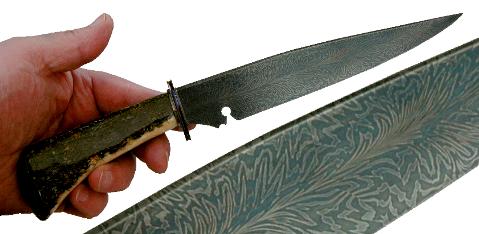 Knives by Rick Furrier 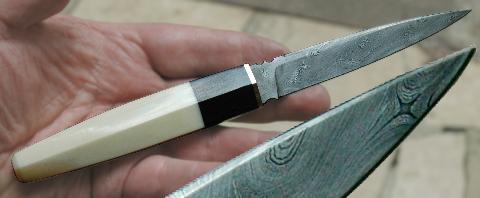 The photos here do not do these blades justice. Taken in low light they do not nearly come close to showing the beautiful finish. In this case the blades ARE the jewels. |
| - guru - Monday, 05/08/06 18:00:24 EDT |
|
Guru, would fiberglass be a good epoxy? T. Gold, where do they sall T-88? I've not heard of it before, and I would like to try some. I'm experementing with "Groilla Glue" at the moment as well. I'll let everyone know if that does any good! Thank you all for the help! ---Rob |
| - Rob - Monday, 05/08/06 18:33:01 EDT |
|
Quench oils. The same folks that are retailing the magic punch lube also handle the polymer quench oils for their comercial customers. If there is interest, they may be willing to sell in blacksmith quantities. The UCON NT-NN is sold in 55 gallon drums, but they may be able to get smaller quantities. About $1300 a drum if I remember right, and it is sold in the US through only one distributor. T-88 is a resin system that was used in homebuilt aircraft when I was still following that line closely. Try "Aircraft Spruce and Supply" |
| ptree - Monday, 05/08/06 19:24:45 EDT |
|
Guru, Steve Barringer and I were doing research on the effect of inside diameter of the air hoses and the presence of restrictive fittings. Now the 155# machine runs better and the next set of steps Steve is undertaking will make a really profound improvement. Dean stopped by at dinner and didn't like the red hoses and the hose clamps. Aesthetics over performance? www.ironkisshammers.com |
| John Larson - Monday, 05/08/06 20:40:42 EDT |
|
Fiberglass: This is a common mistake. Folks also think of fiberglass as being inherently slick and smooth. . it is not. Fiberglass is JUST the glass. It is fine strands of glass. Fiberglass insulation is just glass fibers and a little binfer to hold it together. Fiberglass is used three ways, as cloth in sheets and strips, in mats or chop (like shreded insulation) and in bundled monofiliment strands. It is combined with a hardenable plastic resin to make anything called "fiberglass". Epoxy is a popular resin as is polyester. But fiberglass is also added to other things like concrete to increase its strength. Graphite is a similar product. A graphite fishing rod or bicycle frame is made of plastic reinforced with graphite fibers. Because of their strength at elevated temperatures where fiberglass weakens graphite fibre is used for those applications. Perhaps the most famous application is the stealth bomber. But it is not just "graphite" it is resins that when combined with the graphite form a rigid substance. Ever been in a porta pot? Notice that nasty rough surface of much of the interior? That is the exposed side of where fiberglass chop is combined with resin in a mold. The smooth surfaces are from the mold and the rough surfaces from where the chop is literaly tossed in front of a fan that blows it onto a surface being sprayed with resin. The two combine to make fiberglass reinforced plastic. When I built Soap Box racers we used fiberglass cloth and brushed on the resin. You put a coat of resin on the wood surface, then placed the cloth. This was a tricky job as the resin was very sticky and where you put the cloth it stayed. Then you worked resin into the top surface. The frayed edges were the worst getting caught in the brush and making a huge mess. Then they stick up and are like hard steel barbs. Very difficult to cut off. Nothing inherently smooth or slick about fiberglass and resin. . . |
| - guru - Monday, 05/08/06 21:17:21 EDT |
|
Daveb. Leg vise washers. I was going to try to say something wonderful about the washers in answer to your question. Now, I wind up with a question. I have a few vises with cupped washers and one with a 1917 stamped on the front jaw. They are all Columbians. I just took a quick trip to the shop and took from two of the vises their boxes and washers. I spark tested them, and I got a pretty decent spark, similar to high carbon steel in some spots. The washers appeared more like medium carbon. I always thought that the screw boxes and washers were cast, and I still do. However, I know now that they are definitely not a form of gray cast iron. I think that they are malleable iron castings, which would impart high tensile strength to the parts. I have a box full of spark testing materials, and some of the castings give a bright, high carbon looking spark, but gray castings have a darkish red, minimal shower, when compared. I have no book which would tell me how a malleable iron spark shower should appear. |
| Frank Turley - Monday, 05/08/06 22:59:40 EDT |
|
Found two horseshoe shaped pieces of metal inside a broken neon sign transformer. I tapped one with a hammer and it cracked. It is magnetic, but won't hold the magnetism. Is this pure iron? What can I do with this stuff? |
| - Nippulini - Monday, 05/08/06 23:17:33 EDT |
|
Pure Iron: Yep, Probably is pretty close. Transformer core iron is nearly pure with a little silicon I think. If you are looking for something as an etch contrast in laminated steel this is very good. The problem with this stuff as a source for low to zero carbon iron is that it is primarily produced in thin sheet stock less than 1/16". If you need more you have to laminate and forge weld it. |
| - guru - Monday, 05/08/06 23:25:22 EDT |
|
Frank - Malleble Iron: Pipe fittings are often malleable iron [or at least older ones were], these are not as bulkey as cast iron fittings, and if You still aren't sure a sharp wack with a hammer will let You know for sure. Grind on one and see how it sparks. Bear in mind that malleable parts ARE castings, they start as white cast iron and are mallaeblised by heating at 1550 - 1600 F for 48 - 60 hours, then temperature is slowly reduced. |
| Dave Boyer - Monday, 05/08/06 23:43:28 EDT |
|
|
|
|