| WELCOME to the anvilfire Guru's Den - V. 3.0 |
|
THIS is a forum for questions and answers about blacksmithing and general metalworking. Ask the Guru any reasonable question and he or one of his helpers will answer your question, find someone that can, OR research the question for you. This is an archive of posts from May 9 - 16, 2006 on the Guru's Den |
|
|
|
MO' LEG VISE WASHERS: How 'bout a tool post rocker washer off'n a lathe. They come in various sizes. |
| 3dogs - Tuesday, 05/09/06 00:54:24 EDT |
|
I was hoping someone knew where i could find a good pattern for making a mace with 5 flanges. |
| maxpress - Tuesday, 05/09/06 02:31:48 EDT |
|
The T-88 was bought for me at a West Marine supply store. It is a structural epoxy that is used for woodworking -- I have also used it on stone with amazing results. |
| T. Gold - Tuesday, 05/09/06 03:51:17 EDT |
|
Hello anvilfire Guru Would a leaf blower be a suitalbe a wind source for a forge .(EG SIZES, SHAPES ect) . I am keen to make a few gifts for my father and freinds I reckon that it will be fun 2 do . So please reply soon cheerz simo |
| Simon - Tuesday, 05/09/06 05:57:34 EDT |
|
Frank ,the MIG worked as far as I can tell, The washer is cleaned up and the vise is back together and all appears to be well. My friend heated the entire washer, not just where the break and fracture, too get it to close. After the heat was applied we found another hidden fracture that the heat exposed. He only welded what was needed and no more. The ends of the exposed brake did have a very defined heavy grain appearance. So it was decided that if washer puddled, work would stop and I would take it to a shop that does O/A torch welding. So now it’s just a matter of using it to see if it’s going to fail. |
| daveb - Tuesday, 05/09/06 08:19:40 EDT |
|
Leaf Blower: Simon, Way too much air. Will blow the fire completely out of the fire pot. Also much too noisy. . . part of solid fuel fire maintenance is listening to the sound of the fire. The same blower with a low speed electric motor or rigged to hand crank at about 500 to 1000 RPM would probably do. To calculate hand crank speed assume 40 PRM top speed at the hand cranked end. Blow hair driers are about the right amount of air for full blast. The fire is operated at much less most of the time. However, coal fires need some pressure (known as head) along with the relatively low volume. Larger diameter fans have more head than small ones for the same volume. You can buy actual forge blowers from our advertisers. |
| - guru - Tuesday, 05/09/06 09:03:41 EDT |
|
Greetings, I've been trolling the site and love it but still have a question. I'm new to the site so maybe this question has been asked before. I have an old anvil that is enormous(almost 300 lbs) with a 1 1/4" hardy hole and I'm having a real problem finding any hardies, fullers, or anything that will fit it. Someone suggested using a piece of square tubing to fill the gap and use 1" shanks but I'm concerned about jamming and snapping my anvil heal. Any suggestions? |
| Robert - Tuesday, 05/09/06 10:40:23 EDT |
|
ANvil Bushing: Robert in an anvil that size it is unlikely that you can break the heel. A bushing would want to be a loose slip fit with a large flange. The hardie would also want to be a slip fit. Making a bushing of this type requires some luck finding the right material and a bit of grinding and filing until it fits right. Standard 1-1/4" square tubing has a wall under an eighth and 1" will fit it nicely. However, I am not sure if it will fit your hardie hole. Another way to make it is to piece the bushing from angle iron or flat plate and weld together. Bushing a large hole is easier than reducing all your shanked tools. I have a collection that runs up to a 1.5" shank! Do not use tapered shanks in hardie holes. |
| - guru - Tuesday, 05/09/06 10:57:00 EDT |
|
Guru, I tried to forge the "iron core" this morning. It crumbled real nicely at an orange yellow heat. Was it cast? I didn't do a spark test. |
| - Nippulini - Tuesday, 05/09/06 11:01:01 EDT |
|
Nip, it may have been sintered or pressed iron powder. If it was not a thin flat part it may have been made from iron powder as it is readily available. For some magnetic purposes it is made like plastic "refrigerator" magnets with plastic binder. |
| - guru - Tuesday, 05/09/06 11:06:51 EDT |
|
Robert: Sleeves seem your solution. Just find two pieces of 1/8 |
| - Ken Scharabok - Tuesday, 05/09/06 11:21:33 EDT |
|
Plastic! Ah.. that would explain the strange smoke coming from the forge during the heat. The piece is about 1/2" thick and is U shaped square. Can I at least weld with it? Or is it ornamental garbage? |
| - Nippulini - Tuesday, 05/09/06 11:28:33 EDT |
|
Maxpress, start with a strip of wrought iron about 4-5 inches wide, 1/4 inch thick *at* *most* and the length is dependent on how far out the flanges will stick out (take twice the length it will stick out for each flange plus the spacing between the flanges + forge welding allowance) Heat it in the forge and bend it at one end over onto itself so it's doubled over about as long as you want the flange to stick out plus an inch for a tab, Forge weld the folded section---except for the bottom inch and then hot cut the basic flange shape you want and dress with the hammer. Mover over the correct spacing and repeat until you have a strip with 5 flanges sticking out. then heat and bend around the handle mandrel and forge weld the ends together (remember the 1" tab at the start?). The file and polish to suit yourself. I'm sure that you would have mentioned your tools and skills if you wanted to do it a different way---right? Thomas |
| Thomas P - Tuesday, 05/09/06 12:11:19 EDT |
|
Nip, Tis curious technical garbage. . . |
| - guru - Tuesday, 05/09/06 12:19:32 EDT |
|
Simon, a leaf blower is great fun for a forge blower, especially if you want to shower a group of people with your fire. Despite warnings from anvilfire and other sites, I had to try it myself to see what would happen. I like to experiment with things, even if I know they are dangerous. So, if anyone has an idea they are too wary to try, let me know about it- Grin! |
| - Rob - Tuesday, 05/09/06 13:28:15 EDT |
|
Well, so far the "Gorilla Glue" is holding up nicely. I'm not much of a torture-tester, but I've given some large tree stumps some nice hard whacks with it, and it isn't loose. I'll try out a few other things later on, and I'll update on how it's holding up. |
| - Rob - Tuesday, 05/09/06 13:31:18 EDT |
|
Chain Mail- Check out theringlord.com for all types of pre-cut rings as well as wire to coil your own. I made a halberk from galvinized wire available at any hardware store. Also if you are a "Lord of the Rings" fan, check out the special features on the DVD for other options. |
| - BT - Tuesday, 05/09/06 13:35:34 EDT |
|
TGN, In addition to iron powder, your ballast core could well have been ferrite. Ferrite is used a lot in inductors (like ballasts.) Essentially fine ground fire scale either sintered together or in a composite. A few turns of a power cord through a ferrite torus has solved many Radio Frequency Interference (RFI) problems. |
| John Lowther - Tuesday, 05/09/06 15:11:48 EDT |
|
Hello, I came across this anvil on ebay and wondered if anyone one knew anything about these. item 6278161699 Does ductile Iron really maake a decent anvil? |
| Blu - Tuesday, 05/09/06 17:07:02 EDT |
|
Ductile is a type of cast iron that has been modified to be less brittle. However it's pretty soft and would not be my choice for an anvil. It would be much better than a plain gray cast iron anvil. If they had done it using something like the Fisher process where it would have a steel face I would be much happier. Thomas |
| Thomas P - Tuesday, 05/09/06 17:28:22 EDT |
|
Blu: The third photograph of the original anvil is very hard to see, but the top plate appears to be in VERY bad condtion. If this one is straight ductile iron, like pipe fittings, then I would expect it to be in much the same conditon with any heavy use. Listing does not say if it is straight ductile iron or a composite, nor if it has been heat treated. It is also offered straight from the foundry without any finishing work. Like a blind date, I doubt it is as pretty as its picture. Also note it has a 5/8" hardy hole - essentially a square pritchel. Current bidding is at $4 pound. For about the same money you can purchase one made of a much higher quality steel from one of the anvilfire advertisers. Just my opinion: He will sell a couple of them as a novelty item, but that is about all. |
| Ken Scharabok - Tuesday, 05/09/06 19:08:27 EDT |
|
Combination Swage/Anvil: First, this is not going to be a first class anvil, ever. As Thomas noted it is the wrong material. Second, the pattern, while different just does not have the feel of an old design (see link below). Third, the original appears to be heavily damaged the way a cast iron anvil will fail. As a casting similar to a swage block it could have been made anywhere and within the last 100 years. The shape is a combination of a French anvil and a Dutch swage block (where is my catalog when I need it??). But the design just does not have the feeling of a French anvil. The feet are peculiar little things if the photo displays them properly. Check out the ones on Jöel Becker's web site. There is one on the second page of anvils that has a dish impression in the side but the whole has a great deal of style as do most of the French anvils. It has the graceful wear and tear of a good OLD anvil as well. . couteaux.free.fr/ If you don't read French, go to: Les Enclumes, c'est beau... je collectionne... and Photos d'enclumes d'amis What you CAN do with a ductile iron anvil is hard face it. Add about $300 in materials and a week's labor and you will have a half decent anvil. At the current ebay price you can get a real anvil. . . (175 pound Euroanvil). Current prices on ductile iron swage blocks is about $3/lb. So if you want the thing for a swage block then the price (~$600) is too high on this one. This thing is a curiosity for collectors of curiosities. It is a new casting which means there will be more and the price should drop. |
| - guru - Tuesday, 05/09/06 19:28:12 EDT |
|
Thanks for the replies It looked like an interesting combination of swage block and anvil I've got a pretty limited space to set up my shop in so it cought my eye. I did pick up an 80 pound farriers anvil at an auction a few weeks ago that i've been playing with and man does it ring loud. It looks pretty recent and has minnisotta written in raised letters on the side. I can't quite make out the company name though. Would it be safe to guess it's cast steel? |
| Blu - Tuesday, 05/09/06 19:41:32 EDT |
|
Probably |
| - guru - Tuesday, 05/09/06 20:01:59 EDT |
|
I do feel bad for the fella who likely spent serious dollars on a pattern and the casting of those ductile anvils. I am with Ken. He will sell a couple as a novelty then loose his shirt on his investment. Really too bad. I wish he stoped here to get some direction from guru first before blowing his jack of green on his project. |
| - Burnt Forge - Tuesday, 05/09/06 20:41:21 EDT |
|
I just completed my first knife today. Do I hammer a blade on it or grind one on using a bench grinder before I temper? |
| - BNC - Tuesday, 05/09/06 20:41:51 EDT |
|
At least this ASO was American made this time...LOLOL. |
| - Burnt Forge - Tuesday, 05/09/06 20:42:28 EDT |
|
Nice French Blacksmith Website. I am enjoying it very much. :) |
| - Burnt Forge - Tuesday, 05/09/06 20:44:38 EDT |
|
BNC, by "hammer" do you mean shape the blade? There will be some grinding or filing needed eventually. I try to do as much shaping as possible with my forge before grinding. Could you be a bit more clear on what you mean, please? ---Rob |
| - Rob - Tuesday, 05/09/06 20:47:19 EDT |
|
Just want ot (listen in). Peace ! DR Boulais |
| Denis R Boulais - Tuesday, 05/09/06 20:51:00 EDT |
|
I was lookin' at a rr track anvil on ebay that just sold for $86.00 (I only went to $46.00)!! Maybe one of you saw it. What intrigued me was the overly long horn. Since I couldn't buy that one, I went ahead and made one out of some scrap rr track I had laying around. After 4 hours of by guess and by gosh, it's done. It's purpose is mainly for mounting in my vise and doing small metal bending and hammer finishing small pieces of iron and brass. Now the question. I cut the basic shape with a oxy acet torch, filled a couple of cut lines back towards the flat face with regular mild welding rod (the repairs were on the bottom, I just did it for the asthetics) and finished it with a grinder, file and sandpaper. I let everything air cool at all stages (except for one cutting proceedure when I got impatient and quenched when it was at black heat). So, should I reharden the anvil or is it a low enough carbon content that I'd just be wasting my time considering the work I'm planning to do with it? |
| Thumper - Tuesday, 05/09/06 21:15:14 EDT |
|
BNC: I don't understand. You said>I just completed my first knife today<, and then you ask a question of how to put a "blade" on it? |
| Bob H - Tuesday, 05/09/06 21:17:55 EDT |
|
Thumper, RR track is generally medium high carbon steel. Go ahead and harden/temper it. Use warm oil for the hardening and temper at about 400°F for a couple hours. If that doesn't get it hard enough, try very warm water for the quench. |
| vicopper, Chairman - Tuesday, 05/09/06 22:08:19 EDT |
|
RR-Rail Steel: Thumper, you need to be careful how you treat this stuff. It varies from 55 to 75 point carbon. It will harden very hard and will quench crack if quenched when over heated or unevenly heated. It is normally in the normalized (unhardened but not annealed) condition and is still quite hard. The biggest problem I have had with RR-rail is cold shuts from the smearing of the metal by the RR-wheels. There are often cracks as well from the heavy use. For a horn type tool I would not harden it. |
| - guru - Tuesday, 05/09/06 22:08:21 EDT |
|
Is there any difference in the firepot between a coal forge and a charcoal forge or are they both the same? You would'nt need a clinker breaker for lump charcoal would you? I was also wondering where I can purchase Hofi's hand hammer video. Thanks. |
| Rich33 - Tuesday, 05/09/06 22:49:05 EDT |
|
Vicopper, Thanks for the reply, I think I'll stick with guru's idea of just using it in the "normalized state" cause it's not going to take a pounding in the traditional blacksmith sense of the word and after 4 hrs work I sure wouldn't want to break it with a sloppy blow. As far as cold cold shuts, I've ground down the visible burr on one side of the track and dressed the opposite side just in case. |
| Thumper - Tuesday, 05/09/06 23:02:28 EDT |
|
Rich33: Hofi's DVD or VHS video can be purchased from a seller on eBay; he has them all the time. Hofi recommends him. Traditional firepots for charcoal had a side blast, and held a deeper fire. That being said, I've used my coal firepot (Centaur) for charcoal, and it worked well. A softer air blast helps. |
| Ellen - Wednesday, 05/10/06 01:39:42 EDT |
|
On air compressors, what is the difference between cfm and scfm - what does the s represent? |
| Ken Scharabok - Wednesday, 05/10/06 07:33:31 EDT |
|
Ken, The "s" is for standard. It means the air is measured at 1 atmosphere pressure and 68 degrees Farenheit. The plain cfm measure can be the volume under any conditions. not often used is acfm which means the volume is measured at the actual conditions of output, which might be 125 psi and 125 degrees F. If not scfm the conditions of measurment should be specified. Pressure measurments have some quirks too. pressures are given in either psig or psia. the gauge reading is psig. since the pressure is not realy zero, but just equal to the atmosphere when the gauge reads zero, the absolute pressure is psia=psig +atmosphere. |
| John Odom - Wednesday, 05/10/06 08:25:55 EDT |
|
BNC, I think he means he forged a knife blank and would like to put a cutting blade edge on it. I hammer the thin edged into my knives BEFORE the blank is finished. Heat, quench, temper. Then I use a variety of grinders and grit to acheive a razor sharp edge. I begin with a bench grinder, then angle grinder, then belt sander, then wet grinding wheel. Depending on the blade and its designated use, I'll hone the blade. |
| - Nippulini - Wednesday, 05/10/06 08:44:21 EDT |
|
Am doing an eduction day at a local historic site. Read somewhere that only square stock was available in the 1800's. Is this true or in 1850 would round stock be available? Thank you Patrick |
| Patrick - Wednesday, 05/10/06 08:47:34 EDT |
|
To do any gas law calculations or to convert acfm to scfm you have to use the absolute pressure. The standard atmospheric pressure is 14.7 psi. usualy this is rounded to 15 psi. So in most calculations one uses the indicated gauge pressure +15. |
| John Odom - Wednesday, 05/10/06 09:06:13 EDT |
|
What I meant to ask is how would I put an edge on a blank, do I temper before or after I grind an edge on, and at what temperature do I temper my blade? Sorry if I was not clear. I have only been ironworking for about a month. |
| - BNC - Wednesday, 05/10/06 09:20:03 EDT |
|
John, Isn't scfm also measured at sea level? |
| Ron Childers - Wednesday, 05/10/06 09:28:28 EDT |
|
Square and Round: Hmmmm good question and I do not have a positive answer. There were huge changes in industry during that period with steam power coming in. But there were also large water powered rolling mills such as Tredegar Ironworks in Richmond VA. Tredegar was producing RR-Rail in the 1830's so it can be assumed that they could also roll round stock and other structural sections. Factory drawn (round) wire has been available since the 1300's in brass. In most shops today rectangular stock is more common than round but round is still commonly used. I would say the same was more true in the 1850's in some shops but where chain was made round would be more common. I would not say as an absolute that round stock was not available. |
| - guru - Wednesday, 05/10/06 09:59:52 EDT |
|
Patrick, I would ask this on the arch-metals mailing list; but a quick study of Diderot's encyclopedia might give a quick answer. Rolling of iron had been around about 200 years then so I would admit the possibility that rounds were available but I would have to dig for the info. BNC, generally you leave the edge at least as thick as a US dime before heat treat, perhaps thicker if you have trouble with decarb. If you get it too thin it's more prone to decarb, warp or crack during heat treat---tempering is only the *last* stage of heat treat. You will want to normalize it several times and then heat till non-magnetic and quench to harden and *then* temper it back to trade some of the hardness for toughness and then finish it off. Of course to get exact temperatures we HAVE TO KNOW THE ALLOY! But most simple steels will work with the non-magnetic point, high alloy steels you HAVE TO KNOW THE ALLOY! as many of them require quite high temp soaks to put the carbon in solution. To figure out what you quench it in you HAVE TO KNOW THE ALLOY! With still air, moving air, warm oil, water, brine being the usual choices going from most gentle to most intensive. When guessing you usually try warm oil and if it doesn't harden enough re-do it with a water or brine quench. But really to get a decent answer to questions like this we HAVE TO KNOW THE ALLOY! Thomas |
| Thomas P - Wednesday, 05/10/06 10:39:55 EDT |
|
Ron: Elevation affects pressure. 1 Atm. press is the standardized pressure at sea level, so scfm at standard pressure ie effectively sea level in other words. |
| John Odom - Wednesday, 05/10/06 10:41:07 EDT |
|
Patrick, I fired off a post on arch-metals for you. Charcoal firepots while you can burn charcoal in a coal firepot it helps to raise the sides with a couple of firebricks to make it narrower and deeper "ethnic forges" often are built to feed in the charcoal while not letting it spread to the sides. Wygers has a picture of one in "The Modern Blacksmith" I hope it was included in "The Complete Modern Blacksmith" Neo-tribal smiths have build a nice charcoal forge---do a search for washtub forge to find their sites. Thomas |
| Thomas P - Wednesday, 05/10/06 11:37:30 EDT |
|
RR track Its great for small projects but its a pain to quench it and get it to not crack have fun with that one |
| - Tyler - Wednesday, 05/10/06 11:42:32 EDT |
|
I have a product I am reciving cold rolled (1040) We recieve it straight, 240" cut it to various lengths, than heat treat it, during heat treat we get sever warping (0.030") Any ideas on what is causeing it or how to resolve the issue? |
| Dan Wall - Wednesday, 05/10/06 12:12:34 EDT |
|
Dan, regarding your warping problems you'll get a lot more help if you provide some additional details of the heat treating - induction hardening, electric furnace, gas furnace? what austenitizing temperature, what quenchant, & what temperature is the quenchant? temper temperatures ? 0.030 " over what length of stock? How does the stock enter the quenchant? Also, what is the bar diameter you're using? Why cold rolled - hot rolled would be less expensive & have fewer stresses going into heat treat, though the cross section wouldn't be as precise. You've got at least 3 metallurgists who look in on this board on occasion, but we all need as much information as possible to make an educated guess as to the problem & steps you could take to correct it. |
| - Gavainh - Wednesday, 05/10/06 12:40:10 EDT |
|
Actually, if one gets RR track that has been run on, the crown is already like the proverbial woodpecker lips, due to work hardening. I destroyed a $150 shell end mill cutter, because the guy wouldn't believe how hard it was, but should have known better. That's OK, though, it was his mill, and his cutter. |
| 3dogs - Wednesday, 05/10/06 12:49:59 EDT |
|
Warp: Dan, this can be caused by many things. However the most common in cold roll is the stressed surface. Simply cutting the surface off the side of a piece of cold finished steel will cause a severe warp. If the steel was rolled in a coil prior to delivery to the warehouse it was then straightened. This leaves more tension in one side than the other due to bending and straightening. Uneven heating can also be the cause. Parts heated on a surface or conveyor may have a temperature differential. When making parts from CF steel you often need to full anneal as part of the heat treat to remove the cold working stresses. Ocassionaly this requires the parts to be straightened again prior to final heat treat. In the worst case you may have to straighten them after. The as-delivered condition of steel can vary depending on how it was handled. This often causes fits for the manufacturer. |
| - guru - Wednesday, 05/10/06 12:50:02 EDT |
|
Warp 2: Dan, also see Gavainh's post above. |
| - guru - Wednesday, 05/10/06 12:52:59 EDT |
|
Knife Making: BNC, Everything depends on having a plan, your equipment and as Thomas noted, the alloy. Also the condition of the blank. Many tool steels are carefully annealed and are ready to harden and temper. You pay a lot for that initial anneal. Being fully annealed may be something the small shop cannot do and this means that you could not drill holes in the tang, saw or other cold operations. Modern bladesmiths often grind a knife just short of final polishing and then heat treat using a salt bath. The liquid salt keeps air away from the steel so there is no oxidation while heating. Few of us have a salt pot but they are becoming more common. Even neophyt knife makers may have one if they have studied the available books and are going all out to setup shops. Optionaly you can rough shape the blade, harden and temper it then finish grinding and polishing. This requires keeping the steel cool while grinding to prevent drawing the temper further. Often folks that make knives out of files start with a hard file, grind to shape and end with a file hard knife. This is typicaly too hard but it has been done thousands of times. I suspect the edges often get reduced in hardness by the grinding heat. . . Another method is using old heavy saw blades. This is better as the steel is closer to the right alloy and is already heat treated close to what a knife should be. Many good knives have been made this way in primitive shops. Many modern alloys are air hardening in knife thin sections so hardening is a simple heating and air cooling after forging. The steel is tempered immediately after hardening (in all cases). Some air hardening have very high temper temperaturs so it is difficult to hurt them while grinding. However others are just as sensitive to temper temperatures as common carbon steel. We cannot tell you what temper temperature to use other than a minimum of about 350-375°F. This leaves most steels as hard as they are going to get but DOES temper the steel. Beyond that may be too much or too little. Finished blades are also hardened in stainless foil wrap to exclude air and clay has been used for the same purpose. There are many ways to heat treat. As I started, you need a plan. A bench grinder is not a particularly good tool to grind a knife on unless it is unusualy large. It also requires the wheel to be repeatedly dressed with a diamond to produce a good surface. Most blade grinding from blanks is done with belt sanders for a variety of reasons. One is you have both flat and curved surfaces to work against. The other is the blets are easily changed to change grits and renew the surface. The greater surface area also lasts longer. They also can run cooler than a wheel but not necessarily so. You can make a blade by many methods and with very few or a lot of tools. I've known makers to use milling machines and lathes to shape a blade. High production operations use punch presses to blank out the blades. Some makers buy laminated steel "Damascus" blanks and start from there. Heat treating involves several steps that can be done in a forge if using the right materials. However some modern steels often need careful temperature controls and atmospheres to properly heat treat. It gets worse. If you have managed to forge weld a laminated steel billet then not only are you now the bladesmith but the steel manufacturer and metallurgist. Given the exact starting alloys and the exact process there are a few experts that can suggest a possible heat treatment. They will tell you that you will have to experiment. Now you are into R&D. The same goes for an unknown alloy. If you pickup a spring, RR-spike, saw blade or other steel you are now dealing with mystery steel. You can start with a guess based on what the object was but there is less than a one in four chance that you will be even close. So you test and play metallurgist. Knowledge is the key ingrediant to both question and answer. Asking "what next" leaves us in the dark as much as you are. |
| - guru - Wednesday, 05/10/06 13:00:01 EDT |
|
There is an old riding lawn mower sitting in my back yard, and I'd like to make some knives from the blade. Does anyone know what steel the blade would be made out of? From the information I have, it is at least 20 years old. I'm not sure of the brand, because it either faded off or was never marked. Thanks in advance! ---Rob |
| - Rob - Wednesday, 05/10/06 13:09:15 EDT |
|
Rob, Its Junkyard Steel. See FAQ on same. It is probably about a 1040 steel. But it is not really that old as lawn mowers go and many have soft steel alloy blades to reduce libility problems. The alloy is often for wear resistance (if the maker cared). Older blades were harder steel, probably a 1050 or 1060. Cut off a piece and test. |
| - guru - Wednesday, 05/10/06 13:34:26 EDT |
|
hi everybody.i am building a power hammer and i need to straiten a leaf spring it is a 3 leaf spring ,i have left the bucket of the JCB on it all day but as soon as i take the bucket of it springs back.eny body got eny idears,thanks dave |
| washtub dave - Wednesday, 05/10/06 13:45:04 EDT |
|
Dave, Just loading a spring will not change its shape (unless loaded to capacity for many years). You have to over travel the spring (bend it). This can be done cold using a press or a tire bender (rolls). You will probably need to dissasemble the stack and re-arc each spring seperately. |
| - guru - Wednesday, 05/10/06 13:50:13 EDT |
|
I got alot of questions today. What all alloys are used in steel? What is brine and were could I acquire some? Are there any american anvil amking companies and if so what are there names? What is Jcb?? RR track In order to find the alloys that are in it you need to find out what RR company had the tracks and get ahold of the documents if there are any left that were kept for that section of track. Alot of RR's did that so they could re order a section of track if that one failed, broke, or camelled ( Bent straight up after it was laided down and spiked causing the train to de rail) this happened alot on the Cross country RR between east and west coast. |
| - Tyler - Wednesday, 05/10/06 14:20:54 EDT |
|
HELLO GURU, I AM TRYING TO GET A MATERIAL IDENTIFICATION SPARK CHART OFF THE INTERNET OR HAVE ONE SENT TO THE COMPANY I WORK FOR. I'VE CALLED CRUCIBLE METALS IN FORT WORTH TX AND THEY SAID NO SUCH CHART HAS EVER BEEN PUBLISHED, COULD I BE WRONG ABOUT THIS CHART. PLEASE HELP. |
| ERNIE FLORES - Wednesday, 05/10/06 14:45:31 EDT |
|
Metal Alloying: Tyler, Although the rail roads may have had specs the mills in fact defined the alloy first and the rail roads standards people defined the cross section (after or in conjunction with the mills according to what they made). Somewhere in there an engineer defined all the cross sections eventually adopted including extra heavy rail down to little mono-rail crane stuff. Early standards however were catch as catch can. There are about 30 metals that can be alloyed and almost all are used in one type of steel or another. When you get into high strength tools steels for cutter applications there is often more non-ferrous stuff than the iron. In fact the super high performance cutter alloys have little or no iron in them at all. Common ingrediants are iron, carbon, silicon, manganese, chrome, nickle, tungsten, vanadium, cobalt, copper, aluminium . . . Brine is salt water. The oceans are full of it. You can make your own, a saturated solution is common. Yes, there are a number of American anvil makers today. Most farriers anvils are domestic made and too numerous to mention but MFC (an advertiser here) is one, Mankle and Texas Farrier Supply (TFS) as well. Then there is Nimba and Rat Hole who both make big forging anvils. |
| - guru - Wednesday, 05/10/06 14:55:22 EDT |
|
Spark Charts: Ernie, A number have been published, maybe not by crucible metals. See our review of Metals for Engineering Craftsmen Click on the excerpt for the spark chart. Note that even though the spark patterns are fairly standard that different grinding wheels with different grits and speeds produce different results. You also need low light. It is almost always best to have a selection of comparison samples of known material to test and compare to. |
| - guru - Wednesday, 05/10/06 15:01:38 EDT |
|
thanks for the information on the springs guru regards dave |
| washtub dave - Wednesday, 05/10/06 15:06:06 EDT |
|
More Spark Charts: Modern Welding also has a spark test chart attributed to Norton Co. (the grinding wheel and abrasive company). NEW Edge of the Anvil by Jack Andrews has a spark chart by the author. However, I thought the one in the original Edge of the Anvil was better (see our review). Metalworking Technology and Practice has a very good chart as well as color descriptions even though it is not listed in the index. . Many welding supply companies also provide these charts and I have seen some in color. |
| - guru - Wednesday, 05/10/06 15:17:51 EDT |
|
Tyler, JCB is a brand of heavy equipment. The term's used in the UK to refer to a specific piece of equipment. I think a backhoe, but I haven't quite worked it out for sure. |
| Mike B - Wednesday, 05/10/06 18:05:08 EDT |
|
Another hopeless mystery steel id... To set the tone, the potter down the road bought 3000 pounds of stainless steel billets at an auction, of sizes on the order of 2"x4"x12". Why, neither he nor I can explain, but he gave me 15 free firebricks, so I'm ok with that. He wants to know what to do with it. I told him he would get alot more out of it if we could reasonably ID the steel, and since he has a pallet of it, it could be reasonable to have it tested for type. My question is, is it possible to send off a sample of steel to a lab, then have them tell you what type the steel is(as in ASTM number)? A curious attribute of one of the pieces is that it was painted blue on one side, with a black arrow that indicated the rolling direction. I thought this might be an indication of some importance, but am ignorant as to what. |
| - Tom T - Wednesday, 05/10/06 18:26:42 EDT |
|
I have a broken 9 gauge no sag spring in my auto seat. I have tried to purchase some spring material to replace the bad spring. My local supplier says he noe only carries no sag spring material by the foot, but he states if I just bend the material into the shape of the broken spring. The spring will not hold its shape. THe spring material need to be heated and bent in order to have memory (spring back into the original after you take weight of seat) My question what tempature does the spring have to be while bending? Will the spring retain its temper and hold to the shape bent into? Or does the spring material need to be rehardened? I vaguely remember back 30 years ago in a college metal class heating steel with carbon to temper it. Is this the same general principle for the no sag spring material. Thanks conky |
| conky - Wednesday, 05/10/06 19:37:27 EDT |
|
Does anyone have a sourse for #14 steel slot head countersunk wood screws 1",1 1/2" & 2"? Am working on 1880's carriage and can't see using zinc philips heads. If I have to, tips on hand cutting them? |
| goodhors - Wednesday, 05/10/06 19:48:50 EDT |
|
Fun with a leaf blower, Way back when... I would take a usual 55 gal drum set up for burning debris, get moderate or small fire going in it then pile it full the wet leaves, grass clippings, whatever... Through the bottom 2" pipe hole I had plumbed that to an electric leafblower, then switch it on ! The smoke was unbelieviable ! It would easily and quickly burn enormous piles wet of yard debris. I one-upped the thing by welding another drum on it end to end. That way it could be charged more fully because while it was burning, it was not pleasant to stand next to it and shovel in more wet leaves plus the smoke exited about 8' off the ground and was less anoying. Suprisingly, There would be a great deal of clinker formed as well, I suspect the maple leaves contain silica or other mineral absorbed from the ground. Blacksmithing content,, The base of the drum would get red hot, Were one to put a hole in the side of the drum, barstock could be inserted for forging... |
| - Mike - Wednesday, 05/10/06 21:09:57 EDT |
|
I'm a professional smith with a 50lb Little Giant. Thinking of upgrading to an air hammer, since I'm moving my shop and will have to pay shipping one way or another. Any suggestions for affordable quality air hammers? Thanks. |
| Chris Shea - Wednesday, 05/10/06 21:28:03 EDT |
|
Chris Shea: To and from where are you moving? I think you should investigate the "Iron Kiss" hammers, made by John Larson. You can Google them but I think it is ironkiss.com |
| John Odom - Wednesday, 05/10/06 21:31:48 EDT |
|
I am looking for information (instructions)on making nail headers. |
| tweaver - Wednesday, 05/10/06 21:33:51 EDT |
|
JCB: The ones My boss has are loader / backhoe 4WD 4 wheel steering machines. These are "Compact" machines, about half as long as a Case 580, but only a little less capacity. they are about 7000#. Interesting feature is the backhoe can be moved from the center to either side of the machine. |
| Dave Boyer - Wednesday, 05/10/06 22:24:56 EDT |
|
It is www.ironkisshammers.com and everyone I have talked to gives rave reviews to the quality; they are universally described in the first sentence as "wow, what a hard hitter, with great control". |
| Ellen - Wednesday, 05/10/06 22:32:27 EDT |
|
Tredegar Iron Works, Richmond, VA: I forwarded that site to our Richmond National Battlefield Park ( www.nps.gov/rich ), which presently has its Visitor Center in the old Tredegar Ironworks building. From a short conversation, I think they were unaware of that website. Nice site, nicely done. It will add to my trip when I have to go there for business in the next month or two. 3,000# of Stainless Steel Billets: Hmmm, sounds like a good non-reactive, non-toxic mass of sailboat ballast to me. ;-) What are their dimension/weight? Awaiting the rain on the banks of the lower Potomac. Visit your National Parks: www.nps.gov Go viking: www.longshipco.org |
| Bruce Blackistone (Atli) - Wednesday, 05/10/06 22:35:31 EDT |
|
Hello, My search for an anvil is still ongoing, but I have found a 137lb Peter Wright locally. The seller has offered it to me for $350, which seems pretty steep to me as I have read on anvilfire as well as other places that the going rate for small used anvils should be $1-$2 per pound. Now, assuming that I closely examine the anvil and find it to be in good shape should I seriously consider this opportunity or in your opinions am I better off waiting for another one? Thanks. |
| Steven Galonska - Wednesday, 05/10/06 23:13:10 EDT |
|
Steven G. It depends on how anxious You are, and the condition of the anvil. If perfect it might be worth that much. Blacksmiths want and get more for anviles than people who are tired of tripping over them. |
| Dave Boyer - Thursday, 05/11/06 00:25:43 EDT |
|
Steven Galonska: Really supply and demand. $2-2.50 for a PW in excellent condition wouldn't be out of line, so asking price is at the top. As Dave noted, if perfect than going above $2.50 may be a fair price. You can somewhat use eBay as a price guide. Just do a search on anvil, within the collectibles category, by highest price on completed items only. More than price, I would consider 137 pounds to be a tad on the light side for general blacksmithing. I would recommend 150-170 pounds with a 1" hardy hole. |
| Ken Scharabok - Thursday, 05/11/06 01:03:16 EDT |
|
Steven: At $2 per pound a 137 lb anvil is $274, what's another $76 ? If it's in really good condition, get it. You can always resell later if the opportunity presents itself to get a bigger one. Otherwise, you have a good anvil. The old bird in the hand theory. |
| - rthibeau - Thursday, 05/11/06 02:07:57 EDT |
|
oh, and you can always counter offer less and negotiate from there. |
| - rthibeau - Thursday, 05/11/06 02:08:57 EDT |
|
Tom T: yes, you can send a sample off to a lab and they will tell you the chemical composition and the type of metal it is. I recently did that very thing for some steel I got. The lab I used charges $50 - $75 a sample depending on what you think it is. Tool steels are higher. nsl@nslanalytical.com 7650 Hub Parkway, Cleveland, Ohio 44125 Phone: (216)447-1550 or (800)497-6752 Fax: (216)447-0716 E-mail: nsl@nslanalytical.com http://www.nslanalytical.com |
| - rthibeau - Thursday, 05/11/06 02:17:26 EDT |
|
JCB is a British company with a product range similar to CAT. JCB has very recently won their biggest order ever from...... the good ol USA, I was frankly astounded by that as I think when theres not to much between two tenders the governemnt should buy 'local' - especially given your trade defecit ! Good news for manufacturing this side of the pond though- the JCB work filters down to alot of small engineering companies in one form or another. (meanwhile our govenment has been threatening to order the UK's new aircraft carriers from the French.... ? makes no sense to me.) |
| - John N - Thursday, 05/11/06 04:52:36 EDT |
|
Thanks for the advice everyone. I think that the size of the anvil should be fine for me since my aim is to be a hobby smith and at the moment I don't anticipate doing a lot of heavy forging. That said, I will ask the seller if he will accept $275-$300 but will remain open to the $350 if it's in really good shape. |
| Steven Galonska - Thursday, 05/11/06 08:31:16 EDT |
|
Perfect Peter Wrights go for as high as $4/lb easily. But most old anvils are far from factory delivered perfect. |
| - guru - Thursday, 05/11/06 08:37:43 EDT |
|
Chris Shea: So, are you selling your Little Giant and do you have a buyer? Let us know, and where you are, and you may get a sale from here. |
| Bob H - Thursday, 05/11/06 10:36:42 EDT |
|
Tweaver- Welcome to anvilfire, nail headers look at in the navigate window upper left coner on this page , then go to iforge how to, pick demo #48. hope that helps. |
| daveb - Thursday, 05/11/06 10:55:23 EDT |
|
upper right corner, from in here is on the left BOG. |
| daveb - Thursday, 05/11/06 11:15:21 EDT |
|
Stainless steel doohickeys They all are on the small side, from 2-4" in width, to 6-12 inches in length, I believe. Easily handled by hand. |
| - Tom T - Thursday, 05/11/06 13:25:47 EDT |
|
Sounds like blanks cut for something and not made or did not pass muster. Stainless scrap is high. If he got it at a good price it may be profitable to just scrap it. |
| - guru - Thursday, 05/11/06 13:29:16 EDT |
|
hey, i have a question i am hoping someone can answer. i have a small blacksmith shop in a residential neighborhood in south mpls, mn. the ringing of my anvil is very loud and i am wondering if there is any way to quiet the ring. i have chain wrapped around the base and have heard that putting high power magnets on the anvil will help but it doesnt seem to work. does anyone have any suggestions besides moving my shop to an industrial or rural area. thanks |
| - j. vanmadrone - Thursday, 05/11/06 18:01:37 EDT |
|
J. vanmadrone, Having your anvil tightly secured to a good stout stump will quiet it immensely. It needs to be held down with tight chains, cable or straps so that the stump dampens the ring. A piece or two of asphalt roofing felt between the anvil and the stump will even out any little irregularities and make the bond better. SOme people have used RTV silicone gasket compound to good advantage for that same purpose. Getting it held tightly is the main thing, though. |
| vicopper - Thursday, 05/11/06 18:39:22 EDT |
|
I often put a bullpin in the pritchel to quiet things down---of course my style of use keeps me away from that area most of the time so no "impact" issues... Thomas |
| Thomas P - Thursday, 05/11/06 18:43:59 EDT |
|
J. vanmadrone, You probably know this already, but it isn't the magnetism that quiets the anvil, but the weight of the magnets. You need fairly large ones -- maybe 8 OZ or so, and they need to be in the right place. So if they don't work at first, try moving them around -- under the horn, for example. |
| Mike B - Thursday, 05/11/06 18:52:43 EDT |
|
Chris Shea: www.ironkisshammers.com (410) 925-2255 |
| John larson - Thursday, 05/11/06 18:59:08 EDT |
|
j. vanmadrone If the only thing I was worried about was the noise from the anvil (and I couldn't tone it down enough), I would sell what I had and go buy a quieter anvil. Look for a Fisher.... |
| - djhammerd - Thursday, 05/11/06 19:18:39 EDT |
|
Magnets on Anvils: It is not just a "magnet" but certain classes of speaker magnet which have an elastomer cushion between the magnet and the shell. It is the dampening effect that helps quite the anvil. However, I've seen large ones on anvils that did little good. . As mentioned, straping the anvil down tight to a dampening medium like wood or concrete will reduce the ring. A gasket or caulking to make a tight fit also helps. In Europe a favorite is the ash and sand filled stand where the anvil base is burried about 3-4" in the fill. See our "anvil stands" iForge demo. You can also sound proof your shop by using wall hangings (carpet and such). Sound also reflects off smooth surfaces so the way doors, walls and fences are positioned makes a difference. A hedge in front of a fence can act as a damper. The way you strike the anvil can make a big difference as well. If you want to make the loudest possible noise strike the horn or heel on the side. The heel usually makes the loudest noise. Keeping hot iron between hammer and anvil makes a big difference. Anvil noise is much less than a table or skill saw or a typical motorcycle. It is microscopic compared to a drum set or electric guitar cranked up a "little". |
| - guru - Thursday, 05/11/06 20:10:12 EDT |
|
What Was I Thinking??? That JCB I described ia about 13000#. |
| - Dave Boyer - Thursday, 05/11/06 20:49:06 EDT |
|
j. vanmadrone: Making your neighbors some hand-forged gifts from time to time, particularly the women, can greatly increase neighborhood tolerance. Also, try to avoid forging outside of what would typically be normal working hours. Sounds which are somewhat muted during the day can be heard a long way at night. IMHO, a non-ringing anvil and a propane forge can go a long way towards being a good neighbor. |
| Ken Scharabok - Thursday, 05/11/06 21:19:29 EDT |
|
As I posted earlier, do what you can to quiet your anvil. I have a small (120#) Peter Wright that is the noisiest anvil I've ever experienced. Since it is my "traveling" anvil, it isn't fastened to the fabricated wooden stand and is earsplitting. My 200# anvil, also a wrought-bodied anvil, is much quieter when not fastened down, and very reasonable when securely fastened to a stump. But my 250# Fisher is dead quiet and very effective, even though is is only sitting on a wooden stand. For my money, you can't beat a Fisher; a workhorse that doesn't ring at all. Lots of mass centered under the main working area helps its effectiveness, too. |
| vicopper - Thursday, 05/11/06 22:00:06 EDT |
|
I've made a vase from sheet copper and heated it to get some nice colors in the metal. Should I put some sort of protective coating now on the metal to prevent it from further oxidizing, protect it from fingerprints, etc? If so, what sort of coatings do people use. Obviously this is a first experiment for me... Thanks! Tom |
| Tom - Friday, 05/12/06 00:20:38 EDT |
|
Tom, Copper is highly reactive, as metals go, so those oxide colors are not vrey stable. Some clear coats wil preserve them for a while, and others will change them drastically the minute you apply it to the copper. Clear acrylic lacquer has worked for me in the past, but it is NOT permanent, by any means. Even the best clear coatings are semi-permeable and let air get to the surface of the copper after a while. Waxing the object regularly, after clear-coating it, is about the best ou can do to preserve the oxide colors. Personally, I recommend not clear-coating, but rather give it a coat of wax and tell the customer to keep up the maintenance, but advise them that the piece will gradually age to a nice lustrous reddish brown patina with age. Until someone figures out how to suspend the laws of physics, copper is going to continue to oxidize. |
| vicopper - Friday, 05/12/06 08:43:27 EDT |
|
Would an automotive noise damping coating work for a loud anvil? Not that I have a problem with mine, but I noticed the earlier post. There are spray coatings that are applied to the undercarriage that deaden road noise, but these products may be flammable, so is there a solution? |
| - Nippulini - Friday, 05/12/06 09:50:59 EDT |
|
Nip, These coatings do help insulate road noise comming through thin sheet metal but are not suitable to dampen a heavy virbrator like an anvil |
| - guru - Friday, 05/12/06 10:44:47 EDT |
|
I was shown a neat trick for damping an anvil ring at the DRM hammer in. One of the demonstrators had a duct tape cap on the end of the horn of his Euro anvil. The cap was made so that it fit tight and had two layers of tape sticky to sticky so that it slipped on and off easily. I asked him what it was for, he took it all and tapped his anvil then put back on and tapped it again. The tape cap did any amazing job damping out the ringing. |
| - Stephen G - Friday, 05/12/06 13:10:49 EDT |
|
Having a slight problem with keeping my forge running what could cause it? |
| - Tyler - Friday, 05/12/06 15:11:04 EDT |
|
Charcoal, Coal, Gas, Oil, Wood, Peat, Dung . . . ? |
| - guru - Friday, 05/12/06 15:17:39 EDT |
|
hi,i am berning coke in my forge i start of with a handfull of charcoal and then add the coke,i try to get up to a welding heat but every time i think things are just right i pull the steel out from the fire and its burnt,do you think i am giving it to much air, |
| washtub dave - Friday, 05/12/06 16:00:24 EDT |
|
Dave, Coke takes quite a bit of air. To make a less oxidizing fire it needs to be 4 to 6" deep under the steel. If the steel is too close to the air it is going to burn in any case. What size is your coke? Foundry coke is much too large and must be broken down into pieces that are from 1/2" to 3/4". A good welding fire uses little air to get to a white heat. It is easy to get too hot when burning coke so the fire must be carefully adjusted. |
| - guru - Friday, 05/12/06 16:23:27 EDT |
|
i am berning 3/4 to 1.1/2 coke,the suplyer sayes thats what all the blacksmiths thay suply get from them,it berns well but you have to keep giving it some air or it dosent take long to lose the fire,i use a hair drier hooked up to a dimer switch,after reeding your last reply i think my problem is i dont keep the fire deep,how deep shuld my fire pot be,at the moment its about 3 inshes, |
| washtub dave - Friday, 05/12/06 16:54:45 EDT |
|
Dave the size of your firepot is dependent on the size of what you are working---if you are working 6" steel you will need a very big firepot compared to working 1/4" steel. Thomas |
| Thomas P - Friday, 05/12/06 17:00:09 EDT |
|
thank you thomas,the bigest size i have worked up untill now is 2by2 inshes. |
| washtub dave - Friday, 05/12/06 17:10:35 EDT |
|
Washtub is that a piece of sheet metal or 2" sq stock? Need a substantial firepot for 2" square stock! Thomas |
| Thomas P - Friday, 05/12/06 18:02:39 EDT |
|
2" sq thomas |
| washtub dave - Friday, 05/12/06 18:05:48 EDT |
|
my fire pot is 6in X 6 in and 3in deep do you think i should make it 6 x 6 and 6 inshes deep. |
| washtub dave - Friday, 05/12/06 18:39:49 EDT |
|
well its 1AM heare in the UK so its time for me to get my sleep,catch you all tomorow i hoppe thanks for all the advice an information, regards (DAVE) |
| washtub dave - Friday, 05/12/06 19:41:36 EDT |
|
jock, pls feel free to delete this post, ...(not that i want to cause you work) Tyler.. are you a troll, really? your posts are, at best contradicotry, offering adivce on cutter blades, and then asking whats in steel? you have 2 anvils? but still want to know how to make one from RR scrap? wikpedia.. troll if your not a troll I do apologise, but you can google 99% of your questions. as an armour smith this will probably bounce straight off you. |
| - john m - Friday, 05/12/06 19:44:32 EDT |
|
dave, in the uk also ... where abouts you based? |
| - john n - Friday, 05/12/06 19:50:57 EDT |
|
jhon,i am in west wales UK |
| washtub dave - Saturday, 05/13/06 05:22:46 EDT |
|
I'm going to make a candle snuffer with a hinged basket twist handle. The handle is no problem, but what's the best method to form the snuffer? I've checked the iForge demos and there's nothing, looked for a candle holder design that I could use upside down. I could curl metal into a cone shape, or I guess I could use a swage and make a cup shape. ANy suggestions? |
| - Nippulini - Saturday, 05/13/06 08:47:40 EDT |
|
The last candle snuffer I made was a simple cone like the top of a witch's hat. |
| - guru - Saturday, 05/13/06 09:05:18 EDT |
|
Hello, I am interested in beginning blacksmithing and need some advice on buying equipment. There is an anvil on Ebay for a reasonable price that I am planning on buying but I don't know if it is worth getting. I am also planning on making a brakedrum forge, for cost efficiencys sake. I am 14 and have limited funds so I don't think I will be able to afford any better than the one on Ebay. Ebay ITEM No. 8282466691 any advice would be appreciated. |
| - Ethan - Saturday, 05/13/06 10:44:29 EDT |
|
Nippulini, This probably isn't the best way, but I've made candle snuffers by starting with a piece of 1/2" square, and upsetting one end slightly. I draw the rest of the piece out to form the handle, then flatten the upset end into a triangular shape (pointing toward the handle). I roll the triangle into a cone and forge weld the seam over a bick. Miles, I was okay up to the ampersand. Does the last bit mean I'm going to be driving a Dodge? |
| Mike B - Saturday, 05/13/06 10:47:02 EDT |
|
Ethan, the first thing you need to do is find your local blacksmith group. Go to the Navigate Anvilfire box, and scroll down to the Abana link, and find your local group and call them. Find out where and when they meet. You will likely find tools as well as instruction. And also, the brake drum forge is not limited. If made properly, it works just fine. I've got one that I use for demo's. I made mine with a break down stand just for that reason. But I lined the inside with furnace cement, so the coke funnels down to the center, instead of hanging up on the sides. Works much better that way. And forget a 55lb anvil, unless someone gives it to you. Too small. 70 lbs is probably the minimum. But a lot depends on what you end up making. 125lbs is still good for a demo anvil, 150lbs or better makes a great shop anvil. |
| Bob H. - Saturday, 05/13/06 12:00:30 EDT |
|
i have been looking at gas forge plans,and on all the plans they use black iron pipe in the burner asembly ,i live in the UK and i havent heard of black iron pipe over heare,can you tell me what type of pipe this is.or what it wuold be called over heare. thanks |
| washtub dave - Saturday, 05/13/06 13:21:24 EDT |
|
Hi there, i was wondering what the difference between Blackmsmith, stoker, and lump coal are, WWW.CoalAndFirewood.com its a local company , and their "Blacksmith Coal" is 35cents a pound, and their lump and stoker is about 17 cents a pound, why the huge difference, also, their blacksmith coal is marble to pea sized with lots of dust, what one would be the best to buy, taking into account, ease of use, and all that thanks |
| Cameron - Saturday, 05/13/06 13:44:03 EDT |
|
sorry, the lump and stoker coal are 12 cents a pound |
| Cameron - Saturday, 05/13/06 13:47:38 EDT |
|
Hej 'Nipp, Mikes method is how I make them too, Excepting I start out with 1/4" sq. or roundstock to make a slender handle, I like this way as its alot less work than drawing out from thicker stock like Mikes method. But to upset enough on the 1/4" stock is not easy so will faggot over the end about 1.5" then faggot that about .5 to .75 again (2nd faggot the easy way). Despite the extra shuts welding makes, This builds up alot of material to make the triangle to roll into the cone. I like to make it all lightweight as possible so the cone is flattened very thin before rolling, But this makes bugger to weld the joint without it burning, So I just dont weld it. It just gets lappjointed and hammered smooth on a special sharp pointed cone mandrels I make. (PS, find a buddy with a big lathe and treat them well ) |
| - Sven - Saturday, 05/13/06 14:47:49 EDT |
|
Washtub Dave: Basically another name for gas-type pipe versus gavanized water pipe. Fittings can be either ductile (grey) or cast iron. Most of the forge plans I have seen call for 9" or so lengths of 3/4" pipe and 1 1/2" to 3/4" bell couplers/reducers. If you need 9", take an standard 18" nipple and cut it in half. One end will be threaded to go into the bell coupler. Your local plumbing supplier should have the parts. |
| Ken Scharabok - Saturday, 05/13/06 15:05:10 EDT |
|
Ethan: Cast iron is not a suitable material for an anvil, and 55 lbs, even if it were a good material, is too small for blacksmithing. This item is really a rip-off. |
| - John Odom - Saturday, 05/13/06 15:26:22 EDT |
|
thank you ken, all the best Dave |
| washtub dave - Saturday, 05/13/06 15:28:11 EDT |
|
Cast Iron Anvils Ethan, These are popularly called "ASO's" for "Anvil Shaped Object". At least this guy is honest and calls it what it is. Cast iron is 1/10 as strong as steel, less under impact. It is very brittle and big chunks will fly off the corners if used like a real anvil. A real anvil is made of hardened and tempered medium to high carbon steel. Note however that most ebay dealers selling ASO's describe them as "hardened steel, professional quality". These are out right bold faced lies. This is NOT a way to do business. Do as suggested and go to some local blacksmith meets. You can often find used tools there and an ocassional bargain. The worst worn out, chipped edged, sway backed, broken horned REAL anvil is better than any ASO. Anvils in this condition are often available for $50 or less and do nothing but appreciate. |
| - guru - Saturday, 05/13/06 16:40:52 EDT |
|
A past customer asked me if I could make her up a snarling iron. Doesn't seem to be much information about them on the Internet. From a photo I found I made one from an auto tire lug wrench, but it doesn't seem to have much vibration at the working end to do much work. One reference I found implies square stock is more effective than round stock for them. True? Do they have to be out of medium to high carbon steel, or will quenched mild steel work? |
| Ken Scharabok - Saturday, 05/13/06 17:49:00 EDT |
|
Well, Ethan, as everyone says a cast iron anvil wouldn't be the best. I started off with a very small avil myself before upgrading. If you do get a small anvil, I wouldn't condemn using it until you can afford a bigger one. I have never had to buy any REAL thing myself to tell you the truth, but I don't think everyone has friends that work in areas that can just right out FIND things for you. |
| - Rob - Saturday, 05/13/06 20:31:18 EDT |
|
Snarling Irons: Ken, These are possible in infinite variety. They do not need to be quenched, mild steel normalized is fine. Remember that all steel has the same springyness and in a long slender spring with low travel there is no need for a hard alloy. The end may want to be a piece of something hard so that it can be finely finished and hold the finish. A slightly flattened ball bearing securely welded on would do nicely. As you know they need to be bouncy enough to hammer from the inside by tapping on the arm. Usualy a wood mallet is used. A tire iron is too stiff. IF one were drawn out to about 1-1/2 to 2 times its length it would do. . but why do all that work. . . Pick a bar size and play with the length. If the length works straight then it only needs to be about 10% longer when bent. The trick to snarling irons is that they are shaped for specific purposes. Many are used in the low brass musical instrument repair business and some are shaped to reach as far into the instrument as is possible. Others simply reach farther than you can by hand. Square or round makes no difference but square stock is used because it can be clamped to a bench, in a vise, held in a multi socket bench plate. Just GUESSING, I would say a piece of 3/8" square would make a nice 2 foot iron. A piece of 7/16 square or 1/2" round would be good to 30 to 36" and so on. A few minutes in the shop would tell. SO: The variables in a snarling iron are, lenght, end shape, arm shape. The cross section is defined by the length. THEN, there may be a preference by the user as to if the iron is stiff or loose. Stiff irons work better fro supporting the work from the inside. Loose irons work better for tapping out. But a stiff iron will do finer work. You may find that your customer needs a whole set of irons. . . . |
| - guru - Saturday, 05/13/06 21:08:43 EDT |
|
I ran across a 100# anvil last week at a yard sale. It is marked VAN I&S FNDY CO, VANCOUVER WN on one side and the number 100 on one end. It appears to be cast rather than forged. It is in perfect shape and the price was right. It looks to be 50? yrs old. I can't locate any info on the company. Can you supply any info on who made it, how it was made and is it any good. Thank you for any help. |
| mike garrahan - Saturday, 05/13/06 21:48:13 EDT |
|
Hello, I ended up buying that Peter Wright I mentioned earlier. The seller was a really nice guy and offered to sell it to me for only $250 when I said that I wasn't an antiques dealer and that I wanted it because I was trying to get started in blacksmithing. It's actually in very good shape with the only real blemishes being a few small chips out of the edges and a couple of chisel marks on the horn. It's a little on the small size at 137lbs, but I think it will serve me well while I'm learning and I can always get a larger anvil to compliment it if I start doing a lot of heavy forging. I do have another question though. Now that I have acquired an anvil, my next target is a post vise. I learned that there will be a blacksmith meet near me next week so I don't think I'll have any trouble finding one. However, I'm not sure what size I should buy. All of the books I have read state that the size of the post vise is dependent on what kind of work you want to do, but sadly none of them come out an say which sizes are appropriate for different types of work. Starting out, I think most of my forging is going to be done on 1/4" - 1/2" stock. Does anyone have a recommendation for what size post vise I should look for? Is this a case of "bigger is better"? Thanks. |
| Steven Galonska - Saturday, 05/13/06 21:57:30 EDT |
|
Anvil Size; Please see our FAQ on Selecting and Anvil. The size anvil you need to work efficiently is the only right size. Anvil size is proportional to the size work you are going to do. However, the work will vary greatly but the convienient hammer size for a wide range of work does not. So you hammer size and the energy of its enertia that must be withstood by your anvil determins the anvil size. For efficient working this is a 50:1 ratio, which results in a 97% hammer energy efficiency. SO, is the work you do requires only a 1 pound hammer then a 50 pound anvil is appropriate. If you normally use a big 4 pound hammer then you SHOULD have a 200 pound anvil. For most blacksmiths there is a maximum size hammer that they are happy with. This generally ranges from 2 to 4 pounds (900 to 1800 grams) with most smiths working using about a 2.8 to 3.5 pound (1300 to 1500 gram) hammer. That means that a 125 to 175 pound anvil is all that is needed. However, if you use a sledge or have helpers to strike then larger anvils are needed. The rule of thumb that an average shop anvil should be 200 pounds (90kg) supports this. Smiths that regularly work on very large anvils (400 to 500 pounds) will also tell you that not only can they feel the difference while working they can feel the difference in how tired they are at the end of the day. Anvils are made for jewlers that only weigh a few ounces. The work done on them weighs less than a gram and even a small fraction of a gram. The hammer used is also just a few grams. Anvils for power hammers do not need to be nearly as efficient as those for hand work and 10:1 to 20:1 ratios are common. This means they start at around a thousand pounds and UP rapidly. The reason power hammer anvils do not need to be as efficient as manual use anvils is the cost of the energy of the machine is MUCH less than that of the human worker and does not tire from lack of efficiency. The human worker tires rapidly and only has a finite amount of energy to expend in any given day. YES, you CAN do almost any general work on an anvil that is a fourth the size it should be. But you squander your energy, waste your time, work harder and get much more frustrated with the work you DO produce. Starting with a small anvil is fine when you are learning and working with a small hammer. But when you out grow that little 2 pound training hammer, you will also have out grown the small anvil you used with it. It usualy pays to shop around, search for a good anvil and start with nothing less than 100 pounds for general smithing. This will only be a little light if and when you move up to a larger hammer. |
| - guru - Saturday, 05/13/06 21:59:22 EDT |
|
Post Vise Size: Steven, Even though most people describe vises by jaw widths all blacksmith leg vises were sold by the pound in about 10 pound increments. Among the manufacturers you might find a vise with 4" jaws that weighed as much as a vise with 5" jaws. The WEIGHT, like that of anvils is what makes the difference. As far as size of vise relative to work size there is not much difference among average leg vises. The little 30 pound vices are just as useful as a bigger 70 pound vise for most purposes (sawing, filing, chisling, light hammering). If you do heavy pounding jobs in a vise the bigger the better. More important than size if you are looking at used leg vices is the condition of the vice. Are all the parts there? Yes, a spring is easy to replace but it is a 50 to $100 dollar part for you to make. Bench brackets, more so. Pass on any that have bad screws unless they are selling for almost nothing ($10 to $20). GOOD leg vices have been selling for $100 to $200 for several years. Exceptional large vices sell for more. See our leg vise FAQ for sizes and other information. Probably the most important thing about a vise is how it is mounted. The two I show on the leg vise FAQ are mounted for portability. They are less than half as usefull than if they were anchored to a solid bench anchored both to floor and wall. The absolutely most convienient and steadiest leg vise I have ever used was a little 30 pound vice mounted on my 4,000 pound shop trailer. The bench/bracket was triangular so you had good access to the vise and it was steady and imovable. 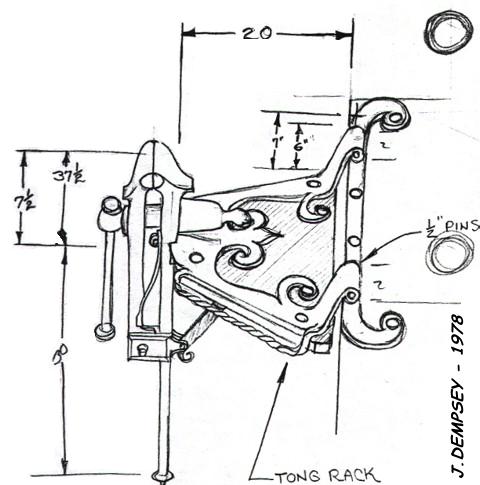 When I mounted this vise I made a bracket that the vise fit into so that it did not rotate and where this shows a single diagonal to the leg there are two at angles matching the V bracket. I welded a tab to the back of the leg for the diagonals to bolt to. It was small but it was the best vice I have ever used. My next favorite vise is a 130 pound Prentis chipping vise mounted on a bench with a heavy bracket underneight that attaches to the wall behind the vice. The bench is bolted to the wall and floor at four corners then the vise is anchored through a 3/4" bolt to an 8 x 10 wall bracket with through bolts. You could pull the building down with this setup. And that is the point. |
| - guru - Saturday, 05/13/06 22:30:16 EDT |
|
Steven G - Postvise: 4 - 4 1/2" and 40 - 50# is a nice size. |
| Dave Boyer - Saturday, 05/13/06 22:39:16 EDT |
|
As always, thank you very much for the advice. I definately anticipate that I will need to buy a larger anvil eventually. I plan to learn how to forge on this smaller one while keeping my eyes open for a 200+lb anvil. Thanks as well for the advice on post vises. I have been told that there will be a huge amount of equipment for sale at this meet so hopefully I should be able to come away with a vise in good condition. |
| Steven Galonska - Sunday, 05/14/06 01:02:20 EDT |
|
The best mount for a post vise is just what the name implies; a post. Set a 6x6 or an 8x8 post about three feet deep in concrete, with enough apron around it to accept the leg without cracking. I use a steel plate that is lag bolted on two sides of the post and rests on the concrete with a hole for the leg pin. At the top of the post I have tray about 10 x 14 inches welded to a heft cap for the post. The tray is heavy enough plate to have tapped holes for the vise bracket. I can walk all the way around the vise and it set where I can clamp one end of a 20' stick os stock in it, if need be. Now, if it would raise up and down it would be just perfect, but unless your shop is in an old service station with a floor hoist, I'm darned if I know how to make the up and down thing work well. (grin) I also have a decent-sized chipping vise mounted to a bench. The bolts for the mount go through the benchtop and on the bottom, instead of washers, I use 5/8" rod flattened and drilled at the ends. One end is under the nut, the other end is bolted to the wall, down near the floor. The bench top is bolted to the wall with angle iron, so that vise will NOT move, no matter how hard I yank on something in it...even with a cheater pipe. ONe other VERY handy vise, especially for demos, is one that is adapted to either drop in the hardie hole on your anvil, or can be bolted to it. I modified a fairly small 4" bench vise to go in my hardie hole. I believe it was Ken Scharabok, of Poor Boy Blacksmith Tools, who took an anvil and drilled/tapped the side to accept the moveable jaw of a small vise, with the other jaw being the side of the anvil. That actually seemed like a darn good idea for an anvil used for demos, as one problem with vises for demos is finding a *convenient* way to mount one that is stable. One reason for using a post vise is that it will withstand pounding due to the leg connecting the fixed jaw to the ground. A vise wherein th efixed jaw is the side of your anvil would also allow a fair bit of pounding, no? A bit low for filing, but acceptable for a brief demo, I'm sure. |
| vicopper - Sunday, 05/14/06 01:24:09 EDT |
|
Mike, I live in Vancouver,(at least part time,,,) I might look into this one. I believe the foundry was known as "Fick Foundry" in the 70's making manhole covers, rainwater drains etc. Far as I know its still there, But maybe as a different name. |
| - Sven - Sunday, 05/14/06 02:09:31 EDT |
|
I can find all kinds of imformation on forges, anvils, vises & technics, but I find little on how to put a good finish on the things I forge. Sure I can paint them so they don't rust, but are there other technics to get a good finish that won't rust? I would be greatful for any information. |
| - Bill Helean - Sunday, 05/14/06 05:33:46 EDT |
|
I can find all kinds of imformation on forges, anvils, vises & technics, but I find little on how to put a good finish on the things I forge. Sure I can paint them so they don't rust, but are there other technics to get a good finish that won't rust? I would be greatful for any information. |
| - Bill Helean - Sunday, 05/14/06 05:34:33 EDT |
|
I can find all kinds of imformation on forges, anvils,vises,& forging technics,but I can't find much on how to put a finish on the products I forge. Sure I can paint them, but the paint burns off with the tools I make for the fire place & they seem to rust fairly quick. Any information would be of great help. |
| bill - Sunday, 05/14/06 05:38:55 EDT |
|
Mike Garrahan: I have spoken to Richard Postman in the past about anvil manufacturing in Canada. He said as far as he knew at the time all of them were one-piece cast. Casting may range from cast iron to cast steel or just whatever they happened to be pouring that day. They may have had various molds ready and just cast them when they had material left over from another pour. May have been for employees, local sale or through a distributor. Not an absolute test but tap the end of the horn with a hammer. Generally the higher quality of the steel the more distinctive the ring will be. |
| Ken Scharabok - Sunday, 05/14/06 06:56:06 EDT |
|
Steven Galonska: While postvises were originally sold by the pound I have never seen anyone walking around a tailgate sales area at a conference weighing them. Rule of thumb has been $X per inch of jaw. At one time the standard was $10 per inch, but that has crept up to usually a minimum of $20 per inch. Those prices were for a complete vise in good condition. There isn't much you can do with one with bad threads. A missing spring is easy to make. You can made a missing bench bracket, but it would be a lot easier just to continue looking. |
| Ken Scharabok - Sunday, 05/14/06 07:01:18 EDT |
|
Finishes: Bill, It depends on the application of your work, where it goes and the local environment but good paint is the best route to go. Wax and oil finishes require maintenance that the owner will not give and when it rusts its your fault and your reputation. Paint does not have to be thick and goopy. Multiple coats of different products (cold galvanizing, primer, top coats) if sprayed on will show ALL the textural detail. Finishing your work is part of the ART and if you want your work to look fresh forged then work on creating a finish that has that look. I repeatedly harp on the fact that if Hollywood can make wood and plaster look like anything form brick to chrome to wrought iron then smiths should be able to make wrought iron look like wrought iron. Black is boring and many beautiful things can be done with color on iron. This is one thing many fabricators are doing that is beating the pants off the "artist blacksmiths" and between the finishes and the higher quality components the all hand made work is loosing the quality battle. Good high quality attractive duarable finishes are a part of the job. Those that think they are great artist blacksmiths, or "purists", that throw a coat of oil or wax on their and ship it are only doing half a job. It may be great forge work but it IS NOT a great product. |
| - guru - Sunday, 05/14/06 08:26:40 EDT |
|
Vises by Weight: Ken, since I have started harping on this point several years ago I see more vises at gatherings marked in pounds. Of course you have to trust the seller. But then we buy unmarked anvils that have been weighed by the seller all the time. The point is that given two vises with 5" jaws the one that weighs 10 or 15 pounds more is a much better vise for the money considering everything else is equal. Although you might not be able to weigh or pickup both vises at the same time the vise will LOOK heavier if you look close. Vises came in 1/4" increments but many jaw sizes are duplicated as the weight goes up (from the one manufacturer's list we have) Consider the 8" jaw Chinese vises that the Kaynes sell (currently out of stock). They are a forged vise of English style and the material is probably better than the old wrought iron vises which were a little soft. But the 8" vise weighs only 120 pounds. This is a LOT less iron than the old ones where an 8" vise weighed 200 to 250 pounds. Although new vices are selling for more than old, when it comes to the rare ones over 130 pounds and especially the biggest ones in the 200 pound class, if in good condition they ocassionaly sell quite high. Kens $20/inch rule is low on big vises which have been selling for $25-$30/inch or $1/pound. This is still a bargain compared to used anvil prices. In fact, it depends on where you are. I have not seen $20/inch vises for years. But when those Chinese 8" vises start showing up on the used equipment market should they sell for the same price as an old vise of twice the weight? Not two many years ago when Centaur had no competition in the new leg vise business they were selling the English 4.5" vise for $1400. They are not nearly as pretty as the old vises (have some arc welding and the nut is not finished). I have seen folks try to get HALF what they cost new and settled for much much less. As tools go they are worth that much compared to other forged tools but there are an awful lot of good used old vises still floating around for bargain prices. They are currently the best investment in blacksmithing today and MUCH safer than the stock market. |
| - guru - Sunday, 05/14/06 09:26:20 EDT |
|
More from Vancouver Wa. I think this is it. www.varicast.com/home.htm |
| - Sven - Sunday, 05/14/06 10:53:13 EDT |
|
I have a post vise that I would like to be able to take with to a local education day. Can anyone suggest a method of mounting it that would be portable. I will only be working with smaller stock, 3/8-1/2",so it doesn't have to be mounted on a bench. |
| Patrick - Sunday, 05/14/06 11:14:04 EDT |
|
Guru is right about the screw bieng the important thing in postvises. BUT IF you have access to a lathe, adapting an acme screw from some other use, such as a scaffold leg jack, to the post vise is not that hard. You can get a post vise with a missing or bad screw very cheap, and make a new acme screw/nut assembly from an old acme screw and come out very well. That is what I did for my first post vise, and it actually works better than my bigger all original vise. |
| - John Odom - Sunday, 05/14/06 11:16:21 EDT |
|
I finished the candle snuffer, it came out beautifully. I'm sure my mother will love it for Mother's Day. I made a basket twist handle with a nice small hook end. I made the other end a hinge by hot cutting the tip lengthwise, then spreading it with a piece of sheet between. I went with the lilly candleholder idea, but put a tab at the base to fit the slotted end of the handle. Hot riveted the whole thing together. Thanks a lot everyone for your help. The iForge demos are excellent. |
| - Nippulini - Sunday, 05/14/06 12:42:00 EDT |
|
Patrick: If we had a photo album I'd show you how I mount my portable vise. I made a table of 4 inch thick maple, with four removeable legs. The table is about 40" long and maybe 15" wide, so it has some weight to it. I have my tong rack on one side, for more weight. I mount the vise on one end, and a hand cranked grinder on the other. It is not real solid, but does do a pretty good job for demo applications. |
| - Bob H. - Sunday, 05/14/06 14:57:03 EDT |
|
Thanks for the advise, but I really do want something really portable as I have a Ford Ranger(I call it my pretend truck) so not a lot of room with all the other things to take. I have made a hammer/tool rack for this demo and might have to do some trial and error to find what will work. |
| Patrick - Sunday, 05/14/06 15:23:18 EDT |
|
kkj,kp;lkljlholhjlhlokpjohjo.jp;jklujpjpyupujpyujohgkghkgh |
| - kkgkho gohpgog - Sunday, 05/14/06 15:47:47 EDT |
|
WARPING: Usually, warping or distortion is due to uneven heating or uneven cooling. Distortion is the response to unbalanced stresses that are created by heating and cooling when the heat transfer or distribution is not uniform. Try to keep the parts separated to let the heat flow around them, keep them fully supported, make sure the furnace is uniformly heated, heat slowly, soak for 1 hour per inch of thickness, cool as uniformly as you heated it and you stand a chance of keeping the parts straight. |
| quenchcrack - Sunday, 05/14/06 16:00:38 EDT |
|
Hi there, i was wondering what the difference between Blackmsmith, stoker, and lump coal are, WWW.CoalAndFirewood.com its a local company , and their "Blacksmith Coal" is 35cents a pound, and their lump and stoker is about 12ents a pound, why the huge difference, also, their blacksmith coal is marble to pea sized with lots of dust, what one would be the best to buy, taking into account, ease of use, and all that, , im using a brake drum forge, thanks |
| Cameron - Sunday, 05/14/06 16:04:43 EDT |
|
I am a beginner blacksmith an I am havein trouble getin my Cole to stick together Do I haft to use fresh Cole ever time? |
| Terry - Sunday, 05/14/06 16:20:05 EDT |
|
Terry , do you understand the process of coal becoming coke ? Beginning is hard because you are learning to forge metal & and keep a fire at the same time ...I am no longer active , just stumbled in here today ... See if you get some lively help here ... if not then Email me in a few days , no sence reinventing the wheel... best to you Phil j. |
| Phil J. - Sunday, 05/14/06 18:17:32 EDT |
|
Radii for edges of anvil face: Hello, I've been busy most of the day cleaning up the anvil I bought yesterday. Thankfully it appear that I will only need to sand down about .010" to remove 95% of the blemishes on the face. The lowest point I measured was only about .015" below the highest point, which is in line with the 1/64" max for resurfacing mentioned in the anvil FAQ. I do have a question on what to use for the edge radii. I have found a couple of conflicting opinions on this "New Edge of the Anvil" by Jack Andrews recommends finishing the edges fron the shoulder to the midpoint at a 3/8" radius and the edges from the midpoint to the heel at a 1/4" radius. Another book I have read, "A Blacksmithing Primer" by Randy McDaniel, recommend finishing the first 4"-5" past the shoulder at a 1/4" radius and the rest of the edges at a 1/8" radius. I am going to hold off doing any finishing on the edges until I have reseached this more thoroughly. I was hoping some experienced smiths could give me some advice on what types of edge configurations they have found useful. Thanks. |
| Steven Galonska - Sunday, 05/14/06 18:25:14 EDT |
|
Hello , I was just going to pop in and offer to share info...on stick welding beat-up anvils , broaken / chipped /face comeing loose around the sides / or resurfaceing completely on a code-blue anvil... I type terribly slow , but if there is interest , I can converse with a good typist / and relay what has worked so well for me .... reguards Phil J. |
| Phil J. - Sunday, 05/14/06 18:28:37 EDT |
|
Cameron, Thanks for the coal site! I've been trying to locate a good coal supplier so I can start using coal for my forge for a fairly long while now. Although I'm by far not an expert on coal, I would personally think that the Stoker coal would be better because of size issues. This is just my opinion however, and I would like to know the right answer myself so I can order some as well. ---Rob |
| - Rob - Sunday, 05/14/06 19:23:50 EDT |
|
Can I acheive useful hardening on bright mild steel? I don't know what carbon content BMS has. Maybe I can use carbon to introduce surface hardness but of course I would rather not. Thanks - JW |
| Jonathan Woolrich - Sunday, 05/14/06 19:28:08 EDT |
|
Rob- I don't have any experience running a coal forge, but I do design coal-fired steam boilers as my profession and have worked on a number of research projects studying the combustion of coal. You may want to call that supplier and ask for a fuel analysis for each type of fuel. They should have at least a dry-proximate analysis (heating value, %ash, %fixed carbon, and %volatile matter). I suspect that there will be a significant difference in the fuel analysis as what appears to be a slight difference in size alone would not warrant a 200% increase in price between the stoker and blacksmith coal. Both coals appear to be coarse ground. The blacksmith coal may be somewhat finer, but this would only require an adjustment in the crusher and wouldn't result in that big of a price jump. I would suspect that the blacksmith coal likely has a higher heating value and likely a lower percentage of ash as well. |
| Steven Galonska - Sunday, 05/14/06 19:59:18 EDT |
|
Patrick I saw a post vise that was mounted to a wooden whiskey barrel, when filled with water, it was quite stable, and empty with the post vise removed it was portable. Extensions mounted to the top provided for a hand grinder, work surface and tool rack. The leg support was made from a 3"x1/4" stock conected to the bottom of the barrel. |
| habu - Sunday, 05/14/06 20:02:00 EDT |
|
Slack tub size? I finally got my forge going - yay! Frustrating, though, to see the wide difference between what I see in my head before I start and what I see in my hand when I'm done. Sigh - but I have a lot of steel and coal (my tuition, as it were), and this website. Here's the question: given a 12x12 barn as a smithy, how big a slack tub would you want? I am using a standard galvanized feed bucket right now, and while it works for the hooks and short end treatments, to cool from the long end only works if the stock is under a foot long. I'm guessing the half-whiskey barrel would be the most likely candidate. And will freezing next winter break it apart? Thoughts? |
| Tim S - Sunday, 05/14/06 20:29:47 EDT |
|
Steve Galonska, Be very careful when it comes to believing what you hear, or read, about proper edge radii for anvils. In almlost every case that I have heard or seen, the person was saying "radius" but really meant "diameter", a difference of 100%. That 3/8" "radius" will result in an edge with roughly the contour of a broom handle; a bit much, in my opinion. 3/8" diameter, on the other hand, is just about right for the first four or five inches of edge back from the step. (This is based on an anvil of about 175-250#) I personally only like that much on the off side; on the near side, I use about 2/3 that much, or roughly a 1/4" diameter (1/8" radius). For the few occasions where I need a larger radius on the "near" side, I just walk around the anvil. The remainder of my anvil's face I llike to have about a 1/16" diameter, which I find to be the minimum that will generally prevent stress risers and yet is atill tight enough to "cut" small stock on the corner. |
| vicopper - Sunday, 05/14/06 21:21:02 EDT |
|
Cameron: You want SOFT coal for smithing. I don't know about where You are, but around here [Pa.] stoker coal is anthricite, the wrong type of coal. |
| Dave Boyer - Sunday, 05/14/06 21:28:11 EDT |
|
Tim S, That's not really that important, but it just needs to be so that there is enough water, oil, or watever that it won't heat up too much to make it useless for quenching. |
| - Tyler Murch - Sunday, 05/14/06 21:33:46 EDT |
|
Jonathan Woolrich, "Useful hardening" is a pretty broad term, and Bright Mild Steel means, I assume, cold-finished A-36 structural mild steel. The carbon content of A-36 can vary pretty widely, from too low to harden to almost medium carbon, hardenable for uses other than cutting edges. The only specification for A-36 is pretty mcuh that it will have a minimum yield strength (tensile) of 36kpsi. Further, deponent sayeth not. Adding carbon is practicable only for the outer few thousandths of an inch, using Kasenit™ or a carbon box, and gives wear resistance, but no deep hardness needed for cutting edges or high-yield springs and the like. There are folks who swear that you can harden mild steel using Rob Gunter's "SuperQuench" formula (basically, brine with a surfactant added), but I haven't noticed any huge difference when I've tried it, and does make everything in sight rust like mad. YMMV. |
| vicopper - Sunday, 05/14/06 21:34:02 EDT |
|
Slack tub size, well I'm currently in a 20'x30' smithy and my slack tub size is *zero*, well I have a coffee can sized one for procedures that require specific area coooling; but when I want something to cool I chuck it out the door to cool off on the dirt, or hang it on a hook, or lay it on the soapstone bench top---too many bad experiences with A36 hardening when you didn't want it to. Wasn't it St Francis (Whiticker--sp) who banned slack tubs from his shop? Portable Post vise mount: I use a 55 gallon steel barrel with a bung low on the side. Cut a chunk of 2x12 to fit inside along an edge and used lag bolts to hold it in place. Holds all my scrap steel when travelling and the vise btw (and I'm on my third small 4 cyl imported PU, been carrying all my stuff both for demo's and camping that way for 15 years) Fill with water and you have a fire safety water supply and 400+ pounds of stability, unscrew the bung and it self empties. I do put the bottom of the leg in a pipe welded to a flat plate (actually its the head of a hand powered tamper) and then stake the plate down so I can get serious bending with it. A wooden barrel is much neater but more fragile and heavier to transport. Thomas |
| Thomas Powers - Sunday, 05/14/06 21:38:24 EDT |
|
Thanks for info rea my anvil made by vancouver iron & steel foundry. They are still in business under the name varicast inc. in Vancouver Wa. I'll contact them to see if they can provide additional info. Thanks again. |
| - mike garrahan - Sunday, 05/14/06 22:12:26 EDT |
|
Slack Tubs: I've used a 20 gallon drum (until it rusted out), a galvanized wash tub, and (presently) a 44 gallon square stainless steel crab cooker. During the winter I've kept them from freezing (mostly) with a heat wand under the bottom, and a trouble light with a 60 watt bulb on the top, but this only works when you have them on the metal to transmit the heat. Old electric blankets worked well, but the mice liked them too much. I understand that with wooden slack tubs, traditionally, folks would lean in a 4" X 4" timber in the winter to keep the ice from bursting the tub. I usually have to have a lid on my slack tub, or the mice fall in and drown. Not very sanitary. :-P I don't know about Francis Whitaker, but 44 gallons provides for fire emergencies (as Thomas suggests), quick burn cooling in case of injury, and provides for whatever else needs cooling or wetting down when operating the coal or gas forge. Working low carbon and wrought, I use it sparingly, but it's there for me when I need it. Like anvils, having a little too much water is better than not having enough. (Then again, I live in a wet part of the country, between the swamp and the river. ;-) Thunder storms have passed through along the banks of the lower Potomac. New England is getting clobbered. I'll have to check with the park in CT that I'm working with when I get back to work on Tuesday. Visit your National Parks: www.nps.gov Go viking: www.longshipco.org |
| Bruce Blackistone (Atli) - Sunday, 05/14/06 23:12:02 EDT |
|
Anvil edge radius I ended up putting a 3/8" dia roundover at my horn end, tapering it to nothing 3/4 of the way back. In this way, I get a nice continuum of radii to choose from. After working with this for about a year, I ended up putting a 1" dia roundover down by the horn end, just because I like the broad roundover for many operations. The horn would do this, but the edge of the anvil is more convenient, and better performing(more mass under it). My suggestion: Start with a small radius, and you can always file or grind a larger one as the need arises. |
| - Tom T - Sunday, 05/14/06 23:22:58 EDT |
|
Portable Vise Stand: There are a couple options. Farriers use a stand that supports both the vise and anvil. The anvil adds some mass to hold things down. However, the vise is usually a special light duty thing made as part of the stand. Another is a 55 gallon drum that you fill with water. The vise attaches to a wood bracket made to fit the side of the drum. When empty it doesn't weigh much. It helps to put a drain cock in the side of the drum to empty the water. This design assumes you will have a supply of water to fill the drum. It is VERY helpful to put a screen about 1/3 way down the drum so that pieces tossed in are not in 3 feet of water. . . AND, although it is not pretty a stand that attaches to a hitch reciever makes your truck or car your anchor for the vise. . . pretty steady. Then there is the one with the flat disk in the leg vise FAQ. It is fairly light and when you stand on the plate you CANNOT move the vise. You and it are on the same support and therefore you cannot move it. As shown mine needed larger diagonals as the vise was rather springy. Most of the time this is not a problem but when sawing it would bounce back and forth. . . |
| - guru - Monday, 05/15/06 00:51:22 EDT |
|
Slack Tub: I agree with Thomas about the fact that mild steel is not so mild and you can end up with some very brittle work. However, tongs get hot. . many things get hot and need cooling. 5 gallons works but half a 55 gallon barrel is traditional and is a good size. Avoid plastic as you can end up with a hole melted in the bottom. . . |
| - guru - Monday, 05/15/06 00:53:39 EDT |
|
Corner Radius: First, be VERY clear about radius verses diameter. Radius is the proper term and measure. A 3/16 (5mm) radius is pretty common for a short distance over the waist of the anvil where you do heavy work. Some folks taper off from here, others just stop and radius the rest with just enough not to be too sharp. The radius is proportional to the size of the anvil. Most of the anvils I have had were chipped up pretty bad and had as mush as a 1/4" (7mm) radius in some places to clean up most of the chipping. This sort of tells you what they needed prior to getting all chipped up. On anvils with double horns the square horn is radiused just enough to have a soft edge (about 1/16" radius) and the body is radiused to taste but no less than 1/8" and as much as 1/4". European anvils with the sloping far side need less radius due to the much greater than 90° corner whish is less likely to ship. However the near side is 90° and needs as much as any other. Anvils with clip horns should have the sides of the clip radiused but the end is wedge shaped for getting into tight places and should just be broken and smoothed. |
| - guru - Monday, 05/15/06 01:10:56 EDT |
|
Another point of view concerning corner radius: If You have a softer anvil You could probably get away with a smaller radius, but the harder anvil will need a substantial [Jock's specs] radius in the area where a heavy misstrike is a probability. STEVE- Your anvil is probably pretty hard, don't skimp on the radius. After the belt grinder the edges may be pretty sharp, 1/32 to 1/16 radius is needed just so You can handle it without carving Yourself up, not to mention what would happen if You slam Your knukles into it. |
| Dave Boyer - Monday, 05/15/06 03:30:54 EDT |
|
Mike Garrahan: Please let me know what you find out about VI&SF and I will pass it on to Richard Postman. Only listing I could find for a VARICAST in the Northwest was a welding and ironwork shop in Portland, OR. |
| Ken Scharabok - Monday, 05/15/06 06:44:22 EDT |
|
I have acquired both a model 6a and 4a emmert bench vise and am needing information on approximate value and available parts suppliers. I will also contact my local machine shop in Washington, MO |
| - Mike Peters - Monday, 05/15/06 08:33:37 EDT |
|
Mike: I have an Emmert "Turtleback." I love it! If you Google "Emmert patternmaker's vise" You will find lots of resources. Also look up Olt Tools Mail List. There are a lot of Emmert enthusiasts there. I have seen Emmerts go form $100 to $1,000, depending on condition of the vise and the market. |
| - John Odom - Monday, 05/15/06 09:41:30 EDT |
|
Support your local machine shop. Recently,I was in need of some pillow block bearings and after looking on-line at several big warehouse dealers, I found that most wanted $20.00 to $35.00 each plus shipping ! Our maintenance man suggested I give one of the local machine shops a call, He had them for $11.00 bucks and goods one at that. I asked him if he dealt with any blacksmiths, he said "Blacksmiths, that’s manual labor boy! What the heck wrong with you ? " of course I sanitize the conversion. He was joking I think. Anyway by supporting the machine shop now they might just be in business when I really do need some serious work done. |
| daveb - Monday, 05/15/06 10:05:57 EDT |
|
Coal types: If you can find coal labelled as "blacksmith's coal" buy it. The days of high-quality stoker coal are over in the southeastern U.S. You do want small bits, marble-to-pea sized is perfect. Bigger lumps must be broken up to be used in a forge. Somehwere on this site is a list of desirable coal qualities, but the short version is that you want a high volatile, low sulfer soft coal that cokes well. Good smithing coal is nearly smokeless once it's burning well, high-sulfer stoker will lay a greasy yellow-to-black smokescreen the whole time you're burning it. That's why "blacksmith's" coal is more expensive. It's better. Keeps the neighbors happier, and doesn't get so much crud on the steel that you can't weld in it. Dust or Fines are okay, but you'll have to use some water to control a fire with a lot of dust in it. When wetted, coal dust sticks together and forms big lumps of coke around the fire. A little water helps most green (uncoked)coal coke up and stick together, actually, but use it sparingly. Also, always have some air blowing when you water a new coal fire. The water reacts with coal to form a heavier-than-air gas that can explode if hit with fresh air, which will test both your intestinal fortitude and your hearing should your blower duct suddenly disappear with a mighty BOOM! Fear not, a slight breeze will keep that from happening. |
| Alan-L - Monday, 05/15/06 10:09:32 EDT |
|
Mike: Here is a good Emmert Vise starting point: http://mprime.com/emmert/index.htm Enjoy those vises! You are now an LBEVO. (Lucky Bastard Emmert Vise Owner) |
| - John Odom - Monday, 05/15/06 10:10:21 EDT |
|
Thank you John, I have looked through "mprime.com". that site seems to be dedicated more to the woodworkers vises. The models I have are the rotating 3-head metalworkers type. I am looking for the threaded collar that applies the clamping force. Any help is appreciated. |
| - Mike Peters - Monday, 05/15/06 12:39:37 EDT |
|
my cooling tub is 1/2 a wine barrel. Was cheap (free) as my wife was working there at the time. KISS keep it smiple and to what you can adapt to hand.That iswhat makes a smith in my opinion, which if asked, I always have one. |
| Ralph - Monday, 05/15/06 13:15:26 EDT |
|
Dear Guru; I have a couple of anvils I like to use when I hammer gun parts and knive blade, but they seem dead. No ring or bounce. Someone has told me the anvils must have been in a fire and were tempered down. If this is so, is there a way to re-harden the anvils, or is there a service around which would do this for me? |
| Alan E. Hoeweler - Monday, 05/15/06 14:39:06 EDT |
|
Hi,I'm going to make punches and cutting tools out of coil and leaf springs, i have heard that they can be worked too hot and so spoil steel? also what post heat treatment do they require, if any, to have them as durable as possible, but not brittle? |
| grimme - Monday, 05/15/06 14:42:45 EDT |
|
Dead Anvils: Alan H., There are several brands of anvils that were made with a cast iron body and hard steel face. These have no ring and rebound is reduced somewhat. They are good anvils but people either love them or hate them. The ORIGINAL is Fisher-Norris and had an Eagle on the side of most of them. There are also many 100% cast iron "Anvil Shaped Objects" in circulation. These are not "real" anvils, just cheap. ebay is loaded with them. They are door stops and lawn ornaments. IF your anvil is an old wrought (forged) anvil and is soft then you have a problem. To harden it you will need to bring the entire anvil up to hardening temperature (a little above non-magnetic) and then quench under a stream of water (a veritable water fall of maybe 100 to 200 GPM). After the anvil is quenched thouroughly it is set aside to finish cooling and the residual heat in the core should temper the anvil. This is a big expensive job. More expensive to setup and do a one-off than to buy a new anvil. |
| - guru - Monday, 05/15/06 15:02:21 EDT |
|
Spring Steels: Grimme, these vary greatly and can require different heat treatments. See our FAQs about Junkyard Steels and Heat Treating. |
| - guru - Monday, 05/15/06 15:05:16 EDT |
|
Slack tub: I've been using a half-whiskey barrel for a couple years, and it works fine. My shop doesn't freeze up, but my old teacher's did. He had the same type of tub and it never ruptured when it froze. |
| - Marc - Monday, 05/15/06 15:13:02 EDT |
|
Wheeoow. . We just had a hail storm that had nickle and quarter sized hail and left an inch on the ground and deck. . . Loads of fun moving the car under the car-port in the storm! Ice in my pockets, ice in my shirt. . . Then gone as soon as it came. Shoveling ice of the porch in May in NC! |
| - guru - Monday, 05/15/06 16:45:46 EDT |
|
Slack Tub: I picked up a half keg used for beer. Looks to be stainless. I intend to cut it with my sawsall unless someone has a better idea. Should hold about 12 to 15 gallons I would think. It was free! Hooray! |
| Ellen - Monday, 05/15/06 17:27:33 EDT |
|
Alan Hoeweler, I attempted to send you an email with further informaiton about your anvil question, but apparently the email address you provided is bogus. I seem to have wasted a not insignificant amount of time trying to help you. Next time, I'd suggest a valid email address if you sincerely want information. |
| vicopper - Monday, 05/15/06 17:42:07 EDT |
|
VIC, Try alan.hoeweler at. . Our incryption system still scrambles addresses with multiple periods. . . |
| - guru - Monday, 05/15/06 17:56:53 EDT |
|
Hello Guru, I need some advise on how to "draw steel" with heat. I'm a machinist and welder and I work for a small job shop. For the past month I have been welding together large weldments, and as you could imagine thay turn out looking like a bannana when I'm done. My boss showed me how to "draw" the weldment straight with the torch and a bucket of water heating only one side and quenching the other side...personaly I think he is full of it...it didn't work for him either, but I remember seeing it done before. Any advise would be apreciated. |
| - Aaron D - Monday, 05/15/06 18:33:12 EDT |
|
I'll try that Jock, thanks. I forgot about the encryption issue. |
| vicopper - Monday, 05/15/06 18:39:41 EDT |
|
Ellen: beer kegs are stainless, either 303 or 304 I think. A plasma cutter is much better than a sawzall if you have access to one. I use several kegs with the top cut out for brewing beer. That stainless is hard on a saw. It should be 15.5 gals if about 36" high. Leave the rim on with the handholds, just cut out the piece where the tap is, as close to the sides as possible and deburr it. |
| - rthibeau - Monday, 05/15/06 18:48:43 EDT |
|
I am looking for good qualiy blacksmith/bladesmith anvil. The anvil can't cost more than about $500 bucks. It needs to be a large one well suited lots of use. |
| russell - Monday, 05/15/06 18:48:51 EDT |
|
Straightening weldments: Aaron, Generally you just have to use a MUCH bigger hammer. . . A lot depends on what the weldment is for and what stresses are allowed. In a highly loaded situation adding stresses with heat and cooling is not a good idea. The part can end up with over half its capacity taken up by just lying there straight. . . First step is to NOT make warped weldments. This as you know is much easier said than done. It takes practice and thought. Careful tacking then welding in short stretches on opposite sides of the part. Alowing cooling between beads. A good designer designs weldments with stitch welds, not long continous beads. Where long full beads are shown they can be made in parts then the gaps filled. This allows the part to relax between beads and when done correctly it will be straight (or close enough to use a big hammer). One of the most fool proof methods of heat straightening is to grind a rounded groove and fill with weld bead. This will take a convex surface and pull it back straight. The length and amount of bead must be experimented with but just a couple inch bead can deflect a 2" thick plate. But the resulting stresses are huge! For reliability the entire part (or the weld zones) should be heated to a red heat, straightened and allowed to cool. This should remove the weld stress and let the part remain straight. Again, the engineering and weld spec should be consulted (if it references a standard, then you will need to obtain it). Often the weld process is specified to NOT effect the mill temper of a part other than in the weld zone. Heating to straighten it would be in violation of the specification. |
| - guru - Monday, 05/15/06 18:51:22 EDT |
|
Anvil for under $500: Russel, Then you will likely need to shop the used equipment market. Otherwise it is like saying I want to buy a NEW pickup truck for $10000 or less. . . You can get a Delta TFS 100 lb. anvil for $525 from Blacksmiths Depot, $550 from Centaur Forge You can get a 175 pound Euroanvil for $540 from Blacksmith Supply. You can get a 81 pound "Hollow Core" anvil from MFC for $350 unfinished and $375 finished. However, these are farriers pattern anvils. You can also get small farriers anvils from Centaur forge. Price advantages and diadvantages to the above depend on how far the anvils need to be shipped. Many bladesmiths are using a 30" or so length of 5' to 6" diameter shafting set on end. These 160 to 240 pound pieces of steel have the mass inline with the blow of the hammer and are as effective as an anvil two or three times their actual weight. However they have no anvil "features", just a flat face and edges. |
| - guru - Monday, 05/15/06 19:09:30 EDT |
|
There is a good book on the subject of straightening weldments, written by a welder/fitter with a good 40 years of experience, called "Flame Straightening Technology" by John P. Stewart. I think you have to order it from him, he lives in Ontario. If anyone is interested, email me and I can give you his address. It covers this subject, with a lot of examples of techniques. At last falls NWBA conference, John Adoph, from Vancouver Island, Canada, demonstrated this as well- he worked in heavy construction for 50 years or so, and can tie I beams into knots with heat and water. He uses a compressed air line with water injection, blowing very high pressure water/air mix at the heated area, to precisely and quickly cool exactly what he wants. He told a story about building a bridge up in the interior of British Columbia, years ago, and the crane operator dropped a 50 foot long 3 foot custom rolled I beam down the canyon, bending it. Lead time to get a new one was 3 months or so, 100 plus guys were working- so in 24 hours or so, they straightened it. So it is definitely do-able- but it takes skill, and practice. Not every weldment can be straightened, but most can. When they built the Space Needle, in Seattle, in 1961, they built up huge welded sections for the legs, and since it is 605 feet tall, they didnt have rolls big enough- so all the curves on the legs were done with big torches and cold water, on the floor of the plant at Pacific Car and Foundry. Heat, cool, and the legs pulled up against the stops they had bolted to the floor. |
| ries - Monday, 05/15/06 19:53:57 EDT |
|
rthibeau: thanks for the info. No plasma cutter, so saw it is the choice. Don't think an oxy-acetylene torch will work on stainless, but can fire up the torch and try it. I was planning on leaving those beautiful handles in place. |
| Ellen - Monday, 05/15/06 20:03:32 EDT |
|
Russell, Look at the Chuck Robinson bladesmith's anvil. A great tool. $275 w/out stand, $425 w/ stand. To give you an idea of shipping costs- from MS to GA is $180. http://dfoggknives.com/Anvil.htm |
| - Tyler Murch - Monday, 05/15/06 20:59:25 EDT |
|
Ellen, the oxy/fuel torch will sorta melt a spot then you can sorta blow the melted metal out. It will leave a very nasty looking mess of an edge. If you know anyone with a plasma, it is maybe a 2 minute job to cut a clean neat circle. Less grinding than a sawn cut probably. Good luck |
| ptree - Monday, 05/15/06 21:00:09 EDT |
|
Russell, It's about what YOU want to do. Your style I mean. Some great knives have been forged on unhardened blocks of steel from the scrap yard. Even mild steel. I use a 4" sq. piece of mild for some forging. Check out taigoo.com He has some beautiful knives and uses a mild steel anvil and plain wood for fuel. Many people would try to steer a beginner away from that sort of thing. Do what you want to do. |
| - Tyler Murch - Monday, 05/15/06 21:05:44 EDT |
|
Ellen: you would be better off going through a few cutoff wheels on a 4 1/2 angle grinder than use a torch on that stainless keg. Once you torch it, it hardens and is almost impossible to grind clean and smooth. Is there a shop anywhere around with a plasma cutter? It would be worth paying to have it done before using a torch. Been there. |
| - rthibeau - Monday, 05/15/06 21:40:32 EDT |
|
Ellen:If You try the sawsall,keep the speed really low. In stainless I had better luck with the carbide grit blades than normal toothed blades [using a scroll saw on 16 ga.]. You would probably have better luck with an angle grinder and cuttoff wheels, and that would'nt be a day in the park. |
| Dave Boyer - Monday, 05/15/06 22:03:04 EDT |
|
Ellen, Beer kegs aren't all that thick, so I might give some serious thought to just doing it the old blacksmith's way. Hammer and a sharp chisel. Fill with water first to get it to sit still while you whack away. |
| vicopper - Monday, 05/15/06 23:36:17 EDT |
|
Guru, I was surfing E-bay and saw Frankie8acres ad for the 110 pound ASO. I believe he is still using your picture and he claims that if you see anything in his ad elsewhere that was stolen from HIM. You might already be aware of this and I'm not sure there's anything you can do, but I thought I'd let you know. Item number is 6279379449. |
| - Rich33 - Tuesday, 05/16/06 03:11:06 EDT |
|
On Franie's ASO: I was in a Harbor Freight on Sunday and that anvil has a decal saying "Made in Russia". He skirts the issue by saying they are made in Europe. Technically Russia lies in both Europe and Asia. Also, he shows a photograph of one with the hardy square to the horn as his gallery photo, then says later in the ad another photo with the hardy diamond to the hole is what buyer will receive. Still $89.95 at HF retail outlet. Central Machine brand, which is HF's brand. Unlikely he is getting them anywhere other than a local HF. Another eBay seller has 55-, 110- & 165 anvils which he says are imported from Mexico. They at least have more of a London pattern to them and a 1" hardy hole square to the horn. |
| Ken Scharabok - Tuesday, 05/16/06 03:22:08 EDT |
|
Other types of coal. It seems that this coal for 12 cents per pound is available in large quantities from a store. In that case, I'd recommend buying a few pounds to try out. I have heard about bad coal spitting out a lot of sulfur fumes and being impossible to weld with. Unfortunately, I have experienced both, and once got sick from coal fumes (Chinese "beehive" coal, which is rumored to cause brain damage from repeated inhalation of the fumes). On the other hand, I once stopped at a garage sale and saw some stove coal that the fellow wanted to make me a deal on. Remembering advice I heard over the Internet, I only bought a few pounds and took it over to try out with my striking partner. It worked really well. It coked up just fine, and was hot and clean. But I forgot where I bought it. You should have no such problem if it is a store. Take it to someone who knows the difference, and try it side by side with real blacksmithing coal. That should tell you how much it is worth. |
| EricC - Tuesday, 05/16/06 03:42:12 EDT |
|
Gas forge temperature. The instructor for the gas forge building session at the California Blacksmith's Association suggested that my gas forge heating problem was due to an excessively rich mixture caused by using the wrong size of MIG tip. I used a 0.035 tip for a 1/2 inch burner tube and a 1.5 inch bell. It got the stock up to high orange, and it worked great for forging, but I was afraid that it would not weld. I never tried, since I have a charcoal forge which works for that. Anyway, he suggested that I put in a 0.023 MIG tip and give it a try. It seemed a bit hotter, but I could not tell by looking inside. The refractory was mostly orange, with some yellow (and purple?!!?) spots. There were orange tinged flames coming out in the exhaust, but they were mostly directed sideways. So, I balled up a surplus piece of 12 gauge ground wire and poked it into the forge. It quickly melted into two large drops which splashed to the floor. So, that means that it is hotter than 1980F. Then, I put two pieces of 3/8 rod in and they got up to a light yellow. When touched together, they were definitely very sticky. Unmistakeable. This was with no flux. So, would this forge be hot enough to weld in? I need to get a pyrometer or a thermocouple. My eye is just not able to reliably judge the interior temperature, but I do have these two data points. Actually, the sticking rods tells me a lot. When I was trying (futilely) at the Spring Conference to weld small pieces of square stock to beef them up to make a steak turner (that was all they had available for the workshop), I distinctly remembered no sticking of irons in the fire, even with flux. As I posted earlier in this forum, I was worried about using the dancing borax. But, now that I had experienced sticking for the first time, it was very clear that the irons were not sticking at the workshop, even up to sparking heats. This was using Sierra Forge and Fire's "buckwheat coke" which does not "coke up" since it is already coke. It burned plenty hot, but absolutely no sticking. Perhaps the steel... Anyway, this gas forge experiment gives me a lot of confidence, but sticking is only part of the battle. |
| EricC - Tuesday, 05/16/06 03:55:44 EDT |
|
how to achieve hardness of 60 hrc for spring steel to grade EN47 grade or 50crV4 ? |
| ATUL - Tuesday, 05/16/06 07:34:13 EDT |
|
EricC: My standard propane forges have 3/4" tubes with a 1 1/2" - 3/4" coupler. Orifice size is .0335. Thus, it does sound like you were putting in more gas than air which could be drawn into the 1/2" tube behind it. While forge welding is done at a reduced oxygen your's may have been too gas rich. You can somewhat judge mix by watching the dragon's breath indoors (out of direct sunlight). Yellow flames indicate oxygen rich. Blue flames indicate gas rich. A flame which virtually disappears is essentially neutral. I have noted my personal propane forge runs a LOT hotter if I close off the front opening about half way. I was showing someone my new air hammer and had a piece of 3/4" round in it with the door opening restricted. Got distracted. Come back to find the metal in the process of melting into the 2300 degree firebrick bottom. For those in the Northeast, the Aubuchon Hardware chain sells Blaschak Premium Blacksmith Coal in 40-pound bags. Item #BITUMINOUS. Said to be pretty decent for forging. Your local outlet may have to order it in from the distribution center. I believe the mine is in PA. For those around Louisville, KY, The Elkhorn Coal Company (name may not be exact) has blacksmith-grade coal by the ton, truckload or bag. To check around your local area go to www.switchboard.com, then a search by business (coal), your Zip Code and use 100 miles for search. |
| Ken Scharabok - Tuesday, 05/16/06 08:02:56 EDT |
|
Cutting Stainless: I was working with some scrap stainless (and therefore of unknown alloy content) for a bell-hanger for the new ship. Cutting it with a hack saw was awful. The metal was sort of "gummy" and tended to foul the blade. I ended up making more progress with a chisel and vise. Other stainless I've worked with hasn't been this bad, so it might just be the particular pieces alloy; but I've worked most of the stainless hot rather than cold, so it may be more common than I know. Cloudy and cool on the banks of the Potomac. Visit your National Parks: www.nps.gov Go viking: www.longshipco.org |
| Bruce Blackistone (Atli) - Tuesday, 05/16/06 08:39:04 EDT |
|
I just picked up "Professional Smithing" by Donald Streeter, orig. pub. 1980, reprint 1995. Seems obscure, but has a lot of neat info in it. He describes whitesmithing as work done at the bench, rather than the forge. No scale meant cleaner work. He also writes that since whitesmithing is mainly benchwork, the smith would have less soot on him, hence white instead of black. |
| - Nippulini - Tuesday, 05/16/06 08:42:23 EDT |
|
I have a "second chance" at a Hadfield Sanderson Anvil of approx 106 lbs via eBay. I don't have an anvil of any type at the moment which is quite frustrating. In reading this forum for the last 30 days or so, I realize that 106 lbs is considered too light for any work on material over 1/2" square. Right now, I'd like something so I can start making tongs, and small items (hooks, towel racks, etc) as I learn this craft. I would value your opinion of this anvil. It can be found as eBay item: 6277272343. This would be a local pick up for me which would put my cost at roughly $205. |
| Dennis M - Tuesday, 05/16/06 09:20:05 EDT |
|
Dennis M: The Hadfield-Sanderson was made by Mouse Hole Forge for a client. Mouse Holes themselves seldom sell on Ebay for more than $1.50 lb even if in very good conditon. My theory is their blocky shape somewhat turns people off - as compared to say a Peter Wright. Were it me I would pass on the anvil and wait for a better deal of perhaps 150-170 pounds. Have you considered putting wanted ads in the local small town newspapers to the effect: Wanted: Blacksmith anvil and tools. XXX-XXXX. You may find equipment that way. |
| Ken Scharabok - Tuesday, 05/16/06 09:36:52 EDT |
|
Frankie8acres:, No, he finally polished one of his own and photographed it. However, he SOLD that anvil at a premium and if you read his ad that is NOT what he is selling. Frankie8acres who stole clearly copyrighted information from anvilfire (photos AND text) then flaunted our copyright by claiming HE took the photo, putting HIS name on it and then claimed that it was a "common" photo found anywhere on the internet and then said "sue me". . is now concerned about others using his advertising information! HA HA HA HA HA HA HA HA!!!! His ad is still full of misinformation and he is not using the "Russian" place of manufacture so that people do not find our article about them. He cannot stand up to the truth. I would think using the photo of a hand polished anvil at the top that he is NOT selling and then showing the actual thing WAY, WAY down at the bottom is bait and switch and against the ebay policies somewhere. . . |
| - guru - Tuesday, 05/16/06 10:09:42 EDT |
|
Dennis, for years the anvil I did the most work on was 91 pounds as it was my travel anvil and so got lots of day long pounding at demos rather then the rare times I could work at home, (old house, young family, getting a degree and working more than full time). I truly *love* my 500# Fisher and now that I have a real shop and that degree find I don't use the light one---except when teaching or demo's; but it still is very useful for a hobby smith! Thomas |
| Thomas P - Tuesday, 05/16/06 10:35:20 EDT |
|
Second Chance Anvil: On first glance it looks good but two things bother me. The slope of the cutting table which indicates it has been ground down and the very good corners. This anvil MAY have had the face machined down on it some time ago. When the face is machined the step at the table becomes very short and it was common to grind them back at an angle. There is an anvil with a "repair" like this in Paw-Paw's shop where it is obvious that half the face was machined off. It is more extream than this one but it WAS machined. That would easily explain the 4 pound discrepency between the marked weight and the measured weight. However, I give no credence to bathroom scales +/- 10 to 20 pounds. At one time a couple of the anvil manufacturers in the US advertised repair service of anvils. It may explain why I have seen this exact type of repair more than once. I may be wrong on this point but I don't think so. And that is the problem with old repairs. AND the problem with repairing anvils at all. A little wear and some rust and it is difficult to tell. On third look. . the photo taken from the label side, the "off" side which usualy has the most wear and damage yet this one has a perfect edge. . there is weld porosity and recent grinding all the way to the edge which is sharper than as-delivered on these old anvils. I think this poor old anvil has been repaired more than once. . . Anvil Patterns: These old English anvils have a good thick waist and most of the weight in the center. This makes them a more effective anvil than later models that look prettier but are the same weight. A 100 pound anvil is OK but is a little light if you plan on doing heavy work for a living. I met a fellow that made his living making Colonial reproduction door hardware and he used nothing but a 75 pound Hay-Budden. In fact he had TWO, one as a spare. He had worn a shallow groove in the one he was using! Everything is a matter of scale. |
| - guru - Tuesday, 05/16/06 10:39:46 EDT |
|
Professional Smithing by Streeter: Nip, This was one of the more popular books of the time. It was one of the few that shows REAL shop techniques such as using a press for cutting and blanking, and various special bending jigs for hinges. He was also one of the first to say you needed a power hammer to make a living at smithing. This was at a time when there were a lot of "purists" that thought using a power hammer was "cheating". . I think ALL those guys now have several power hammers in their shop or are accountants or some other paper pushers now. . . I did not put doing a review of this book at the top of my list because it was out of print when I started anvilfire. It is back in print and we need to review it. Let me know if you would like to write a piece on it. I have a copy and can photograph it and scan sample pages as needed. |
| - guru - Tuesday, 05/16/06 10:52:36 EDT |
|
Air compressor break-in. Looking to purchase a larger air compressor. My neighbor said the one he purchased included instructions to run it at full air output for one-half hour to break it in. I looked in the owner's brochure for this one and don't see similar instructions. Is a break-in period required? |
| Ken Scharabok - Tuesday, 05/16/06 11:18:36 EDT |
|
hello everyone. I was wondering if anybody knew a place where I could find out more about my old lathe? Its a lodge& shipley. from the looks of it its fairly old but in great condishion. also does anyone know where I might find some replacement parts? the tool post and diaginal feed handle is missing, but everything else is there.Thanks for all the help. John |
| John Scancella - Tuesday, 05/16/06 11:59:44 EDT |
|
Lodge & Shipley: John, First listing on Google LODGE & SHIPLEY, Sidney, OH, USA, Manufacturer Center Lodge & Shipley Lathes division of Monarch lathes 615 Oak Street Sidney, OH, USA 45365-1335 937-492-4111 FAX: 937-492-7958 Contact: Jim Gilgenbach ... www.lucasprecision.com/monarch/ Note that the link from their home page is broken. But the above works. Back in the early 1950's my Dad worked for Lodge & Shipley as a designer. His tasks included designing the tooling to make the tapered gibs. At this time Lodge & Shipley and Monarch American were seperate companies and they as well as others in the area competed to see who could make the BEST, most durable, industructable machine tools that could possibly be made. It was the ethic that made the United States great and current lack of that ethic is going to destroy us. . Tool posts are semi-universal and an Armstrong should be able to be made to fit. |
| - guru - Tuesday, 05/16/06 12:30:47 EDT |
|
Lathe parts- yes, Monarch will sell you L&S parts- but if you arent Donald Trump, you arent going to like their prices. The handle and the tool post are both generic parts, available from places like MSC, Mcmaster Carr, Enco, and J&L. In the northeast, there are still a few places that sell used parts for old lathes. Check out www.practicalmachinist.com for advice, includig people who can tell you a lot about your lateh, or www.lathes.co.uk for general information about all kinds of old lathes. |
| ries - Tuesday, 05/16/06 12:39:51 EDT |
|
Break-In: Ken, Good modern manufacturers now build their equipment ready to go. It is a simple matter of finishes and tolerances. Remember the good old days in the 50's and 60's when automobiles came with "break-in" instructions? For the first 500 miles do not drive over 35 MPH. For the next 500 do not drive over 45 MPH. Then for the next 1000 miles do not drive over 55 MPH. . . Change the oil at each interval. Also remember auto manufacturers telling you it was "normal" for an engine to use a quart of oil in the first 1,000 miles. . .??? Of course these were in the "good old days" when engine warantees were only 12,000 miles. If they could ease you along a couple months then you were out of the warantee period and it didn't matter. I learned this was a lot of bull when the first engines I rebuilt NEVER used oil (a Chevy 6, Dodge V8, Austin 1500) until they had tens of thousands of miles on them. Either the engine is right or it is not. THEN in the 1970's Ford came out with their 12,000 mile oil. . It made cars more efficient by requiring less oil changes. Of course this was still the 12,000 mile waranttee day. . On an air compressor I could see some benifit to blowing out all the debris before hooking up lines and such. . . |
| - guru - Tuesday, 05/16/06 12:59:40 EDT |
|
This frankie8acres seems to stupid to be true! I think he's a bit too anxious to sell his product. Guru, where is this article on the manufacturer? I'd like to read it. ---Rob |
| - Rob - Tuesday, 05/16/06 13:11:07 EDT |
|
Rob, FAQs, Anvil Selection, Cheap Russian 50 kilo anvil |
| - guru - Tuesday, 05/16/06 13:19:42 EDT |
|
For those worried about the slack tubs freezing and busting. This is a little late, but I have seen several items for swimming pools to prevent the problem of water freezing and busting the walls. Most have to do with using a flexible object to absorb the push of the ice. One is a commercial product called a Gizmo? that screws into the skimmer and sticks up above the water level. When the water freezes it has something to collapse instead of pushing against the walls of the skimmer. Have also seen milk jugs, & 2 liter bottles used by putting a little sand or rocks in them to keep part of them below the surface of the water, and part above. Be sure and take the paper off of them or you will have a mess. Of course this would probably not work if the entire tub was to freeze, but might give you an excuse to do more work to keep the temperature up. |
| david - Tuesday, 05/16/06 13:25:20 EDT |
|
Lodge & Shipley: I sent them an e-mail that their web-site was broken. I got an auto-response that says call . . . Guess they don't check their email or have any faith in the Internet. Of course they are not going to see any results with a broken web page and no useful information. . . As Ries noted, the parts you need are fairly common. They also used to be the kind of parts you made for yourself. But you need a tool post to make one (or a small lathe for a bigger one). |
| - guru - Tuesday, 05/16/06 13:39:36 EDT |
|
ASO's: looks like a Harbor Freight in the bottom image of Franki8acres to me. Amazed he has posted so many positive comments. People buying must be totally ignorant! PT Barnum was right. |
| Ellen - Tuesday, 05/16/06 14:10:48 EDT |
|
Ellen, an abrasive cut-off blade on a circular saw is what a guy at the flea market uses to cut those stainless kegs. He said to set the blade where it just barely cuts through the metal; if you don't, the blade will wear out quickly or bind and break. Also, beware of razor sharp burrs- smooth them to minimize the danger. Wear eye and ear protection- but you know that... |
| Ron Childers - Tuesday, 05/16/06 15:02:23 EDT |
|
Stainless, continued, well an Anvilfire friend who lives in this area has ridden to my rescue and we will set up a time for me to take the keg to his plasma cutter. Life is good! |
| Ellen - Tuesday, 05/16/06 15:32:33 EDT |
|
break in. all Harleys come with very explicit break-in requirements |
| Ralph - Tuesday, 05/16/06 15:38:25 EDT |
|
Eric, I melted copper in my forge, and then had trouble with it coating my work and causing hot cracks (especially at welding heat). If you were able to scrape the drops back out of your forge, you'll probably be okay. But I try my best not to melt copper in mine any more -- with a buildup of flux and junk on the floor, I couldn't get it cleaned out until I relined it. Sounds like Ellen's covered on her keg, but I feel like I could repeat the warning I keep hearing cutting *any* closed vessel with an O/A torch. Apparently unburned acetylene can build up inside the vessel and then detonate. Doesn't sound fun . . . . |
| Mike B - Tuesday, 05/16/06 17:00:23 EDT |
|
Dennis M & Russel Anvil: I am going to list on ebay a quality Emerson London pattern blacksmith anvil weighing in at 158 lbs that has never been used. The anvil maker made this one from 4140 tool steel completely heat treated all surfaces. It is really very nice. I am selling it for less than it cost. It will still cost a bit and shipped at actual shipping cost. Go to ebay and within the next couple of days it will be listed under 108budden. I will say you can't buy a nicer one. |
| - 108budden - Tuesday, 05/16/06 18:26:06 EDT |
|
Reason I am selling the anvil is due to health issues. I am unable to use it. |
| - 108budden - Tuesday, 05/16/06 18:26:48 EDT |
|
I can review Streeter's book. Meanwhile, when I started years ago, I ran across one of Don Streeter's small catalogs. I was impressed, as there was no ABANA at the time. He made hardware for years, mostly repro hardware, in Franklinville, New Jersey. I think he also worked for Yellin briefly in the early days. I'm pretty sure he shared ideas with Peter Ross. When Streeter retired, he moved to Santa Barbara, California, where he met, of all people, Helmut Hillenkamp, now of Santa Fe. Helmut spoke very highly of Don Streeter. |
| Frank Turley - Tuesday, 05/16/06 19:19:14 EDT |
|
I almost went and bought one of those Harbor Freight anvils a couple months ago. Glad I didn't! I can't believe the nerve of that guy. Guru is right, there HAS to be an ebay rule against putting a picture of the WRONG product on the bidding page. |
| - Rob - Tuesday, 05/16/06 19:22:45 EDT |
|
Rob: One problem with eBay is they will allow you to notify them of a suspected fraudulent listing, but won't allow you to explain why you think it is. Perhaps procedures have changed as eBay rapidly evolves. |
| Ken Scharabok - Tuesday, 05/16/06 19:48:55 EDT |
|
Frankie8acres: Well, yes, he does prey on the ignorance of people who do not do their homework before buying something as uncommon as an anvil. But as obnoxious as he is, he is probably not doing anything actually ILLEGAL. There is a person on eBay selling DVD's and gets $7.95 S&H. He takes your order, places an order with another company for the DVD you want, has it drop shipped to you (the other company charges no S&H) and pockets the S&H for doing basically nothing. He has no inventory, he doesn't even have to pay for the shipping even though he is charging you for it! And this is not illegal! Caveat Emptor! |
| quenchcrack - Tuesday, 05/16/06 20:12:07 EDT |
|
HF Russian Anvil: Just for the record, the original selling price of the HF Russian anvil was $79.95 about five years ago. Since they are generally no longer available from HF, the prices have gone up considerably. I recently sold my HF Ruskie for $100 but it had been cleaned up by hand grinding the working surfaces as the FAQ review of this anvil shows. These original HF Anvils were a fair bargain at that price if used as a beginners anvil. Eventually, if you stay with blacksmithing, you will want to replace it with a better one. |
| quenchcrack - Tuesday, 05/16/06 20:18:55 EDT |
|
It is true Frankie8acres preys on the ignorance of people. I have also found folks buy those anvils willingly. It may be because they truely don't have the money for anything that costs more. The otherside is folks are just plain cheap. I have sold many anvils on ebay. Many folks will compare a quality old anvil to Russkies to try and lowball you on the price. They want to pay $50 for a $400 dollars anvil and want you to throw it in the air and have it land in their driveway to avoid paying actual shipping cost. I for one have lost my patience with those folks. Let them by a cast iron turd. It seems when I buy a quality tool I need to pay full tilt and inflated shipping cost. I am sick of cheap people. Then you hear the folks who will drive from Alaska to Florida because they don't want to pay 125.00 in actual shipping. Let them buy cast lumps as well. They are just trying to avoid shipping and get you to pay it when they never show for pickup. They want a brand new truck for the price of a worn out used 10,000 one like Guru stated above. |
| - Burnt Forge - Tuesday, 05/16/06 20:24:40 EDT |
|
As of last Sunday at least the Harbor Freight retail outlet in Clarksville, TN had one of the Russian 110 lb (hardy diamond to the horn) anvils on display. Didn't ask if they had more in the back. $89.95 plus TN state sales tax. I don't think they have ever been carried in the on-line or catalog versions of HF. From what I understand essentially two different operations under one family umbrella (on-line & catalog vs retail outlets). I certainly agree with prior forum comments. If they took the effort to make the hardy hole square to the front, 1" in size and then rounded off the horn it would be a fairly decent starter anvil. |
| Ken Scharabok - Tuesday, 05/16/06 21:13:33 EDT |
|
Ken Scharabok, Compressor break-in: Every piece of reciprocating or rotating equipment that uses oil for lubrication needs to have some "break-in" procedures followed, if you want them to have a long and happy life. When such things are manufactured, they are machined to certain tolerances, and holes are usually, though not always, de-burred, etc. In the first few minutes or hours of use, the largest percentage of the tool's lifetime wear happens. Those compressor rings seat in the bores, scraping off tiny bits of iron and steel, the odd burr from bored holes gets run through the works, any asembly lube is mixed in with the oil, and so on. Do you reazlly lthink it makes sense to keep that crud swimming aroun din your equipment for six months until the first oil change? Or worse, for three years until it finally runs out of oil or the wear is so excessive that it craps out entirely? NO. Ingersoll-Rand, who has been manufacturing the same basic design of compressor head for over fifty years, still recommends that the initial oil fill be drained and discarded after (I think) fifty hours use. Subsequent oil changes are at 6 month intervals. I imagine that the know what they are doing in recommending this, and I *don't* think they're just trying to sell oil; they have far too good a reputation , and I'm sure they wish to maintain it. Personally, I change the initial oil fill after no more than five hours time, whether it is a compressor head, a lawnmower, a car or GMC 6-71 diesel. Yeah, it costs a bunch on the diesel, but then the engine itself is worth twenty grand or so. Fifty or a hundred bucks worth of oil is cheap insurance against having all that crap running through the engine repeatedly for hundreds of thousands of revolutions. Also, keep in mind that your compressor almost certainly has no oil filter...there is nothing to strain out that crud. On the same line of thinking, your air compressor has an intake air filter, probably. Make sure you keep it clean and replace it as recommended or when it quits passing enough air or passes too much air (holes in it). That intake air wants to be clean. The bottom line? Oil is *way* cheaper than parts, and cheaper than down time, too. Change it frequently. I-R is now recommending synthetic oil in their T-30 compressor heads, although they also allow regular petro oil. Regardless of which you use, it is the change that make sthe bigf difference. Cheap oil changed frequently is better than the best oil that doesn't get changed. |
| vicopper - Tuesday, 05/16/06 21:15:21 EDT |
|
Guru, I am honored that you ask me to write a piece on Professional Smithing, but I am just getting a grasp of some of the techniques in the book. Right now I am making the flesh fork. His photos and instructions are very well made and help you understand what needs to be done. I appreciate Frank Turley for stepping in to write a review. Again, thanks! TGN |
| - Nippulini - Tuesday, 05/16/06 22:04:17 EDT |
|
Member CBA and ABANA Trying to fix a champion blower coal forge, hand crank for a friend. The question is when the parts are put back the way they look like they go, the handle works on the up stroke. I have photos if it would help, or do you know where I could get a drawing? Thanks Pat |
| pat downing - Tuesday, 05/16/06 22:45:23 EDT |
|
IR Compressor Oil: It depends on the type of compressor and the service. On large hospital duty compressors they have two 55 gallon oil drums. One full, one empty. Oil goes in, is used once, is filtered and then dumped. The filter on the waste oil is for checking the system wear. The oil is used once then discarded. About one drum a month. On the little Sears compressor I bought some 35 years ago it had a knock from the factory. I tried changing the oil and it helped a little. After a few hours use it was back to knocking. I changed the oil again to 10W30 (straight 20W was recommended) and added about 10% STP. Stopped the knock. Ran continously for about 10 years and then as-needed for the last 20. . . no changes. I've cured old engines that wer using oil by changing the oil every 1000 miles about 3 or 4 times. After that they were often clean enough that they would run 5,000 miles or more without needing oil. But this was back when I had a service station and it was quick easy and cheap. When I overhauled my Chevy truck 6 it was because it had broken rings. The overhaul was done in-sutu without removing the crank and the cam bearings were not changed. But the worn cylinders were very carefull honed until they had a perfect cross hatch. I am sure they were 1/16" oversize. . . The replacement chevy ring set had graphite filled oil rings. Pretty slick. Had to replace the piston that had broken rings. (1 of 6). Polished the crank throws by hand. But it all together and ran it. Only changed the oil once and shortly after got out of the mechanicing business. Never changed the oil again and it never used a drop in the next 75,000 miles that I put on it. . . Half that time it was running overheated due to a crack in the head. . . Machines are funny, some last no matter how badly we treat them and some do not last no matter how well we care for them. Its a crap shoot. |
| - guru - Tuesday, 05/16/06 22:59:41 EDT |
|
Frank, Thanks for the offer of the review. I've got a bunch I am working on and will photograph my copy of Steeter with the rest. I think they are even still using the same black slip cover. Another book I had overlooked, perhaps because I obtained toward the end of my working career is The Blacksmith & His Art by J.E. Hawley. It has a great historical perspective of blacksmithing in word and art as well as the basics and examples from many collections Sadly my copy is one of several relatively expensive hardback books I bought in the 1970's that were glue bound and are now completely falling apart. One of several I am going to have to find time to rebind. . . Paw-Paw used to make the argument that sprial bound books were the best for shop use. But they are "the worst" on a book shelf. I have maybe a half dozen that rarely get used or thought about. . because they cannot be identified on the shelf. Even the narrowest little 3/16" thick book can be identified on the shelf by the lettering on the spine. But not the spiral bound. . . |
| - guru - Tuesday, 05/16/06 23:59:13 EDT |
|
|
|
|